
Caddie's Gear Advisor
Curated for today's 52°F · Clear
Cold-Weather Performance Layers
Thermal mid-layers that move with your swing
Tour Hand Warmers
Rechargeable warmers trusted by caddies
Thermal Base Layers
Lightweight compression that traps heat
Winter Golf Headwear
Beanies and ear warmers built for the links
Academy Course: Course Intelligence
Signature Setup
I haven't played the Academy Course, and I won't pretend otherwise — there's no public design or tournament record I could verify for it, and the name alone tells you most of what it is: a learning and short-game course, the kind clubs build to grow players rather than host championships. What I can anchor is where it sits. The coordinates put it at 39.43°N, -94.55°W, in Clay County just north of Kansas City, Missouri. That single fact decides almost everything about how the course plays, because in this part of the Midwest the weather is the architect.
So this isn't a story about a famous designer's risk-reward routing. It's a story about a metro short course in the American transition zone, where the difference between a good round and a frustrating one is usually the time on your tee sheet, not the slope rating.
Hole-by-Hole Wind & Playing Lines
Kansas City's prevailing summer wind comes out of the south to south-southeast, and on the open ground north of the city it builds through the afternoon — light at dawn, 12–18 mph sustained by 2 p.m. from June through August. That pattern is the playable edge on any course at this latitude.
- Holes running south (into the breeze): Add roughly 10% to your carry after midday in summer. A 150-yard stock shot plays closer to 165 yards. I'd rather hit one extra club and swing smooth than try to flight a hard one into Missouri humidity.
- Holes running north (downwind): The same wind turns short par-4s and long par-3s into go-for-it holes after lunch — but landing areas get firm in August, so expect 15–20 yards of release.
- Crosswind holes (E-W): Spring is the trap. March and April bring sustained westerlies that the summer sea-of-grass pattern doesn't prepare you for; play the wider side of the green and accept the long putt.
Green & Fairway Characteristics
This is transition-zone golf (USDA hardiness 6a/6b), which means the turf is fighting two climates at once. Greens in the KC metro are typically bentgrass or poa — they roll their truest and fastest from late August into October, when nights cool and disease pressure drops. After the heavy May–June thunderstorm cycle, expect them softer, slower, and grainier, holding approach shots far better than they will in the August firmness.
Fairways here are usually zoysia or bluegrass. Zoysia sits the ball up cleanly but goes dormant and tan in the cold months; don't mistake winter color for poor conditioning. On a short course like this, fairways are short anyway — the scoring is all on and around the greens.
Seasonal Weather Pattern
Kansas City climate normals tell the real seasonal story for this spot:
- Summer (Jun–Aug): July average high near 89°F, high humidity, and a genuine afternoon thunderstorm risk. Heat index, not yardage, is the enemy.
- Winter (Dec–Feb): January average high around 40°F, lows near 21°F. The course is often dormant or closed in hard freezes — this is not year-round golf.
- Spring (Mar–Apr): The windiest stretch, sustained westerlies and big day-to-day temperature swings.
- Fall (Sep–Oct): The best window — firm greens, calmer mornings, comfortable temperatures. If you only play here once, play it in late September.
Annual precipitation runs around 38 inches, concentrated in late spring, which is exactly why morning tee times matter so much from May onward.
Local Play Tips
The single most useful thing I can tell you about golf at this latitude on open metro ground: the wind is a clock, not a constant. I've teed off enough northwest-Missouri mornings to trust the pattern even on a course I haven't walked — calm and cool at 7 a.m., breezy and hot by 2 p.m. On a short course built for learning, that means morning is for honest yardage work and afternoon is for practicing wind shots on purpose. Treat the same hole at 8 a.m. and 4 p.m. as two different holes.
Pre-Round Weather Workflow
Use the 7-day G-Score and windExposure read before you book:
- Check the morning vs. afternoon G-Score split. May–September, the morning number will usually be 8–12 points higher — book the early slot.
- Read windExposure for direction, not just speed. A southerly day plays normally; a spring westerly changes your crosswind holes entirely.
- Watch the afternoon thunderstorm flag in summer. A 40%+ pop after 2 p.m. is your cue to go off the first tee before 9 a.m.
- In shoulder season, prioritize firmness. Cool, dry fall mornings mean fast greens — putt defensively above the hole.
Related Reading
Before you tee off at Academy Course

Best Golf Weather by State: Ranking America by Average G-Score
We ranked all 50 US states by average G-Score golf playability. California tops the list, but the results beyond the top five may surprise you.
Read Story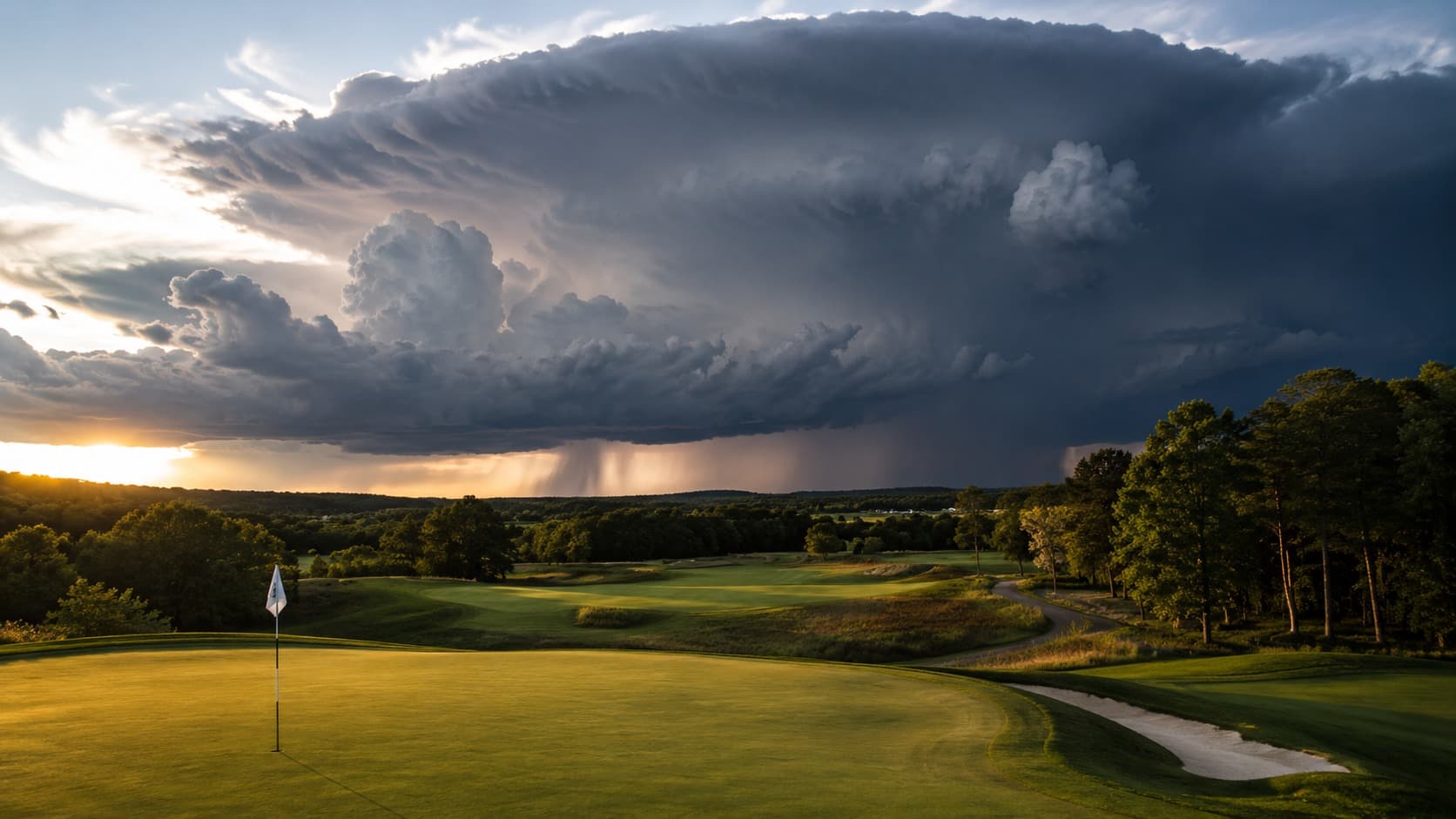
The Three O’Clock Storm: Reading Summer’s Convective Cycle to Protect Your Round
A 40% chance of afternoon thunderstorms does not mean a 40% chance of getting rained on. In the summer convective season it means the morning is nearly clear and the afternoon carries a fast-building, high-energy storm risk driven by a daily heating cycle. Here is the meteorology behind the pattern, the G-Score data on how the storm cycle punishes afternoon tee times across the Southeast, Midwest, and desert Southwest, the lightning-safety decision tree that actually matters, and the workflow that gets you off the course before the first bolt.
Read StoryDanorie
Editorial & Data
Golf Weather Score is built by Danorie. We compute the G-Score — our own playability rating — from NOAA forecasts and published course scorecards, so any US course can be compared on any day with a single number. Methodology and data sources are documented on every page.
Every Friday Morning
When Academy Course plays best next weekend.
Friday 6am ET: peak G-Score windows for Academy Course, wind direction by hour, and one gear call. Three minutes to read, save you the round.
One email a week. Unsubscribe in one click.
The Caddie's Oracle
Draw your luck before the tee off