
Master the Course.
Uncover the Elements.
Live G-Score™ playability for the round you already booked — and month-by-month trip weather for the destinations worth flying to.
Today's Best Golf Weather in America
Live G-Scores at the championship and destination courses defining American golf. Sorted by today's playability.
Top Today
Pinehurst Country Club
Sandhills, NC
The Sandhills capital — eight courses, the iconic Number Two by Donald Ross, recently restored by Coore and Crenshaw.
View Live ConditionsRank #2
Bandon Dunes Golf Resort
Southern Oregon Coast
Walking-only links on a wild Pacific bluff — the closest North America gets to a true Scottish coastal experience.
View Live ConditionsRank #3
Pasatiempo Golf Course
Santa Cruz, CA
Alister MacKenzie's personal home course — the architect's favorite of his American work, played daily by the public above Santa Cruz.
View Live ConditionsRank #4
Mauna Kea Golf Course
Big Island, HI
Robert Trent Jones Sr. on raw black lava and Pacific cliff — the famous third hole, oceanside par-3 that defined Hawaiian destination golf.
View Live ConditionsRank #5
Pebble Beach Golf Course
Monterey Peninsula, CA
The U.S. Open's coastal cathedral — Stillwater Cove, cliff-edge greens, the most photographed seventh hole in golf.
View Live ConditionsRank #6
Augusta National Golf Club
Augusta, GA
Bobby Jones and Alister MacKenzie's masterpiece — Amen Corner, white dogwoods, and a putting surface fluency unmatched in major championship golf.
View Live ConditionsPrecise G-Score™
Our proprietary algorithm calculates the playability score based on wind, temp, and humidity.
Smart Outfit Guide
Never freeze or overheat again. We recommend the perfect gear for every condition.
Verified Database
Championship and destination courses, scored daily — search any home course for Saturday's window.
Trending Courses
Meadows Golf Course
CO, USA
Running Deer Golf Club
Crystal Lake Club
FL, USA
Pukalani Country Club Golf Course
HI, USA
Bethpage Black
NY, USA
Bandon Dunes Golf Resort
OR, USA
Wade Hampton Golf Club
NC, USA
Mountaintop Golf and Lake Club
NC, USA
Texarkana Country Club
AR, USA
Tidewater Golf Club
SC, USA
Brough Creek National GC
KS, USA
Bear Trace
TN, USA
Tour Caddie Desk
Intelligence & Insights
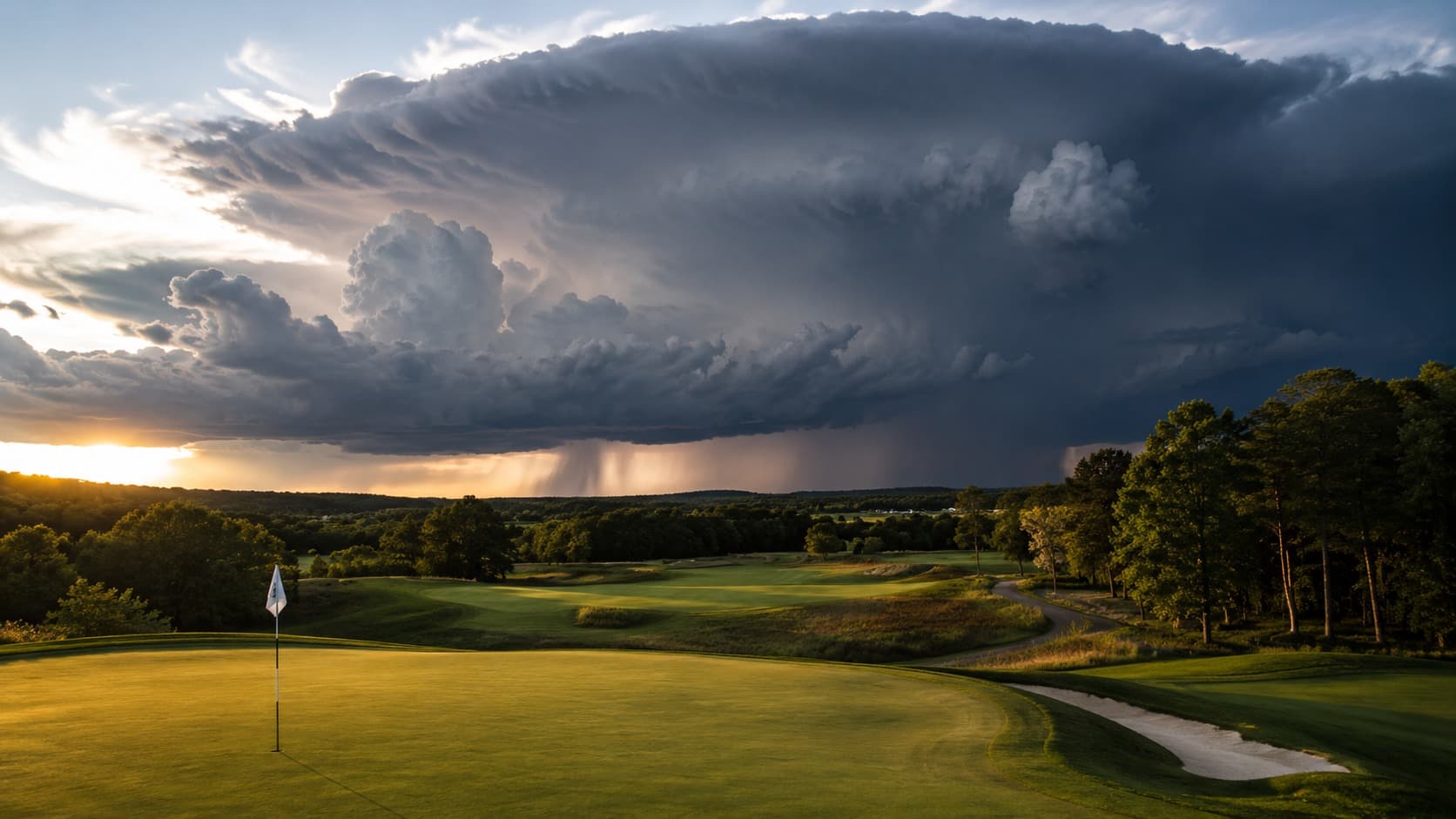
The Three O’Clock Storm: Reading Summer’s Convective Cycle to Protect Your Round
A 40% chance of afternoon thunderstorms does not mean a 40% chance of getting rained on. In the summer convective season it means the morning is nearly clear and the afternoon carries a fast-building, high-energy storm risk driven by a daily heating cycle. Here is the meteorology behind the pattern, the G-Score data on how the storm cycle punishes afternoon tee times across the Southeast, Midwest, and desert Southwest, the lightning-safety decision tree that actually matters, and the workflow that gets you off the course before the first bolt.
Read
Fall Golf Weather: How Autumn Conditions Secretly Change Your Game (And How to Use Them)
Cooler, denser autumn air quietly steals 2 to 4 yards of carry per 10°F drop while dew, low sun, and shorter days rewrite your strategy. Here is what our data shows about why fall is the best-scoring season for most amateurs — and how to play it on purpose.
Read
Reading Coastal Wind: How the Marine Layer Reshapes Pebble Beach, Bandon, and the Pacific Coast Game
Coastal golf does not play by inland rules. The marine layer suppresses wind in the morning, then releases it through midday in a thermal cycle that turns a calm 7am tee into a 22mph back nine. Here is the meteorology behind the pattern, the G-Score data that confirms it across the Pacific coast, and the morning workflow that turns the marine layer from a confusion into a competitive advantage.
ReadWhen should you take the golf trip?
Month-by-month G-Score windows and stay hubs — the pages built for booking, not a local weather check.
Peak February – March
Arizona
November – April
Plan this tripPeak January – March
Florida
November – April
Plan this tripPeak September – October
California
March – November on the coast
Plan this tripPeak March – April & October – November
Texas
October – April
Plan this tripPeak April & October
South Carolina
March – May & September – November
Plan this tripCurated Destinations
Discover the best golf conditions across top regions.
Why the Elements Matter
Golf is uniquely vulnerable to nature. Unlike stadium sports, a 10mph crosswind or a 5-degree drop in temperature can drastically alter your strategy, carry distance, and final score.
Did you know that for every 10°F drop in temperature, your golf ball flies approximately 2 yards shorter? Golf Weather Score tracks these exact physics variables using real-time data, ensuring you are analytically prepared before you even reach the first tee.
Personalized Weather Intelligence
Never Miss Perfect Golf Weather
Set your G-Score threshold for your home course. We will email you when conditions are right.
Set Up G-Score Alert