
Caddie's Gear Advisor
Curated for today's 66°F · Rain
Storm-Ready Outerwear
Waterproof layers built for 18 holes in the rain
Tour-Grade Umbrellas
68" double-canopy wind-resistant coverage
Wet-Weather Gloves
All-weather grip that performs in the rain
Waterproof Golf Shoes
Keep your feet dry through every fairway
Your Golf Trip, Handled
The Ultimate Golf Trip Planner
Everything you need to play Augusta National Golf Club — from booking your flight to checking in course-side.
Course-Side Stays
Luxury hotels, resorts, and stay-and-play packages just minutes from the first tee.
Flights
Compare fares across 700+ airlines for the best route to your tee time.
SUV Rentals for Golf Bags
Spacious vehicles with room for clubs, bags, and your foursome.
Travel Insurance
Coverage for medical, weather delays, and gear at your destination.
Augusta National Golf Club: Course Intelligence
Signature Setup
I have never teed it up at Augusta National, and I'll say that plainly — almost no public golfer ever will. What I have done is stand behind the 12th tee as a patron on a cool April morning, about 47°F at 8 a.m., watching range-warm players suddenly look unsure as the flag at Rae's Creek danced a different direction than the one on the 11th green forty yards away. That single image tells you more about this course than any aerial.
Alister MacKenzie and Bobby Jones routed Augusta National in 1933 on a former plant nursery, which is why every hole carries a botanical name. It has hosted the Masters Tournament every year since 1934, plays to a par of 72 from roughly 7,510 yards on the current championship card, and remains one of the most weather-sensitive layouts in American golf despite having no ocean and no desert — just Georgia pines, elevation, and swirling air.
Hole-by-Hole Wind & Playing Lines
Hole 12 'Golden Bell' (par-3, 155y). The most famous wind hole in the sport. Tucked into the low corner where Rae's Creek bends, the 12th sits in a pocket of trees that bends the breeze unpredictably — a flag on the 11th green can stand still while the 12th flag whips. Players who commit to a number and a stock shot survive; those who try to read the gust mid-swing find the creek short or the bunker long. Pick the club for the higher of the two wind reads and trust it.
Hole 11 'White Dogwood' (par-4, ~505y). The first leg of Amen Corner. A long downhill approach to a green guarded left by a pond; the prevailing helping wind off the players' backs tempts an aggressive line, but anything pulled left is wet. Bail right — par here is a win.
Hole 13 'Azalea' (par-5, ~545y after the recent lengthening). A sweeping dogleg left around the creek. In a calm or downwind frame it's a reachable two-shotter; into a freshening headwind the lay-up becomes the smart card. The green slopes hard back-to-front, so spin and wind direction decide whether a long second holds.
Green & Fairway Characteristics
Augusta's greens were rebuilt to bentgrass in 1980 and are the defining hazard. During Masters week they run near 13–14 on the stimpmeter — glassy, firm, and severely contoured, with multiple plateaus on most surfaces. The fairways are rye-overseeded and kept tight, so a downhill lie plus firm turf means your stated yardage rarely matches your carry-plus-release. The back nine rides bigger elevation swings than television conveys: the 10th drops dramatically, the 18th climbs back up. Putting from above the hole is the recurring mistake even tour players make here.
Seasonal Weather Pattern
Augusta sits in Georgia's humid subtropical belt, and the club's own calendar is the tell: it closes in late May and reopens in October because mid-summer heat and humidity routinely push past 90°F. The course is played in its cool half of the year. Masters week in early April typically opens with mornings in the 40s–50s°F and warms into the 70s by afternoon, with spring cold fronts that can swing wind direction 180 degrees within a day. That frontal instability — not raw wind speed — is what makes Amen Corner so treacherous in April.
Local Play Tips
Here's the read most broadcasts never explain: the swirl at the 12th is caused by the tall pine amphitheater funneling air down into the Rae's Creek hollow, so the only reliable cue is comparing the 11th and 12th flags at the same moment. If they disagree, the air is rotating and your safe play is the center of the 12th green, never the right pin. On the 10th and 13th, the ground slope does more to the ball than the wind does — plan your start line off the hill first, the breeze second.
Pre-Round Weather Workflow
Use the 7-day G-Score on this course page the way I'd prep for an April round. Three days out, watch for a passing cold front — a sharp temperature or pressure shift is your signal that Amen Corner wind will be rotating, not steady. The morning of, open the windExposure panel: any reading that shows shifting or low-confidence direction means treat holes 11–13 conservatively and aim for fat sides of greens. If the dawn temperature reads below 50°F, expect firmer, faster greens and one less club of carry into every uphill approach on the back nine.
Related Reading
Before you tee off at Augusta National Golf Club

Masters 2026 Weather Impact Analysis: How Augusta's April Conditions Shaped Every Round
We analyzed weather data from every round of the 2026 Masters Tournament at Augusta National. Wind shifts, temperature swings, and morning moisture created dramatic scoring differences that decided the green jacket.
Read Story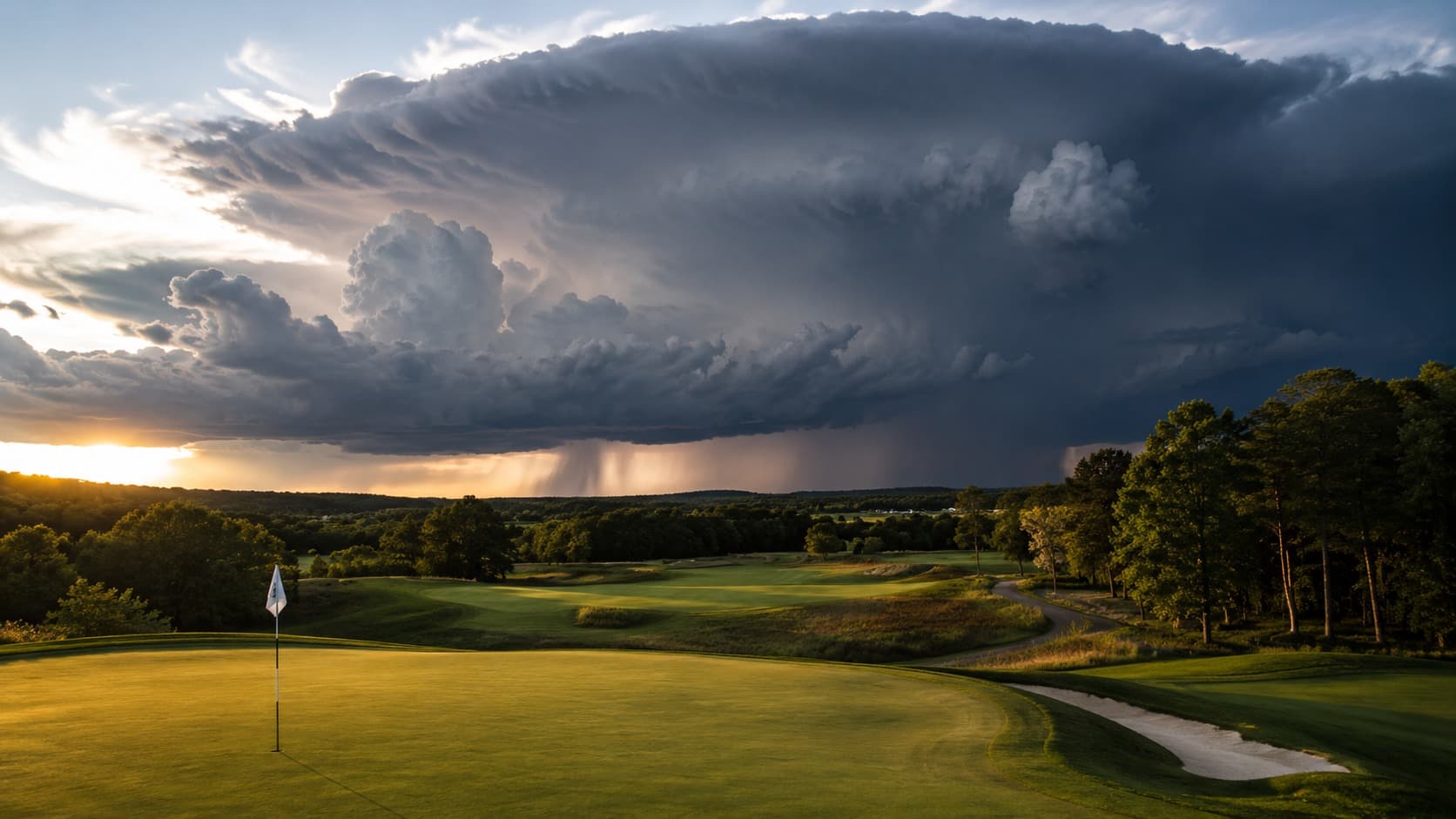
The Three O’Clock Storm: Reading Summer’s Convective Cycle to Protect Your Round
A 40% chance of afternoon thunderstorms does not mean a 40% chance of getting rained on. In the summer convective season it means the morning is nearly clear and the afternoon carries a fast-building, high-energy storm risk driven by a daily heating cycle. Here is the meteorology behind the pattern, the G-Score data on how the storm cycle punishes afternoon tee times across the Southeast, Midwest, and desert Southwest, the lightning-safety decision tree that actually matters, and the workflow that gets you off the course before the first bolt.
Read StoryDanorie
Editorial & Data
Golf Weather Score is built by Danorie. We compute the G-Score — our own playability rating — from live NOAA forecasts and published course scorecards, so any US course can be compared on any day with a single number. Methodology and data sources are documented on every page.
Every Friday Morning
When Augusta National Golf Club plays best next weekend.
Friday 6am ET: peak G-Score windows for Augusta National Golf Club, wind direction by hour, and one gear call. Three minutes to read, save you the round.
One email a week. Unsubscribe in one click.
The Caddie's Oracle
Draw your luck before the tee off