
Caddie's Gear Advisor
Curated for today's 49°F · Clear
Cold-Weather Performance Layers
Thermal mid-layers that move with your swing
Tour Hand Warmers
Rechargeable warmers trusted by caddies
Thermal Base Layers
Lightweight compression that traps heat
Winter Golf Headwear
Beanies and ear warmers built for the links
Brough Creek National GC: Course Intelligence
A backyard outside Kansas City, three and a half acres of prairie and a creek, and a green that runs more tan than emerald in August. Brough Creek National is the rare "course" where the longest hole is shorter than most players' drives. I want to be straight up front: this is not a club you call for a tee time.
TL;DR: Brough Creek National GC is a hand-built, 7-hole, ~630-yard backyard short course near Kansas City, free and members-only. Every hole is a wedge (58–116 yards), so wind — not yardage — decides your score. Firm, brown native turf means the ball releases hard. You can't book it; membership is by donation.
Signature Setup
Brough Creek National was built by hand by Ben Hotaling on land owned by his friend Zach Brough, with the routing plan drawn by architect Colton Craig. The name started as an inside joke and stuck. After Hotaling got the idea while listening to The Fried Egg podcast in late 2016, the build came together for an opening event on September 1, 2018. The "National" tag is tongue-in-cheek: it is a 7-hole loop crisscrossing roughly 3.5 acres, totaling about 630 yards, with six greens. A crowdfunding push raised over $20,000, and the club now has around 450 members who pay no green fees and instead contribute goods, services, or cash. Members get logoed poker chips, not a bag tag.
Hole-by-Hole Wind & Playing Lines
Because no hole exceeds 116 yards, this course flips normal strategy: club selection is dictated almost entirely by wind, not distance. I have not played Brough Creek — it is a private backyard you cannot just book — so these lines come from the public build record (Fried Egg Golf, GolfWRX) plus Kansas City's documented wind climate, not my own scorecard.
- Hole 2 (over the barn): The tee shot is played over a barn to a green protected by a "Road bunker." Into a south wind, a stock 90-yard wedge balloons and drops short into the bunker face — take one more club and flight it down.
- Hole 4 (Biarritz sliver): A long, narrow Biarritz-inspired green with a swale. Crosswind from the SSW pushes a high wedge off the right edge; land it on the front tier and let the firm surface feed it back.
- The creek hole: Brough Creek guards the left side of the original hole. On the prevailing summer breeze, favor the right bail-out — short-siding yourself left here brings the water in play on a 70-yard shot.
Green & Fairway Characteristics
The turf is the whole point. Hotaling maintains it at "no more maintenance than it would take to manage the backyard," so expect native prairie and fescue framing, plus bunkers as the main hazards. Conditions skew firm and brown — the published description notes "more shades of brown and tan than emerald and lime green." Practically, that means heavy release: wedges that would spin and check on a watered municipal green will bounce and run out here. The property has a central ridge with real undulation, so reading the slope off the high ground matters more than green speed. With holes from 58 to 116 yards and six greens shared across the loop, your wedge distance control and trajectory do all the work.
Seasonal Weather Pattern
Kansas City sits in a humid continental zone (Köppen Dfa). Summers are hot and humid with persistent southerly to south-southwest winds, often 10–20 mph by afternoon — brutal on a course made entirely of wedge shots. Spring and fall bring cooler, gustier, more variable directions; the native grasses go dormant and firm up, increasing release. Winters are genuinely cold and the course is effectively seasonal. The single most useful weather fact here: on a wedge-only layout, a 15 mph crosswind moves a 90-yard shot more, proportionally, than it would move a 7-iron on a full-length course. Wind is your handicap.
Local Play Tips
The tip that search results get wrong: you cannot pay to play Brough Creek National. There are no green fees — ever — and no public tee sheet. Access is through membership, which is granted in exchange for a voluntary contribution rather than a fixed fee, and members number around 450. If you are planning a Kansas City golf trip expecting a bookable daily-fee course, this is not one; treat it as a piece of golf culture to follow, not a stop to reserve.
Pre-Round Weather Workflow
If you are ever lucky enough to get a member invite, run the 7-day G-Score the morning of and read the windExposure value first, not the temperature. On this layout, a high wind reading matters more than rain: pick the calmest window of the day, because every approach is a finesse wedge. Check sustained wind direction — a south/SSW day favors the right bail-outs noted above — and expect firm, fast greens after any dry stretch. Bring a windbreaker for the afternoon gusts and trust the bounce, not the spin.
Sources: The Fried Egg Golf (course history), GolfWRX, Golfdom, Central Links Golf.
Related Reading
Before you tee off at Brough Creek National GC

America's 20 Windiest Golf Courses: A G-Score Wind Analysis
We ranked America's 20 windiest golf courses using G-Score wind penalty data. See how coastal gusts and prairie gales reshape playability scores.
Read Story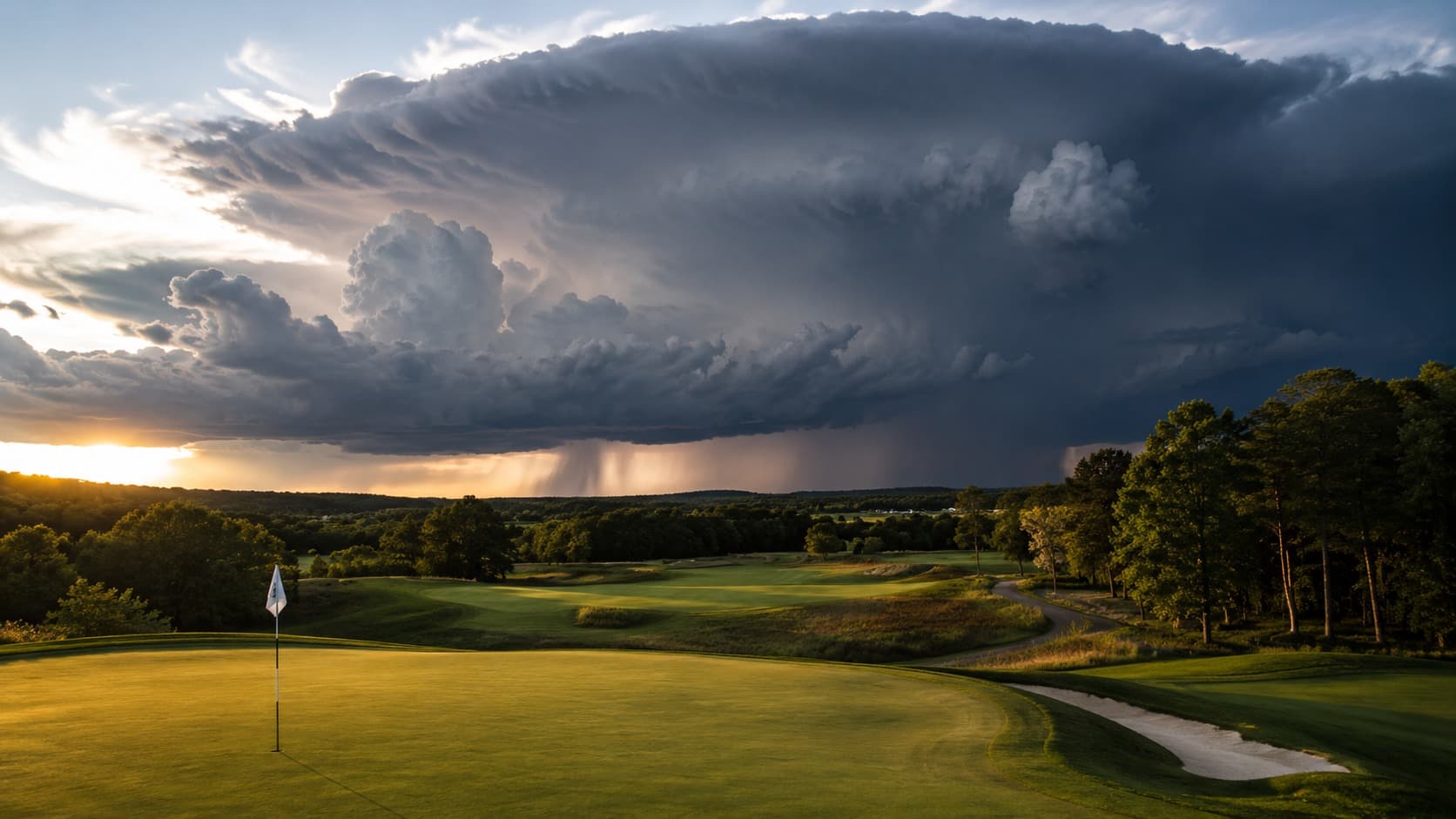
The Three O’Clock Storm: Reading Summer’s Convective Cycle to Protect Your Round
A 40% chance of afternoon thunderstorms does not mean a 40% chance of getting rained on. In the summer convective season it means the morning is nearly clear and the afternoon carries a fast-building, high-energy storm risk driven by a daily heating cycle. Here is the meteorology behind the pattern, the G-Score data on how the storm cycle punishes afternoon tee times across the Southeast, Midwest, and desert Southwest, the lightning-safety decision tree that actually matters, and the workflow that gets you off the course before the first bolt.
Read StoryDanorie
Editorial & Data
Golf Weather Score is built by Danorie. We compute the G-Score — our own playability rating — from live NOAA forecasts and published course scorecards, so any US course can be compared on any day with a single number. Methodology and data sources are documented on every page.
Every Friday Morning
When Brough Creek National GC plays best next weekend.
Friday 6am ET: peak G-Score windows for Brough Creek National GC, wind direction by hour, and one gear call. Three minutes to read, save you the round.
One email a week. Unsubscribe in one click.
The Caddie's Oracle
Draw your luck before the tee off