
Caddie's Gear Advisor
Curated for today's 58°F · Clouds
Tour-Level Drivers
Engineered for maximum distance and forgiveness
Laser Rangefinders
Pin-seeking technology for precision approaches
Premium Golf Balls
Tour-caliber spin and distance performance
Performance Sunglasses
Polarized lenses optimized for reading greens
Your Golf Trip, Handled
The Ultimate Golf Trip Planner
Everything you need to play Almaden Golf and Country Club — from booking your flight to checking in course-side.
Course-Side Stays
Luxury hotels, resorts, and stay-and-play packages just minutes from the first tee.
Flights
Compare fares across 700+ airlines for the best route to your tee time.
SUV Rentals for Golf Bags
Spacious vehicles with room for clubs, bags, and your foursome.
Travel Insurance
Coverage for medical, weather delays, and gear at your destination.
Almaden Golf and Country Club: Course Intelligence
Signature Setup
I walked the first tee at Almaden on a July morning, 58°F with the marine air still draining out of the valley and the oaks throwing long shadows across the fairway. By the time I reached the turn it was past 80°F and climbing. That swing — cool, dead-calm dawn into hot, breezy afternoon — is the whole personality of this place. Almaden Golf and Country Club is a private parkland club founded in 1955, tucked into the Almaden Valley at the southern end of San Jose, against the Santa Teresa and Santa Cruz foothills rather than out on the flat valley floor. It is a par-72 routing of roughly 6,600 yards from the back, threaded through mature oaks with water in play on several holes and gentle elevation rolling toward the hills. It is not a championship monster; it is a member's course where club selection is decided by the weather far more than by raw length.
Hole-by-Hole Wind & Playing Lines
The prevailing pattern is a thermal breeze that builds out of the northwest as the inland valley heats up — calm at dawn, then 10–15 mph by mid-afternoon, funneling down toward the foothills.
- The #1-handicap par-4 (mid-440s): Plays uphill and into the freshening afternoon breeze. A morning 8-iron approach becomes a 6-iron after lunch. Start the ball at the left-center of the green and let it feed; the back-right pin is a sucker, with trouble long and right.
- The signature par-3 over water: The thermal quarters across this shot left-to-right with the Santa Teresa Hills as the backdrop. In the morning calm it's a clean number; by 3 p.m. take one less club and aim at the left edge, trusting the crosswind to push it back over the water to the flag.
- The closing par-4 (18th): A longer hole that runs back toward the clubhouse into the late-day wind. The breeze plus the uphill finish can add a full club to the approach — bail short and putt up rather than chasing the carry.
Green & Fairway Characteristics
The greens are a poa/bent surface that runs medium-fast and holds a true line in the cool morning before the heat firms them up; reads break subtly toward the lower valley, so trust the slope away from the hills. Fairways carry a kikuyu-and-rye mix that grows thick and grabby in the summer heat — sit your ball up and take enough loft, because a buried lie in baked kikuyu kills your spin. Bunkers sit tight to several greens, so the miss matters more than the carry. Slope sits in the high-120s from the back tees: demanding off the tee through the oaks, but fair once you're on the short grass.
Seasonal Weather Pattern
This is classic inland South Bay, not coastal fog. Summer (June–September) is hot and dry — afternoons routinely hit the upper-80s to low-90s°F, with mornings near 55–60°F and a reliable afternoon thermal wind. That diurnal swing of 30°F-plus in a single round is the defining feature. Spring and fall are the prize: April–May and October give you mild high-60s-to-70s°F days, firm turf, and lighter wind. Winter (December–February) brings the region's rain and softens everything; the kikuyu goes dormant and the course plays long and slow. I've walked it in summer; I haven't played a January round here, so for winter conditions I'd lean on the historical record rather than claim firsthand green speeds.
Local Play Tips
Two things the scorecard won't tell you. First, the round here is a race against the thermostat — the still, soft morning is a completely different course than the hot, windy afternoon, and your scoring window closes around late morning when the breeze and the heat arrive together. Second, the summer kikuyu changes your short game: chips off tight valley turf check up far less than you expect, so I started playing them lower and running, not flopping. A towel and extra water matter more here than a windbreaker — the back nine in July is about heat management.
Pre-Round Weather Workflow
Use the 7-day G-Score on this course page to pick the day, then pick the hour. At Almaden the best scoring conditions are almost always the first two hours after sunrise: dead-calm air, soft receptive greens, and temperatures still in the 50s°F. Check the windExposure indicator the night before — if it flags a strong afternoon NW thermal, push your tee time earlier rather than fighting the #1-handicap par-4, the signature par-3, and the 18th into a 12–15 mph valley breeze. On a still spring or fall morning, this course gives back the strokes it guards under summer heat and afternoon wind. Read the forecast and take them.
Related Reading
Before you tee off at Almaden Golf and Country Club
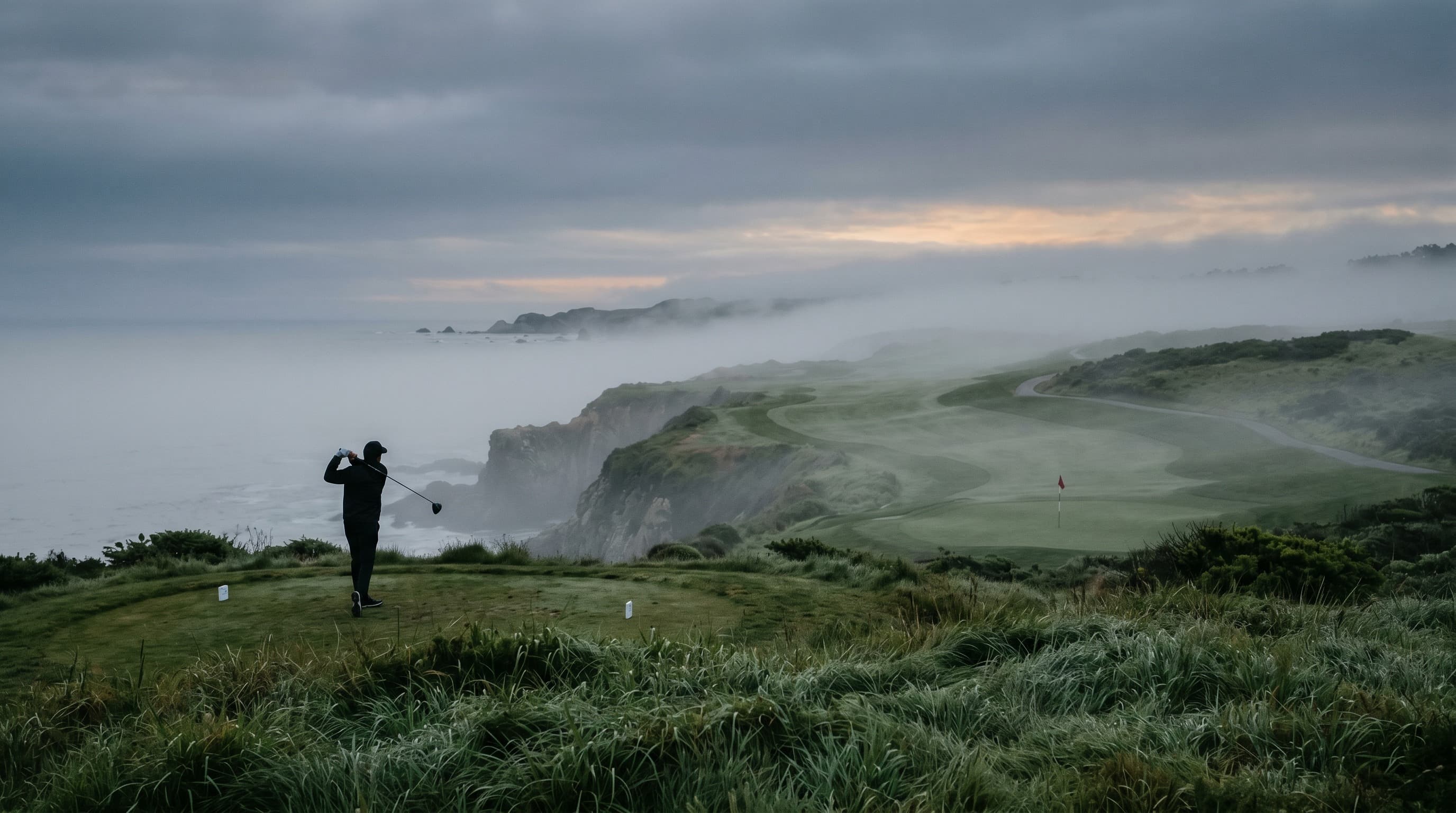
Reading Coastal Wind: How the Marine Layer Reshapes Pebble Beach, Bandon, and the Pacific Coast Game
Coastal golf does not play by inland rules. The marine layer suppresses wind in the morning, then releases it through midday in a thermal cycle that turns a calm 7am tee into a 22mph back nine. Here is the meteorology behind the pattern, the G-Score data that confirms it across the Pacific coast, and the morning workflow that turns the marine layer from a confusion into a competitive advantage.
Read Story
How to Read a G-Score: The 0–100 Golf Playability Number, Decoded
A G-Score on this site is a single 0–100 number that tells you whether today is worth tee-up. Here is exactly what each band means, what drives the calculation, and how to use it to plan a round you will actually score on.
Read StoryMinSu Kim
Founder & Golf Data Analyst
MinSu is a data analyst and golfer with 10+ years on the course. He built Golf Weather Score to answer one question: is today a good day to play? He combines weather data, course intelligence, and the proprietary G-Score algorithm to help golfers make smarter decisions.
Every Friday Morning
When Almaden Golf and Country Club plays best next weekend.
Friday 6am ET: peak G-Score windows for Almaden Golf and Country Club, wind direction by hour, and one gear call. Three minutes to read, save you the round.
One email a week. Unsubscribe in one click.
The Caddie's Oracle
Draw your luck before the tee off