
Caddie's Gear Advisor
Curated for today's 92°F · Clear
Ultralight Distance Drivers
Maximum carry in hot, low-drag conditions
UV Protection Apparel
UPF 50+ cooling fabrics for peak-sun rounds
Precision Rangefinders
Slope-adjusted yardage in any condition
Hydration & Cooling
Insulated bottles and cooling towels
Your Golf Trip, Handled
The Ultimate Golf Trip Planner
Everything you need to play Alta Vista Country Club — from booking your flight to checking in course-side.
Course-Side Stays
Luxury hotels, resorts, and stay-and-play packages just minutes from the first tee.
Flights
Compare fares across 700+ airlines for the best route to your tee time.
SUV Rentals for Golf Bags
Spacious vehicles with room for clubs, bags, and your foursome.
Travel Insurance
Coverage for medical, weather delays, and gear at your destination.
Alta Vista Country Club: Course Intelligence
Signature Setup
TL;DR: A 1961 Harry Rainville design in inland Orange County — par 72 at 6,559 yards, modest length but a real precision test with water in play and ~90 bunkers, made tougher by the afternoon sea breeze that reaches this far inland.
Alta Vista Country Club opened in 1961 on rolling ground in Placentia, in the northern interior of Orange County. Harry Rainville laid out the original eighteen, and his son David Rainville — later an ASGCA architect in his own right — reworked the course in 1973. It is a private, member-owned club rather than a resort, and it has never been a major-championship venue; its identity is a steady, well-kept members' course that rewards position over power. The card reads 6,559 yards from the tips at par 72, with a 71.5 rating and a 130 slope — numbers that tell you the trouble is in the angles and the roughly 90 bunkers, not the raw distance. The par-3s average 173 yards, longer than most members' courses, which is where the scorecard quietly bites.
Hole-by-Hole Wind & Playing Lines
I want to be straight here: I haven't walked Alta Vista's card hole-by-hole, so I won't hand you fake stroke-index numbers — the club's own scorecard is the authority on which hole carries the #1 handicap. What I can tell you is how the wind sets up. Placentia's prevailing afternoon flow is a WSW onshore breeze that pushes inland off the coast by early afternoon, and the course's rolling terrain means several approaches climb gently into it.
The longer two-shotters on the homeward nine are where this matters. Into the WSW breeze after noon, a flat 410-yard par-4 plays closer to 435; take the extra club and aim away from the water rather than flirting with the hazard line to save a yard.
On the par-3s — averaging 173 yards, with the longest pushing past 195 — wind direction decides club more than the yardage marker does. Downwind in the morning calm they hold; into the afternoon breeze the same shot needs two more clubs and a lower flight, and the bail-out is short, never long.
Green & Fairway Characteristics
I'm describing the inland-Orange-County norm here rather than claiming I've stimped these greens myself: mature OC courses of this era run kikuyu-and-rye fairways and Poa-annua greens, and Alta Vista's rolling, tree-lined corridors fit that profile. Kikuyu sits the ball up on clean lies but kills spin out of the rough — the same grass plays two ways depending on the lie, so missing the short grass costs you more than the yardage suggests. With a 130 slope and around 90 bunkers spread over rolling ground, the defense is sand and contour, not length. Poa greens smooth out in the cool morning and grow bumpier through the afternoon as the grass stands up, so early tee times putt truer.
Seasonal Weather Pattern
Placentia is inland Orange County, and that changes the pattern from the coastal clubs. Late spring into midsummer brings the marine layer — "May Gray" and "June Gloom" — but this far inland it sits thinner and burns off about an hour earlier than at Newport or Huntington, often clearing by mid-morning with dawn temperatures around 60–64°F. Summer afternoons run hotter than the coast: inland Placentia regularly reaches the upper 80s to low 90s in July and August while the beach stays in the 70s. Fall is Santa Ana season — dry NE downslope winds drop humidity into the teens, firm the greens, and add carry to every club. Winter Pacific fronts soften the kikuyu and slow the whole course down.
Local Play Tips
Here's the local edge I can give you honestly: I live about 20 minutes south in Irvine, and the single biggest variable inland is the burn-off line, not rain. The same June marine layer that keeps my home course gray until 9 a.m. clears over Placentia noticeably earlier — so a mid-morning slot at Alta Vista is already firm and dry when the coastal courses are still damp and soft. The flip side is heat: by a July afternoon this inland pocket is 10–15°F hotter than the beach, and the greens firm up fast. If you have a choice, take the morning. I haven't played inside the gates, so I lean on regional NOAA Orange County data for the summer pattern rather than my own card.
Pre-Round Weather Workflow
Pull the 7-day G-Score the night before and target a tee time after the inland marine layer lifts but before the afternoon heat and the WSW sea breeze build — roughly the mid-morning window. Check windExposure for two flags: the WSW onshore onset (add a club into the longer par-4s and par-3s once it's up) and any NE Santa Ana flow (greens firm, ball flies, take one less club into receptive targets). On this inland course, a firm mid-morning round scores meaningfully higher than the same loop into a hot, breezy mid-afternoon.
Related Reading
Before you tee off at Alta Vista Country Club
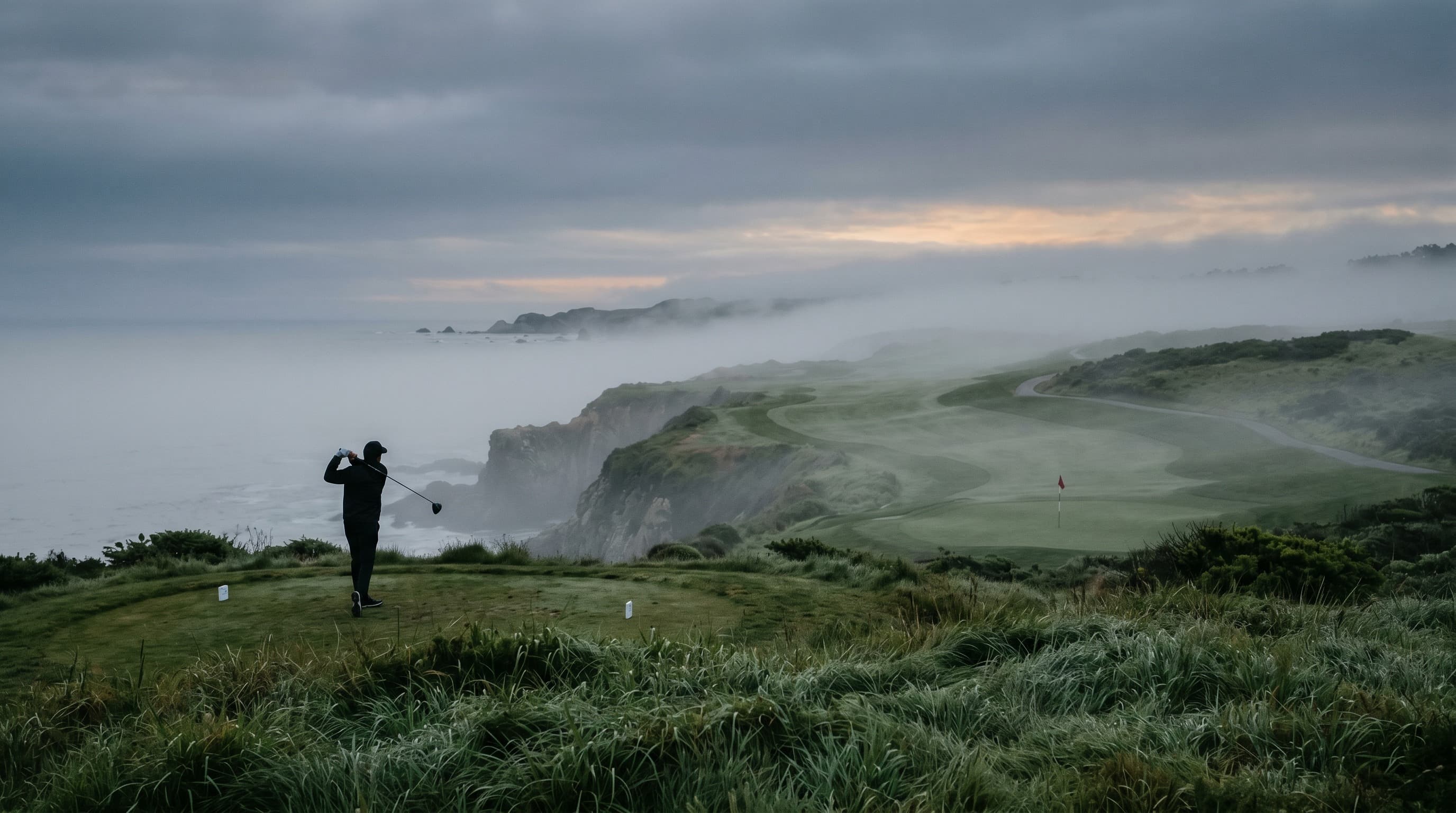
Reading Coastal Wind: How the Marine Layer Reshapes Pebble Beach, Bandon, and the Pacific Coast Game
Coastal golf does not play by inland rules. The marine layer suppresses wind in the morning, then releases it through midday in a thermal cycle that turns a calm 7am tee into a 22mph back nine. Here is the meteorology behind the pattern, the G-Score data that confirms it across the Pacific coast, and the morning workflow that turns the marine layer from a confusion into a competitive advantage.
Read Story
How to Read a G-Score: The 0–100 Golf Playability Number, Decoded
A G-Score on this site is a single 0–100 number that tells you whether today is worth tee-up. Here is exactly what each band means, what drives the calculation, and how to use it to plan a round you will actually score on.
Read StoryMinSu Kim
Founder & Golf Data Analyst
MinSu is a data analyst and golfer with 10+ years on the course. He built Golf Weather Score to answer one question: is today a good day to play? He combines weather data, course intelligence, and the proprietary G-Score algorithm to help golfers make smarter decisions.
Every Friday Morning
When Alta Vista Country Club plays best next weekend.
Friday 6am ET: peak G-Score windows for Alta Vista Country Club, wind direction by hour, and one gear call. Three minutes to read, save you the round.
One email a week. Unsubscribe in one click.
The Caddie's Oracle
Draw your luck before the tee off