
Caddie's Gear Advisor
Curated for today's 76°F · Clear
Tour-Level Drivers
Engineered for maximum distance and forgiveness
Laser Rangefinders
Pin-seeking technology for precision approaches
Premium Golf Balls
Tour-caliber spin and distance performance
Performance Sunglasses
Polarized lenses optimized for reading greens
Your Golf Trip, Handled
The Ultimate Golf Trip Planner
Everything you need to play Aptos Seascape Golf Course — from booking your flight to checking in course-side.
Course-Side Stays
Luxury hotels, resorts, and stay-and-play packages just minutes from the first tee.
Flights
Compare fares across 700+ airlines for the best route to your tee time.
SUV Rentals for Golf Bags
Spacious vehicles with room for clubs, bags, and your foursome.
Travel Insurance
Coverage for medical, weather delays, and gear at your destination.
Aptos Seascape Golf Course: Course Intelligence
Signature Setup
The 14th at Seascape is a par-3 that reads as 189 yards on the card and plays like 200 uphill, and standing on that tee on a gray Aptos morning — marine layer still sitting low, maybe 56°F — I took two more clubs than the number told me to and still came up short. That hole sets the tone for the whole place.
Seascape Golf Club sits in Aptos, California, about half a mile inland from Monterey Bay on the Santa Cruz coast. The layout opened in 1926 as Rio Del Mar Country Club and was reworked into the course played today by architect David Gill, reopening in 1957 as Aptos Beach Country Club before taking the Seascape name. (Sources disagree on the original 1926 designer, so I'm not putting a single name on it — the 1957 Gill redesign is the documented version under your feet now.) It plays to par 71 at roughly 6,034 yards from the tips, with a course rating of 69.4 and a slope of 125. This is not a long course; it's a precise one.
Hole-by-Hole Wind & Playing Lines
The defining weather here is the onshore flow off Monterey Bay — calm, fogged-in mornings giving way to a NW/W sea breeze in the afternoon.
Hole 3 (#1 handicap, par-4 431y). The longest two-shotter and the hardest hole. Into the afternoon NW breeze it stretches toward 455. Take more club off the tee than your ego wants, hold the right side, and treat the approach as a full shot — there's no stock-number version of this green when the wind is up.
Hole 14 (signature par-3, 189y). Uphill to a flat green, so the elevation alone eats a club and a half. On a still, foggy morning you can attack the front; once the W breeze quarters across, club up again and aim center — long and short here are both penal.
Hole 16 (#2 handicap, par-3 190y). The second par-3 in the index's teeth. Exposed enough that crosswind off the bay pushes the ball; play to the fat side of the green rather than the pin.
Green & Fairway Characteristics
Seascape's greens are the test: small, fast bentgrass surfaces with real undulation, the kind that turn a pin-high miss into a slick downhill three-putt. The fairways are tree-lined — tall eucalyptus and canyon corridors — and routed through troughs, so wayward balls often kick down off the ridges back toward the short grass, which flatters the tee shot more than it should. The par-3 set is unusually varied: 6 plays 209 yards, 8 only 128, 12 a short 125, and 14 a brutal 189 uphill. Front to back the yardage stays modest, so scoring lives entirely on the greens and on keeping the ball below the hole.
Seasonal Weather Pattern
Aptos has a cool, marine-dominated climate distinct from inland Bay Area courses. Summer (June–August) mornings are routinely fogged in by the Monterey Bay marine layer, 52–58°F at 8 a.m., often not clearing until midday — soft turf, no roll, and a quiet course until the NW breeze fills in around early afternoon. Fall (September–October) is the prime window: the fog thins, days run 60–72°F, and the greens firm up. Winter (December–February) is the wet season — Pacific fronts bring rain and the greens hold everything; expect 48–60°F. Spring is transitional and breezy. The recurring daily signature per NOAA's Monterey Bay records is a calm, often foggy morning yielding to a W/NW onshore breeze of roughly 8–14 mph by afternoon.
Local Play Tips
Honest limitation: I've played Seascape in the cool months but never in the deep summer fog, so I can't tell you firsthand how much the marine layer deadens the afternoon greens in July — I'd play it conservatively the first time. What I can tell you is that the locals' edge here is the tee time, not the swing. The course is short enough that the morning calm hands you real birdie chances on the soft greens before the onshore wind makes the long par-3s and the 431-yard 3rd play their full length. Take a morning slot, accept that the 14th will probably still beat you, and keep every approach below the hole on those small bentgrass surfaces.
Pre-Round Weather Workflow
Use the 7-day G-Score on this page the way I would for any Monterey Bay course. Three days out, check whether your tee window lands before or after the afternoon NW onshore breeze builds — on a 6,034-yard layout that breeze is the difference between the 3rd and 14th playing their card number or a club and a half longer. The morning of, read the windExposure panel: a W or NW reading means the long par-3s (6, 14, 16) and the #1-handicap 3rd all firm up and stretch, so club up and aim for the fat side of these small greens. If the temperature reads below 56°F with overnight fog or rain, expect little release on the bentgrass — land short, let the slope feed it, and never leave yourself above the hole.
Related Reading
Before you tee off at Aptos Seascape Golf Course
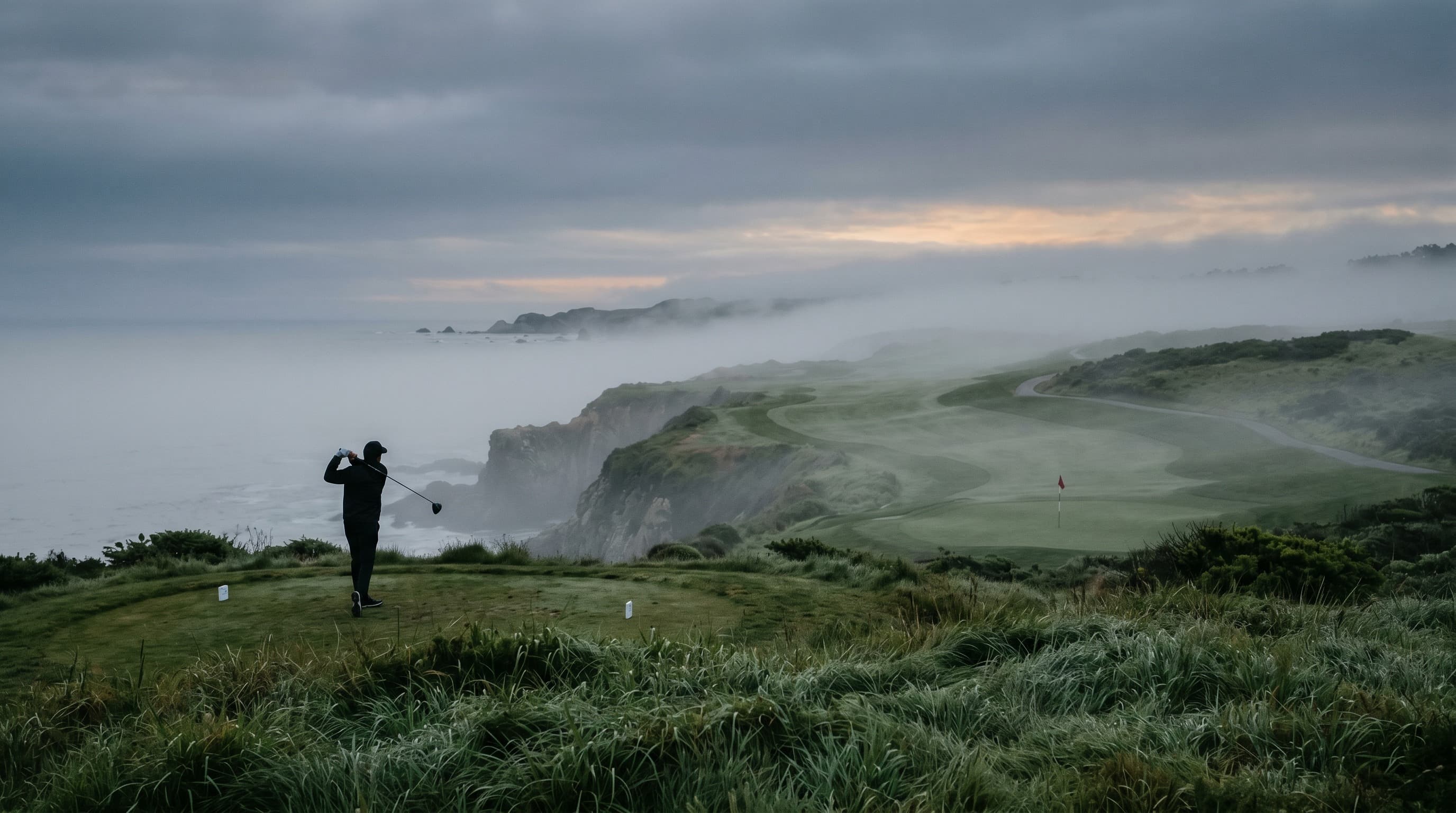
Reading Coastal Wind: How the Marine Layer Reshapes Pebble Beach, Bandon, and the Pacific Coast Game
Coastal golf does not play by inland rules. The marine layer suppresses wind in the morning, then releases it through midday in a thermal cycle that turns a calm 7am tee into a 22mph back nine. Here is the meteorology behind the pattern, the G-Score data that confirms it across the Pacific coast, and the morning workflow that turns the marine layer from a confusion into a competitive advantage.
Read Story
How to Read a G-Score: The 0–100 Golf Playability Number, Decoded
A G-Score on this site is a single 0–100 number that tells you whether today is worth tee-up. Here is exactly what each band means, what drives the calculation, and how to use it to plan a round you will actually score on.
Read StoryMinSu Kim
Founder & Golf Data Analyst
MinSu is a data analyst and golfer with 10+ years on the course. He built Golf Weather Score to answer one question: is today a good day to play? He combines weather data, course intelligence, and the proprietary G-Score algorithm to help golfers make smarter decisions.
Every Friday Morning
When Aptos Seascape Golf Course plays best next weekend.
Friday 6am ET: peak G-Score windows for Aptos Seascape Golf Course, wind direction by hour, and one gear call. Three minutes to read, save you the round.
One email a week. Unsubscribe in one click.
The Caddie's Oracle
Draw your luck before the tee off