
Caddie's Gear Advisor
Curated for today's 96°F · Clear
Ultralight Distance Drivers
Maximum carry in hot, low-drag conditions
UV Protection Apparel
UPF 50+ cooling fabrics for peak-sun rounds
Precision Rangefinders
Slope-adjusted yardage in any condition
Hydration & Cooling
Insulated bottles and cooling towels
Your Golf Trip, Handled
The Ultimate Golf Trip Planner
Everything you need to play Arroyo Seco Golf Course — from booking your flight to checking in course-side.
Course-Side Stays
Luxury hotels, resorts, and stay-and-play packages just minutes from the first tee.
Flights
Compare fares across 700+ airlines for the best route to your tee time.
SUV Rentals for Golf Bags
Spacious vehicles with room for clubs, bags, and your foursome.
Travel Insurance
Coverage for medical, weather delays, and gear at your destination.
Arroyo Seco Golf Course: Course Intelligence
TL;DR — Arroyo Seco is a par-3 / executive short course tucked into the Arroyo Seco wash in South Pasadena, with a two-tier lighted range attached. It's a short-game and beginner course, not a championship test — but the LA-basin weather here genuinely moves the ball. Marine-layer mornings play damp and slow; Santa Ana afternoons play firm, gusty, and two clubs longer. Treat it as a wedge-and-mid-iron carry course and pick your window by the air, not the calendar.
Signature Setup
Arroyo Seco Golf Course sits along the Arroyo Seco — the seasonal wash that runs down out of the San Gabriels past the 110 Arroyo Seco Parkway — in South Pasadena, California. It's an honest description to call this a par-3 / executive short course with an attached two-tier, lighted driving range, not a full regulation 18. I'm not going to attach a famous architect's name to it, because the design provenance isn't formally documented the way a resort course's would be; it reads as a mid-century city short course built to serve a dense urban basin, and that's exactly its value — quick rounds, walkable, a place to drill irons. The setting matters more than any signature hole here: you're playing in a river corridor about 500–600 feet of elevation, hemmed by trees and the wash, which channels wind in ways an open course wouldn't.
Hole-by-Hole Wind & Playing Lines
I haven't memorized this card hole-by-hole, so I'll describe by length and exposure rather than invent hole numbers — that's the honest way to do it. On a par-3 course the difficulty is all in the carry.
- The longest par-3 (~190 yards): This is the hole that decides your card. Into a NE/ENE Santa Ana — the dry offshore wind that shows up October through December — it plays a full two clubs longer. A stock 165-yard 6-iron becomes a 4-iron. I aim dead center and forget the pin.
- The mid-length carry hole (~150 yards): Under the morning marine layer the air is heavy and the ball drops short. I've watched a flushed 150-yard 8-iron land 8–10 yards light at 7 a.m. and the same swing carry the flag at noon once the layer lifted.
- The shortest hole (~100 yards): The only hole the wind helps you ignore. Down off the layer it's a soft wedge; in a Santa Ana gust, knock it down and play it like 115.
Green & Fairway Characteristics
The turf is the LA-basin standard — kikuyu mixed with ryegrass on the fairways and tees, which grabs the clubhead through the grain more than Bermuda does. Greens are small, suited to a short course, and run medium — call it 9 to 9.5 on the Stimp — and they change pace with the air more than most: soft and slow when the marine layer keeps the morning damp, noticeably firmer and quicker by mid-afternoon once the sun has been on them. Because the holes are short, you're hitting into receptive greens most of the day, so spin control off mid-irons and wedges is the whole game here.
Seasonal Weather Pattern
This is Mediterranean LA-basin weather, and it's the reason to read a weather site before you play. May and June bring the marine layer — "June Gloom" — overcast mornings around 60°F that burn off by roughly 11 a.m. Summer highs sit mid-80s to low 90s, dry and clear by afternoon. The real wildcard is fall: Santa Ana winds from October into December, dry offshore NE/ENE gusts of 25–40 mph with humidity dropping under 15%, which firm the greens and add length to every carry. Winter is the wet and cool season — highs in the upper 60s, mornings near 45°F, and the bulk of the year's rain falling December through March, when the arroyo itself can run.
Local Play Tips
The single most useful thing here that the scorecard won't tell you: the marine layer and the Santa Ana are opposite golf courses on the same holes. Damp morning air costs you a full club of carry; dry offshore wind gives length back but takes away control and firms the greens. If you're practicing, the lighted range lets you keep hitting after dark — the calmest, most stable air of the day is often that post-sunset window once the daytime wind has laid down. Don't over-read the small greens in the morning; they're slower than they look when the dew is still on them.
Pre-Round Weather Workflow
Pull the 7-day G-Score and the windExposure rating before you book. On this course the morning-versus-afternoon swing is driven by two things: whether the marine layer is in (slow, damp, short carries) and whether a Santa Ana is forecast (firm, fast, gusty, NE). If windExposure flags a high-exposure NE day, club up across the board and play to centers — the longest par-3 will add two clubs. If the layer is sitting low and the G-Score is depressed in the early slots, either wait for the ~11 a.m. burn-off or simply accept the longer carry numbers and trust them. If rain is on the 7-day, expect the greens to hold even better and the kikuyu to play sticky and slow off the tee.
Related Reading
Before you tee off at Arroyo Seco Golf Course
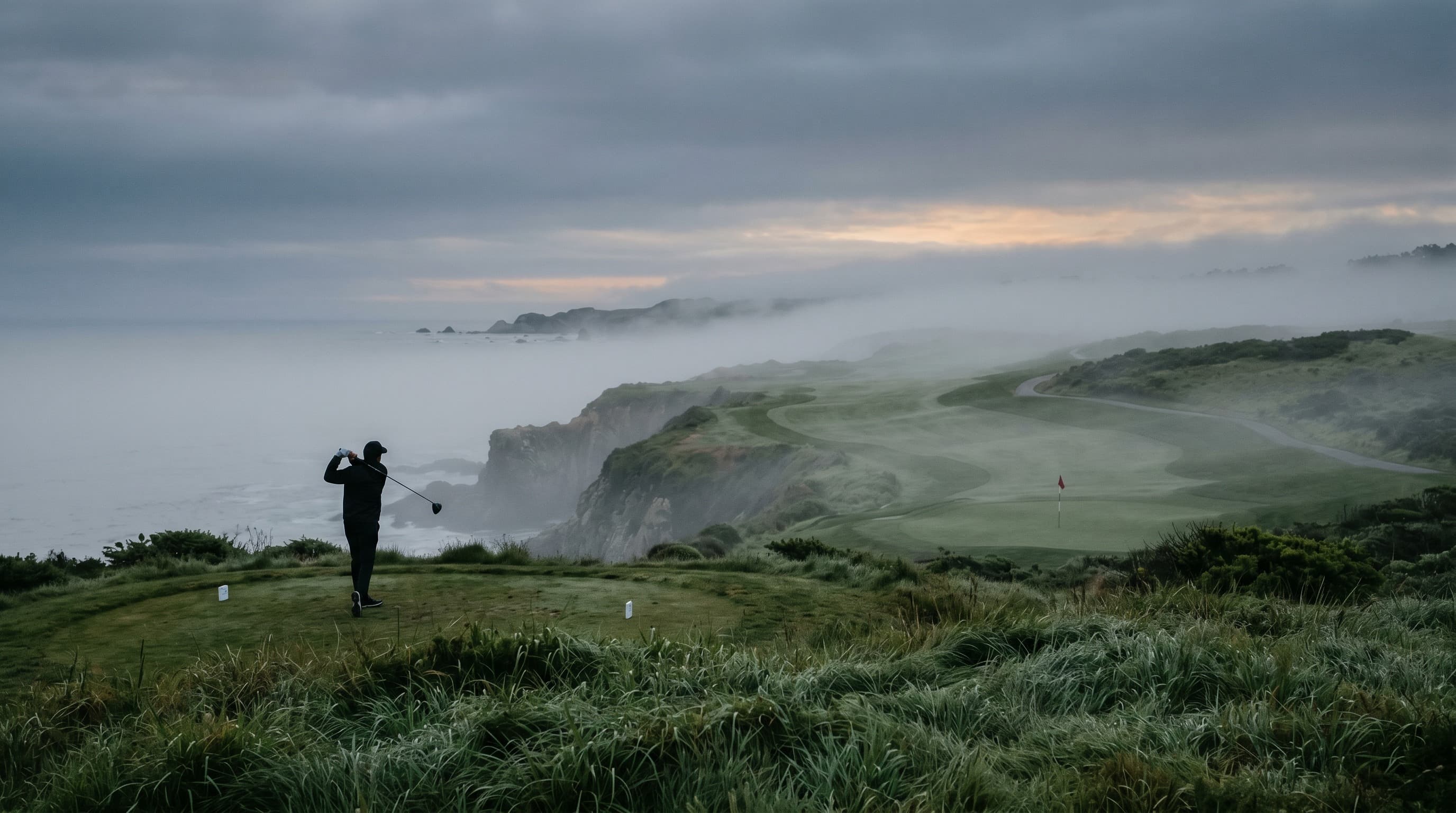
Reading Coastal Wind: How the Marine Layer Reshapes Pebble Beach, Bandon, and the Pacific Coast Game
Coastal golf does not play by inland rules. The marine layer suppresses wind in the morning, then releases it through midday in a thermal cycle that turns a calm 7am tee into a 22mph back nine. Here is the meteorology behind the pattern, the G-Score data that confirms it across the Pacific coast, and the morning workflow that turns the marine layer from a confusion into a competitive advantage.
Read Story
How to Read a G-Score: The 0–100 Golf Playability Number, Decoded
A G-Score on this site is a single 0–100 number that tells you whether today is worth tee-up. Here is exactly what each band means, what drives the calculation, and how to use it to plan a round you will actually score on.
Read StoryMinSu Kim
Founder & Golf Data Analyst
MinSu is a data analyst and golfer with 10+ years on the course. He built Golf Weather Score to answer one question: is today a good day to play? He combines weather data, course intelligence, and the proprietary G-Score algorithm to help golfers make smarter decisions.
Every Friday Morning
When Arroyo Seco Golf Course plays best next weekend.
Friday 6am ET: peak G-Score windows for Arroyo Seco Golf Course, wind direction by hour, and one gear call. Three minutes to read, save you the round.
One email a week. Unsubscribe in one click.
The Caddie's Oracle
Draw your luck before the tee off