
Caddie's Gear Advisor
Curated for today's 65°F · Mist
Tour-Level Drivers
Engineered for maximum distance and forgiveness
Laser Rangefinders
Pin-seeking technology for precision approaches
Premium Golf Balls
Tour-caliber spin and distance performance
Performance Sunglasses
Polarized lenses optimized for reading greens
Your Golf Trip, Handled
The Ultimate Golf Trip Planner
Everything you need to play Atlanta Athletic Club — from booking your flight to checking in course-side.
Course-Side Stays
Luxury hotels, resorts, and stay-and-play packages just minutes from the first tee.
Flights
Compare fares across 700+ airlines for the best route to your tee time.
SUV Rentals for Golf Bags
Spacious vehicles with room for clubs, bags, and your foursome.
Travel Insurance
Coverage for medical, weather delays, and gear at your destination.
Atlanta Athletic Club: Course Intelligence
Signature Setup
I played the Highlands as a guest on an early-September morning, 64°F at 7:40 a.m. with dew still on the Bermuda and the Georgia humidity holding off for another hour. Standing on the 18th tee — the long par-4 that bends right around the lake — I understood why Jerry Pate's 1976 U.S. Open 5-iron to this green is still talked about: there is water short and right of the putting surface, and from the fairway the only safe miss is long-left, away from everything that matters.
Robert Trent Jones Sr. routed the Highlands Course in 1967 in what is now Johns Creek, Georgia, northeast of downtown Atlanta; Rees Jones, the "Open Doctor," reworked it in 2006 ahead of its modern major run. The club carries Bobby Jones heritage from its East Lake origins and has hosted the 1976 U.S. Open (Jerry Pate), the 2001 PGA Championship (David Toms, who famously laid up on 18 and won at 15-under), and the 2011 PGA Championship (Keegan Bradley over Jason Dufner in a playoff). From the back tees the Highlands stretches past 7,600 yards.
Hole-by-Hole Wind & Playing Lines
Hole 15 (#1 difficulty, long par-3, ~250y over water). This is the hole that decides cards. Into the prevailing SW summer wind it plays every inch of its yardage and then some, with water all down the front and right. Bradley made a triple here in the 2011 final round and still won — that tells you the margin. Take the longest club you can keep on line and aim at the left-center; a two-putt from 40 feet is a win.
Hole 18 (signature par-4, ~490y). It bends right around the lake. The drive wants the left-center to open the angle, because a SW wind pushes the approach toward the water guarding the front-right. Club up and favor the back-left of the green — long is grass, short-right is the lake that beat field after field.
Hole 9 (long par-4). A demanding two-shotter that into a SW breeze turns a 150-yard approach into a 170-yard one. Bermuda rough this thick punishes the missed fairway, so trade a little distance for a fairway find off the tee.
Green & Fairway Characteristics
The greens were rebuilt to a heat-tolerant strain that survives Georgia's August humidity, and for championship setups they run firm and quick — low-to-mid 12s on the Stimp — with more internal movement than they show on camera. A downhill putt with the grain gets away fast. The fairways are Bermuda; in the warm months they offer roll, but the thick Bermuda rough is the real defense, grabbing the hosel on anything off-line. The Highlands closes hard: the 15-through-18 stretch, with two water holes bracketing the finish, is where the 2001 and 2011 PGAs were settled.
Seasonal Weather Pattern
Johns Creek sits inland in Georgia's humid subtropical zone, so the seasons read differently than a coastal track. Spring (April–May) is the prime window — 65–78°F, firm turf, though the Atlanta pollen is no joke and soft mornings follow spring rain. Summer (June–August) is hot and sticky, often 88–92°F, with afternoon thunderstorms that build off the heat between 2 and 4 p.m. and a steady SW prevailing wind. Autumn (October–November) is the connoisseur's season: 55–72°F, dry, with calm mornings before any breeze fills in. Winters are mild and playable, 45–58°F by day, with occasional morning frost delays. NOAA's north-Georgia records show summer afternoon winds commonly 6–12 mph out of the southwest, lighter than a coastal course but enough to lengthen the water holes.
Local Play Tips
Honest limitation first: the Atlanta Athletic Club is private, so access comes through a member or an invitational, and I've played the Highlands as a guest rather than learned it as a home course — I won't pretend to know every subtle break. The thing the yardage book won't tell you: in summer, the round is a race against the thunderstorm clock. Storms here build off the afternoon heat, not a front, so a 7 a.m. tee time routinely finishes in calm, dry air while the 1 p.m. groups get chased in by lightning horns. The 250-yard 15th, in particular, is a different hole in dead-calm morning air than it is into a 2 p.m. SW wind.
Pre-Round Weather Workflow
Use the 7-day G-Score on this page the way I do. Three days out, check whether your summer tee window lands before the afternoon storm build — on a 7,600-yard par 72 with forced water carries at 15 and 18, beating that 2–4 p.m. window moves the score 6–10 points and may save the round entirely. The morning of, read the windExposure panel: a SW or W reading means the 15th and the closing 18th both play longer and toward their water hazards, so club up one and aim at the fat side of each green. And if the temperature reads below 50°F with overnight rain, expect the Bermuda to give back almost no roll — take an extra club into every green and let the firm, fast putting surfaces, not your driver, be the part of this test you respect most.
Related Reading
Before you tee off at Atlanta Athletic Club
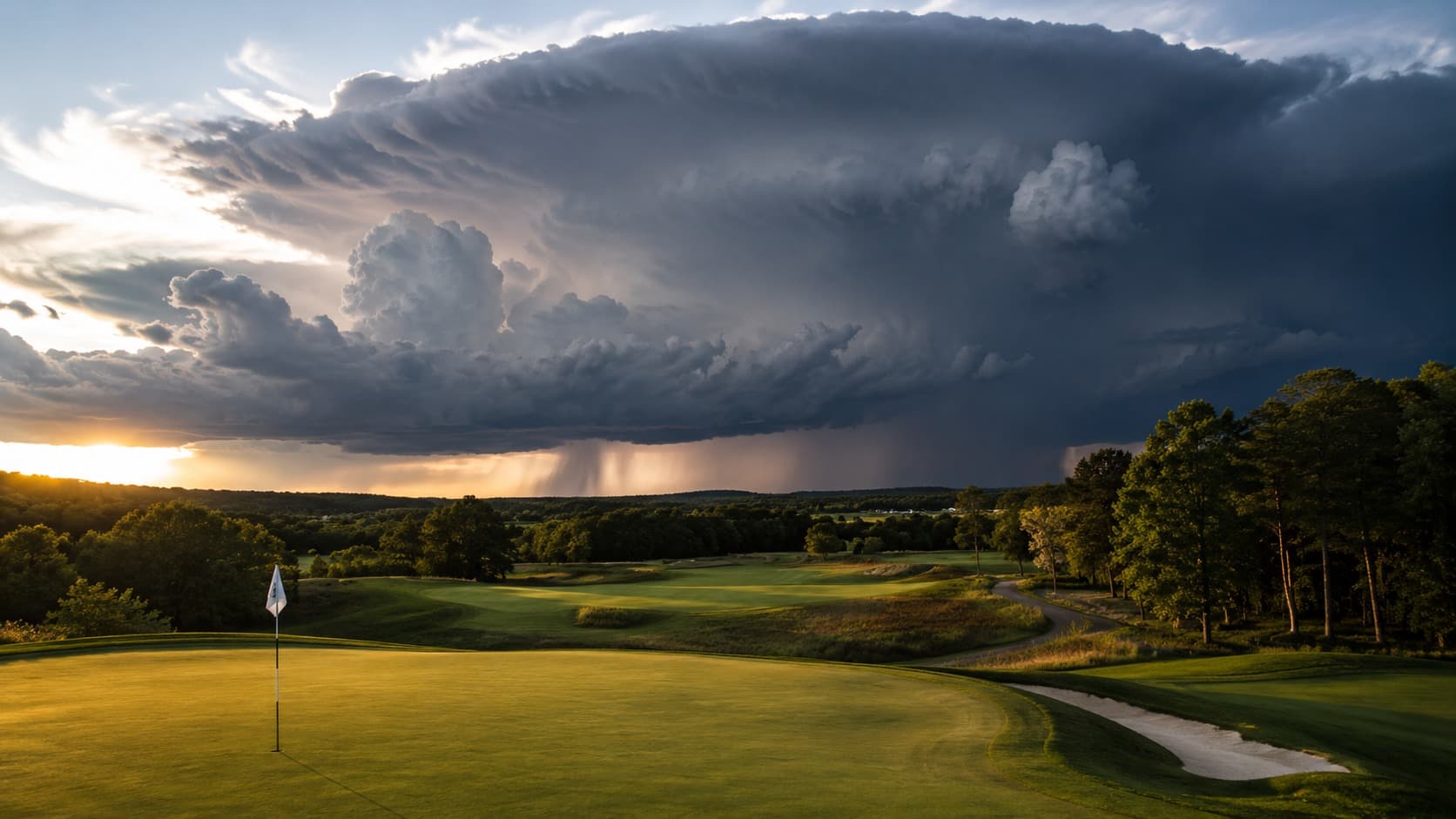
The Three O’Clock Storm: Reading Summer’s Convective Cycle to Protect Your Round
A 40% chance of afternoon thunderstorms does not mean a 40% chance of getting rained on. In the summer convective season it means the morning is nearly clear and the afternoon carries a fast-building, high-energy storm risk driven by a daily heating cycle. Here is the meteorology behind the pattern, the G-Score data on how the storm cycle punishes afternoon tee times across the Southeast, Midwest, and desert Southwest, the lightning-safety decision tree that actually matters, and the workflow that gets you off the course before the first bolt.
Read Story
Best Golf Weather by State: Ranking America by Average G-Score
We ranked all 50 US states by average G-Score golf playability. California tops the list, but the results beyond the top five may surprise you.
Read StoryDanorie
Editorial & Data
Golf Weather Score is built by Danorie. We compute the G-Score — our own playability rating — from live NOAA forecasts and published course scorecards, so any US course can be compared on any day with a single number. Methodology and data sources are documented on every page.
Every Friday Morning
When Atlanta Athletic Club plays best next weekend.
Friday 6am ET: peak G-Score windows for Atlanta Athletic Club, wind direction by hour, and one gear call. Three minutes to read, save you the round.
One email a week. Unsubscribe in one click.
The Caddie's Oracle
Draw your luck before the tee off