
Caddie's Gear Advisor
Curated for today's 54°F · Rain
Storm-Ready Outerwear
Waterproof layers built for 18 holes in the rain
Tour-Grade Umbrellas
68" double-canopy wind-resistant coverage
Wet-Weather Gloves
All-weather grip that performs in the rain
Waterproof Golf Shoes
Keep your feet dry through every fairway
Your Golf Trip, Handled
The Ultimate Golf Trip Planner
Everything you need to play Baltusrol Golf Course — from booking your flight to checking in course-side.
Course-Side Stays
Luxury hotels, resorts, and stay-and-play packages just minutes from the first tee.
Flights
Compare fares across 700+ airlines for the best route to your tee time.
SUV Rentals for Golf Bags
Spacious vehicles with room for clubs, bags, and your foursome.
Travel Insurance
Coverage for medical, weather delays, and gear at your destination.
Baltusrol Golf Course: Course Intelligence
Signature Setup
I have not teed it up on Baltusrol's Lower Course — it stays firmly private — but I walked it inside the ropes during the 2016 PGA Championship, a brutal Springfield afternoon, 88°F and soupy at 2 p.m. with the bentgrass holding water from an overnight storm. What stuck with me was how Tillinghast made a flattish New Jersey property finish uphill twice in a row and still feel inevitable.
A.W. Tillinghast laid out the Lower Course in 1922 in Springfield, New Jersey, about 20 miles west of Manhattan. It has hosted seven U.S. Opens (1954, 1967, 1980, 1993) and two PGA Championships (2005, 2016). Jack Nicklaus won here twice, setting the U.S. Open scoring record both times — 275 in 1967 and 272 in 1980, the latter sealed with a birdie on the closing par-5 18th. Phil Mickelson took the 2005 PGA; Jimmy Walker held off Jason Day in 2016.
Hole-by-Hole Wind & Playing Lines
Hole 7 (the Lower's longest two-shotter, par-4 ~505y). Into the prevailing SW wind this is the hole that quietly wrecks scorecards — a sub-par-5 length that still demands driver and a fairway wood for most amateurs. Lay the second shot short-left of the green rather than chasing a long iron the breeze knocks down into the front bunkers, then wedge on and take your par and run.
Hole 4 (signature par-3, ~194y). All carry over a pond to a green backed by a low stone wall, the hole Robert Trent Jones toughened in 1952. A helping W wind tempts you to take less club, but the front edge falls into the water — favor the back-center of the green and let a long putt be the worst outcome.
Hole 17 (par-5, ~650y). One of the longest par-5s in championship golf, climbing back toward the Watchung ridge. Into the SW wind it is a true three-shot hole; ignore the temptation to force a second over the cross-bunkers ("the Sahara") and lay up to a full third-shot wedge number instead.
Green & Fairway Characteristics
The Lower's greens are bentgrass and Poa annua, mid-sized and more gently contoured than Merion or Oakmont, but they ran around 12 on the Stimp for the 2016 PGA and get slick on the downhillers. Fairways are bentgrass, generous off the tee but pinched by Tillinghast's flashed-sand bunkering near the landing zones. The defining stretch is the finish: back-to-back par-5s (17 and 18) that both play uphill toward the clubhouse, which is why a tired player who spent everything early limps home. The front nine plays around 3,650 yards, the back closer to 3,750 with those long closers.
Seasonal Weather Pattern
Baltusrol sits in northern New Jersey's humid continental zone, far enough inland of the Atlantic to miss any sea breeze and tucked just below the Watchung Mountains. Spring (April–May) is cool and wet, 50–68°F, with soft fairways and no roll. Summer (June–August) is hot and sticky, frequently 84–90°F with high humidity and afternoon thunderstorms — exactly the conditions both PGA Championships were played in, which is why the course gave up low numbers on soft turf. Autumn (late September–October) is the prime window: 54–70°F, firmer ground, and the calmest mornings. NOAA's Newark-area records show summer afternoon winds commonly 7–13 mph out of the southwest.
Local Play Tips
Honest limitation first: I have not played the Lower Course — access is member-or-invited-guest only — so these lines come from walking the 2016 PGA and from the record, not from my own scorecard. The thing no yardage book prints: the round is back-loaded. Most courses ease you home; Baltusrol asks for two of your biggest swings on 17 and 18, both uphill into the prevailing southwest wind, after you have already fought the long 7th. If you ever get on, ration your energy and your driver — the difference between a good number and a blow-up here is whether you still have something left for the last 1,200 yards.
Pre-Round Weather Workflow
Use the 7-day G-Score on this page the way I would here. Three days out, check whether your tee window lands before or after the afternoon SW wind and thunderstorm build — on a 7,400-yard par 70 that finishes with two uphill par-5s, that single factor swings several strokes. The morning of, read the windExposure panel: an SW reading means 7, 17, and 18 all play dead into the breeze, so club up and treat both closing par-5s as honest three-shotters. If the temperature reads above 85°F with overnight rain — the August major scenario — expect soft fairways with little release; you can be aggressive into the bentgrass greens, but watch the front of the par-3 4th, where short is wet.
Related Reading
Before you tee off at Baltusrol Golf Course
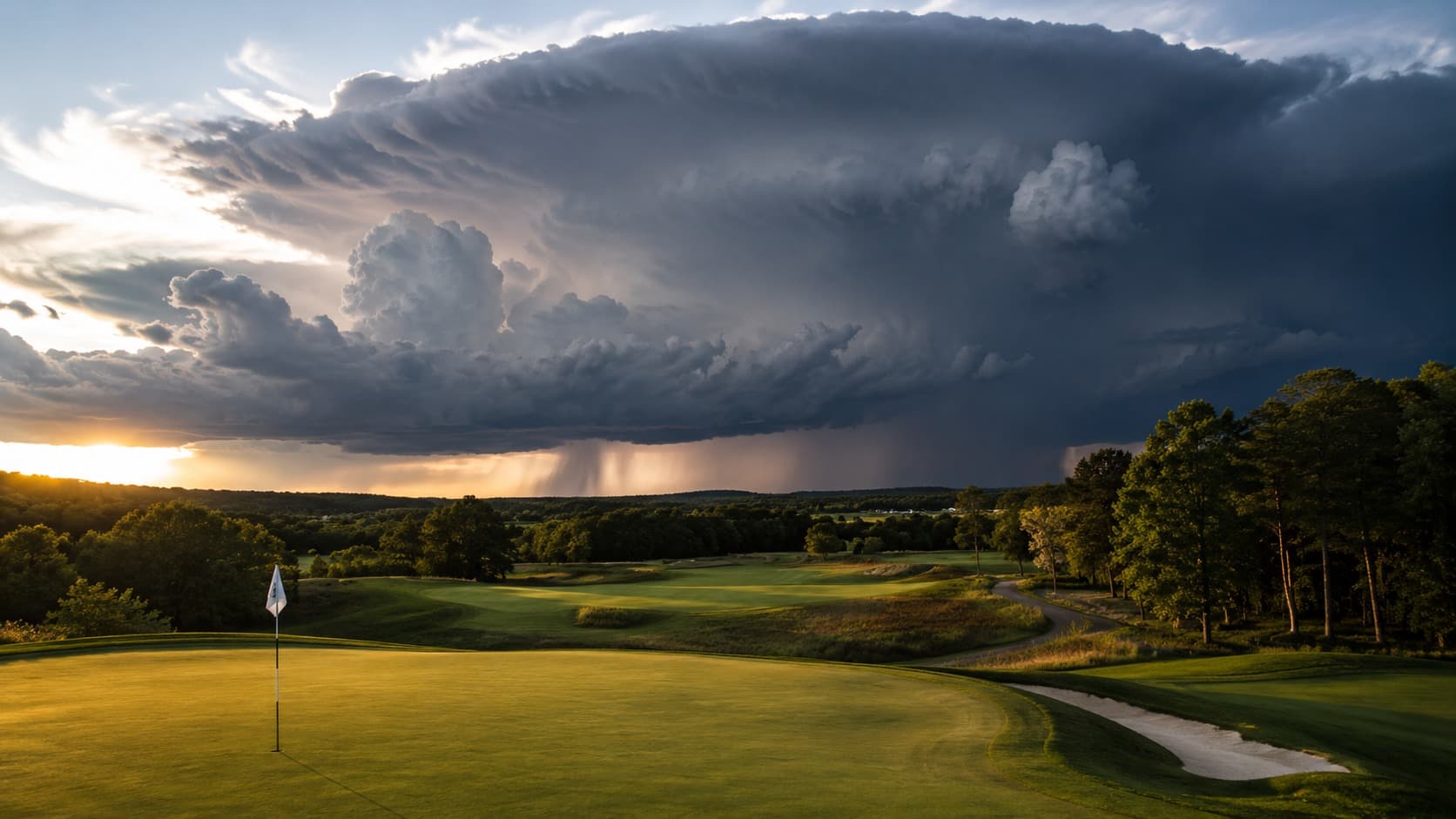
The Three O’Clock Storm: Reading Summer’s Convective Cycle to Protect Your Round
A 40% chance of afternoon thunderstorms does not mean a 40% chance of getting rained on. In the summer convective season it means the morning is nearly clear and the afternoon carries a fast-building, high-energy storm risk driven by a daily heating cycle. Here is the meteorology behind the pattern, the G-Score data on how the storm cycle punishes afternoon tee times across the Southeast, Midwest, and desert Southwest, the lightning-safety decision tree that actually matters, and the workflow that gets you off the course before the first bolt.
Read Story
How to Read a G-Score: The 0–100 Golf Playability Number, Decoded
A G-Score on this site is a single 0–100 number that tells you whether today is worth tee-up. Here is exactly what each band means, what drives the calculation, and how to use it to plan a round you will actually score on.
Read StoryDanorie
Editorial & Data
Golf Weather Score is built by Danorie. We compute the G-Score — our own playability rating — from live NOAA forecasts and published course scorecards, so any US course can be compared on any day with a single number. Methodology and data sources are documented on every page.
Every Friday Morning
When Baltusrol Golf Course plays best next weekend.
Friday 6am ET: peak G-Score windows for Baltusrol Golf Course, wind direction by hour, and one gear call. Three minutes to read, save you the round.
One email a week. Unsubscribe in one click.
The Caddie's Oracle
Draw your luck before the tee off