
Caddie's Gear Advisor
Curated for today's 58°F · Clouds
Tour-Level Drivers
Engineered for maximum distance and forgiveness
Laser Rangefinders
Pin-seeking technology for precision approaches
Premium Golf Balls
Tour-caliber spin and distance performance
Performance Sunglasses
Polarized lenses optimized for reading greens
Your Golf Trip, Handled
The Ultimate Golf Trip Planner
Everything you need to play Bay Harbor - The Links — from booking your flight to checking in course-side.
Course-Side Stays
Luxury hotels, resorts, and stay-and-play packages just minutes from the first tee.
Flights
Compare fares across 700+ airlines for the best route to your tee time.
SUV Rentals for Golf Bags
Spacious vehicles with room for clubs, bags, and your foursome.
Travel Insurance
Coverage for medical, weather delays, and gear at your destination.
Bay Harbor - The Links: Course Intelligence
Signature Setup
The Links 8th is a par-3 that sits closer to the cliff edge than any photo prepares you for. I have stood on that tee in late September with the bay flat and steel-gray below, a 51°F morning that felt ten degrees colder once I was out on the exposed point. The Links is the lakeside nine of Arthur Hills' 1998 routing at Bay Harbor, the northern-Michigan resort built on a reclaimed shoreline west of Petoskey. Of the club's three nines this is the one that earns the Pebble-Beach-of-the-Midwest comparisons: a run of holes strung along the rim of Little Traverse Bay, roughly 100 feet of drop to the water on your shoulder. It is short on paper — under 3,300 yards from the back markers — but the bay turns it into something else entirely.
Hole-by-Hole Wind & Playing Lines
Every hard decision on this nine is a wind decision, and the prevailing flow comes off the water from the W to NW.
- The Links 5th (stroke index 1, ~440y par-4): the longest, most exposed par-4 on the nine. On a NW bay wind it plays dead into you and the approach can stretch a 160-yard club to 185. Take an extra club into the green and favor the inside of the bend; the bluff side gives nothing back.
- The Links 8th (signature par-3, ~190y): with the bay hard right, a left-to-right wind shoves the ball toward the edge and there is no recovery from the wrong miss. Aim at the left-center bunker tongue and trust the wind to feed it. Into a head-on NW gust I would not be surprised to need three more clubs than the yardage book suggests.
- The Links 9th (closing par-4): a downhill tee shot that the wind can carry farther than you want toward the lower fairway pinch. On a helping W breeze, a fairway metal off the tee is the disciplined play, not driver.
Green & Fairway Characteristics
The putting surfaces are bentgrass and, in a firm summer stretch, they read around 10-11 on the Stimpmeter — fast enough that the bluff-top greens, which tilt subtly toward the bay, release downhill quicker than they look. The fairways sit on sandy, free-draining ground and bound out hard; on the lakeside holes you should plan your carry to land short of the target and let the run do the rest. There is little water in play beyond the bay itself, but the cliff edge is a permanent hazard line — anything pushed toward the lake side is simply gone. The nine measures in the low-3,000s yardage and the back-tee slope sits well into the 140s, so the modest scorecard length is deceptive.
Seasonal Weather Pattern
The Links is a May-through-October proposition and no more. Spring mornings in May and again from mid-September often open in the upper 40s°F, and the cold water of Little Traverse Bay keeps the bluff edge several degrees rawer than the clubhouse reading. Peak summer — mid-July into August — brings highs in the upper 70s to low 80s°F, but the onshore breeze almost always builds after mid-morning, so a calm 8 a.m. window is the prize. Shoulder-season lake-effect cloud can drop the felt temperature 12-15°F in under an hour when the wind backs to the NW, which is exactly why the 8th tee feels colder in October than the number says.
Local Play Tips
The three nines rotate, so when you book, ask specifically to start on the Links and request the earliest slot available — the lakeside 7th, 8th and 9th are at their best before the wind organizes, usually around 10 a.m. in summer. I have not played the Links in a hard August drought, so I will not claim to know how fast those bluff greens get at their firmest — but even in normal conditions they release toward the water more than first-timers expect. Carry one extra layer in the bag regardless of the forecast; the exposed point on the 8th sits in its own little microclimate off the bay.
Pre-Round Weather Workflow
Pull the 7-day G-Score for Bay Harbor and weight wind direction above everything else — this nine lives or dies on the W/NW onshore breeze. A morning tee time with light wind and a G-Score in the 8-12 band gives you a window to attack the 5th, 8th and 9th before the bay stiffens. Use the windExposure reading the night before to lock club selection on the exposed par-3 8th, and pack a windproof layer if the onshore forecast shows the breeze building past mid-morning.
Related Reading
Before you tee off at Bay Harbor - The Links
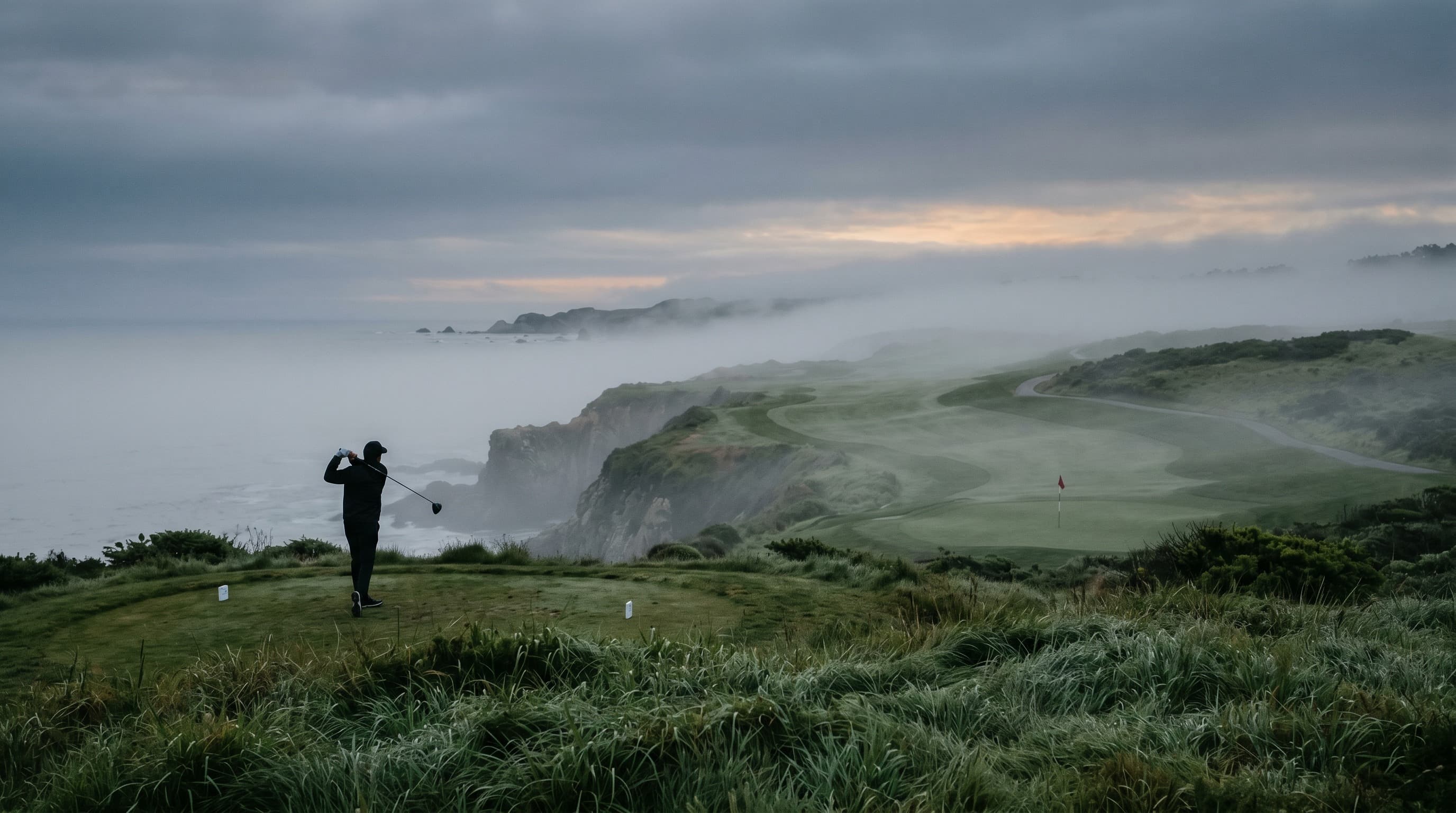
Reading Coastal Wind: How the Marine Layer Reshapes Pebble Beach, Bandon, and the Pacific Coast Game
Coastal golf does not play by inland rules. The marine layer suppresses wind in the morning, then releases it through midday in a thermal cycle that turns a calm 7am tee into a 22mph back nine. Here is the meteorology behind the pattern, the G-Score data that confirms it across the Pacific coast, and the morning workflow that turns the marine layer from a confusion into a competitive advantage.
Read Story
Saturday Morning Tee Time Decision Tree: How to Pick the Right Window in Six Minutes
You have Saturday open. Three courses on the shortlist, the weather is mixed, and your tee-time window is 6am to 4pm. Here is the six-minute decision tree we use to pick the right round, the right course, and the right hour — without overthinking.
Read StoryMinSu Kim
Founder & Golf Data Analyst
MinSu is a data analyst and golfer with 10+ years on the course. He built Golf Weather Score to answer one question: is today a good day to play? He combines weather data, course intelligence, and the proprietary G-Score algorithm to help golfers make smarter decisions.
Every Friday Morning
When Bay Harbor - The Links plays best next weekend.
Friday 6am ET: peak G-Score windows for Bay Harbor - The Links, wind direction by hour, and one gear call. Three minutes to read, save you the round.
One email a week. Unsubscribe in one click.
The Caddie's Oracle
Draw your luck before the tee off