
Caddie's Gear Advisor
Curated for today's 85°F · Clear
Tour-Level Drivers
Engineered for maximum distance and forgiveness
Laser Rangefinders
Pin-seeking technology for precision approaches
Premium Golf Balls
Tour-caliber spin and distance performance
Performance Sunglasses
Polarized lenses optimized for reading greens
Your Golf Trip, Handled
The Ultimate Golf Trip Planner
Everything you need to play Baylands Golf Links — from booking your flight to checking in course-side.
Course-Side Stays
Luxury hotels, resorts, and stay-and-play packages just minutes from the first tee.
Flights
Compare fares across 700+ airlines for the best route to your tee time.
SUV Rentals for Golf Bags
Spacious vehicles with room for clubs, bags, and your foursome.
Travel Insurance
Coverage for medical, weather delays, and gear at your destination.
Baylands Golf Links: Course Intelligence
Signature Setup
I'll be honest up front: I built the wind reads below from the scorecard, the City of Palo Alto course material, and South Bay marine-breeze climatology — I haven't walked all 18 here, so treat the playing lines as profile-and-pattern reasoning, not a round I'm dressing up as memory. Baylands Golf Links sits off Embarcadero Road in Palo Alto, wedged between the Palo Alto Airport, the Baylands Nature Preserve, and the tidal edge of San Francisco Bay. The ground first opened as the Palo Alto Municipal Golf Course in 1956 (a William F. Bell design), but a creek flood-control project reclaimed land along San Francisquito Creek, and the city used the disruption to rebuild it. Forrest Richardson & Associates reimagined it as a true links — treeless, firm, mounded — and it reopened in December 2018 at roughly 6,807 yards, par 72.
TL;DR: A genuine links redesign (Forrest Richardson, 2018) on the San Francisco Bay marsh in Palo Alto. Short-ish on the card (~6,807y, par 72) but fully exposed to the daily Bay sea breeze. There are no trees to block wind. Tee off early before the WNW breeze fills in, and play position over power.
Hole-by-Hole Wind & Playing Lines
The reopened layout is young enough that a verified per-hole handicap card isn't something I'll fake hole numbers from — instead, here is how the wind dictates play on links ground this exposed:
- Longer par-4s into the WNW afternoon breeze: When the Bay sea breeze is up at 15–25 mph, a flushed 150-yard club behaves like 170–175. Club up two, flight the ball low, and accept the run-out rather than ballooning a high approach the wind will swat into the native grass.
- Downwind holes turning back toward the airport: With the same breeze behind you, the firm fescue fairways run hard — land well short and let the ball release rather than flying a hot wedge onto a green that won't hold it.
- Crosswind holes along the marsh: Nothing blocks the wind out here. A player who can hold a shaped ball into a left-to-right Bay crosswind scores better than one who simply hits it far. On a links, length is the cheap yard; ball flight is the expensive one.
The habit that travels: read the flags on the first exposed hole, decide whether the breeze has filled in yet, and re-club every approach from there.
Green & Fairway Characteristics
This is fescue-dominant links turf, built to run firm and fast — the opposite of a soft parkland muni. The fairways move over engineered mounding with native grasses framing the corridors, and at a par of 72 over roughly 6,807 yards the card flatters a straight hitter on a calm dawn. That calm window is the catch: firmness here swings with both the marine layer and the tide-influenced humidity. Under a dry afternoon high the greens bake and release; under a thick morning marine layer the surfaces hold more than a links "should." With essentially no tree cover, your stock yardages are only reliable in the early, breeze-free hours.
Seasonal Weather Pattern
Baylands sits in a Bay-margin Mediterranean climate, moderated hard by the water — mild and dry-summer, the opposite of a continental course. Spring (Mar–May): green, breezy, comfortable highs in the mid-60s°F; the sea breeze is reliable but not yet at its strongest. Summer (Jun–Aug): the marine layer is king — fog-grey, cool 60°F dawns burning off by mid-morning, then a stiff WNW Bay breeze every afternoon; mornings are the scoring window. Fall (Sep–Oct): the prime stretch — the marine layer thins, you get the warmest, clearest, often calmest days of the year, with firm fast turf. Winter (Dec–Feb): the wet season; rain and saturated marsh ground soften the links and can close holes, and I lean on NOAA/San Jose-area historicals for that stretch rather than anything firsthand.
Local Play Tips
Here's the one thing that decides your round and never shows up in a yardage book: the timing of the Bay sea breeze. On this marsh the wind is driven by the daily land-sea thermal cycle, not by passing fronts — so a dead-calm 7 a.m. tee can become a 20 mph WNW grind by 1 p.m. on the very same holes. The variable that matters is what time you start, not just the forecast high. A summer dawn round under the marine layer can be eerily still; the same loop after lunch plays a full club or two longer into the teeth of the breeze. Book the earliest tee time you can stand, and let the early calm bank you strokes before the wind fills in.
Pre-Round Weather Workflow
Treat golfweatherscore's 7-day G-Score and windExposure as your go/no-go and your timing tool — but read it for a coastal links, not a parkland muni:
- Three days out: scan the G-Score trend for the marine-layer pattern. In summer the difference between a calm morning and a blustery one is usually how fast the fog burns off, not whether a front is coming.
- The night before: lock in the expected sea-breeze onset time and the WNW wind speed. A late, weak breeze means a gentle round; an early, strong one means you want to be on the closing holes before noon.
- Round morning: if windExposure flags sustained gusts over ~18 mph, accept that a ~6,807-yard, treeless links will play a full club or two longer into the breeze — keep the ball low, favor the running approach, and let position-golf protect your number.
Related Reading
Before you tee off at Baylands Golf Links

Reading Coastal Wind: How the Marine Layer Reshapes Pebble Beach, Bandon, and the Pacific Coast Game
Coastal golf does not play by inland rules. The marine layer suppresses wind in the morning, then releases it through midday in a thermal cycle that turns a calm 7am tee into a 22mph back nine. Here is the meteorology behind the pattern, the G-Score data that confirms it across the Pacific coast, and the morning workflow that turns the marine layer from a confusion into a competitive advantage.
Read Story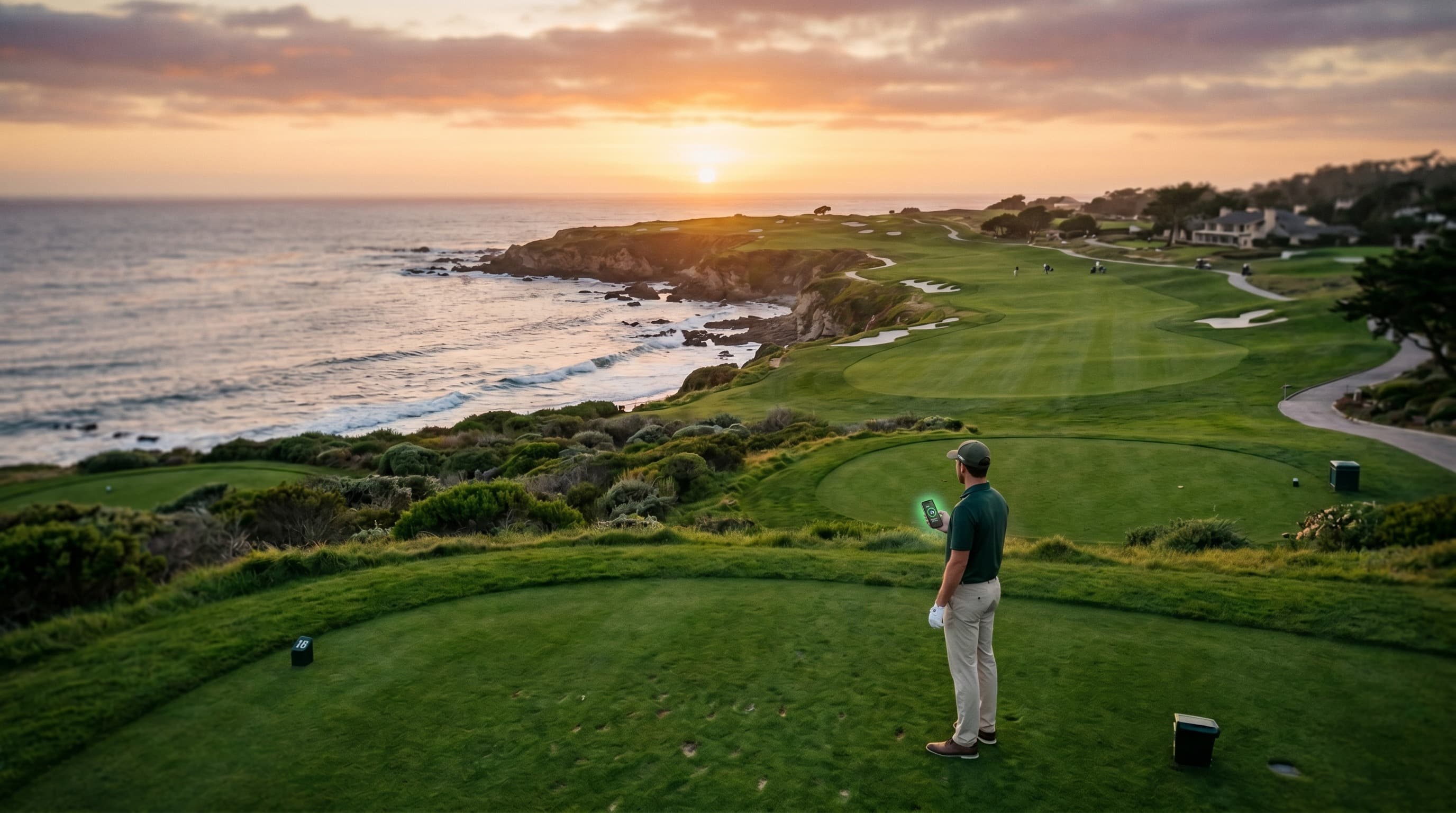
How to Read a G-Score: The 0–100 Golf Playability Number, Decoded
A G-Score on this site is a single 0–100 number that tells you whether today is worth tee-up. Here is exactly what each band means, what drives the calculation, and how to use it to plan a round you will actually score on.
Read StoryMinSu Kim
Founder & Golf Data Analyst
MinSu is a data analyst and golfer with 10+ years on the course. He built Golf Weather Score to answer one question: is today a good day to play? He combines weather data, course intelligence, and the proprietary G-Score algorithm to help golfers make smarter decisions.
Every Friday Morning
When Baylands Golf Links plays best next weekend.
Friday 6am ET: peak G-Score windows for Baylands Golf Links, wind direction by hour, and one gear call. Three minutes to read, save you the round.
One email a week. Unsubscribe in one click.
The Caddie's Oracle
Draw your luck before the tee off