
Caddie's Gear Advisor
Curated for today's 67°F · Clear
Tour-Level Drivers
Engineered for maximum distance and forgiveness
Laser Rangefinders
Pin-seeking technology for precision approaches
Premium Golf Balls
Tour-caliber spin and distance performance
Performance Sunglasses
Polarized lenses optimized for reading greens
Your Golf Trip, Handled
The Ultimate Golf Trip Planner
Everything you need to play BeauPre Golf Course — from booking your flight to checking in course-side.
Course-Side Stays
Luxury hotels, resorts, and stay-and-play packages just minutes from the first tee.
Flights
Compare fares across 700+ airlines for the best route to your tee time.
SUV Rentals for Golf Bags
Spacious vehicles with room for clubs, bags, and your foursome.
Travel Insurance
Coverage for medical, weather delays, and gear at your destination.
BeauPre Golf Course: Course Intelligence
Signature Setup
The fog over McKinleyville does not lift the way it does inland. I have stood on the Humboldt coast at 8 a.m. in July with the thermometer reading 53°F and a gray ceiling that refused to break — that is a normal Beau Pre morning, not a bad one.
Beau Pre Golf Club opened in 1967, designed by golf pro and longtime owner Don Harling, who built it on hilly ground at 1777 Norton Rd, just inland from the Pacific in Humboldt County. It is an 18-hole, par-71 semi-private layout — not a championship monster, but a genuine Northern California coastal course where terrain and weather, not length, decide your card.
TL;DR: A short, hilly par-71 in a cool maritime climate. Play it early before the onshore wind, club up on the uphill holes, and expect cool-season greens that roll truer than the fairways.
Hole-by-Hole Wind & Playing Lines
I want to be straight: I have not walked all 18 at Beau Pre myself, so I am working from the course specs and what coastal Humboldt play consistently demands — not invented hole numbers.
The prevailing pattern here is an afternoon onshore flow out of the W–NW off the Pacific. On the uphill front-nine par-4s, that means a shot playing both up the slope and into the breeze: a 150-yard approach can demand two extra clubs by 2 p.m. On a calm, foggy morning the same hole is a flip wedge. The wind is your single biggest scoring variable on this course.
Green & Fairway Characteristics
From the back tees the course measures roughly 5,748 yards (Blue, rating 68.9 / slope 125), with the White set around 5,417 yards (slope 121–128) and Red near 5,056 yards. Those are modest numbers — but the hilly routing through large evergreens adds effective yardage that the card never shows.
Reviews consistently say the greens are the strength here — well-maintained and rolling true — while fairways and tees have historically been the weaker link. In this climate that tracks: cool-season, poa-prone greens hold up in the marine air, while fairways run firm in the dry summer and turn soft through the Nov–Mar wet season.
Seasonal Weather Pattern
This is where Beau Pre differs from almost every inland California course. NOAA normals for McKinleyville show July ranging only 51.1°F to 68.5°F, and January between 43.2°F and 53.8°F — the temperature barely leaves the band of 41°F to 65°F all year. Summers are cool and dry but famously fogbound in the mornings; winters are long, wet, and cloudy. You will rarely sweat and rarely freeze. What you will fight is the marine layer and the afternoon sea breeze.
Local Play Tips
Cart restrictions kick in during the winter months on this hilly ground, so a wet-season round here is a walking round — plan your legs for the climb on the first dozen holes. Bring a light rain layer Nov–Mar even when the forecast looks dry; coastal drizzle arrives without a front. And do not over-club for "California sun" — the ball does not fly far at 55°F in heavy marine air.
Pre-Round Weather Workflow
Before you drive up Highway 101, pull the 7-day G-Score for McKinleyville and read two things: the morning fog/visibility trend and the afternoon windExposure for a W–NW onshore flow. The play is simple — book the earliest tee time you can. Calm, foggy mornings here score several points higher than gusty afternoons, and the gap widens the closer your slot sits to midday.
Sources: GolfPass course profile (Beau Pre Golf Club), beaupre.golf, NOAA/Weather Spark climate normals for McKinleyville, CA.
Related Reading
Before you tee off at BeauPre Golf Course
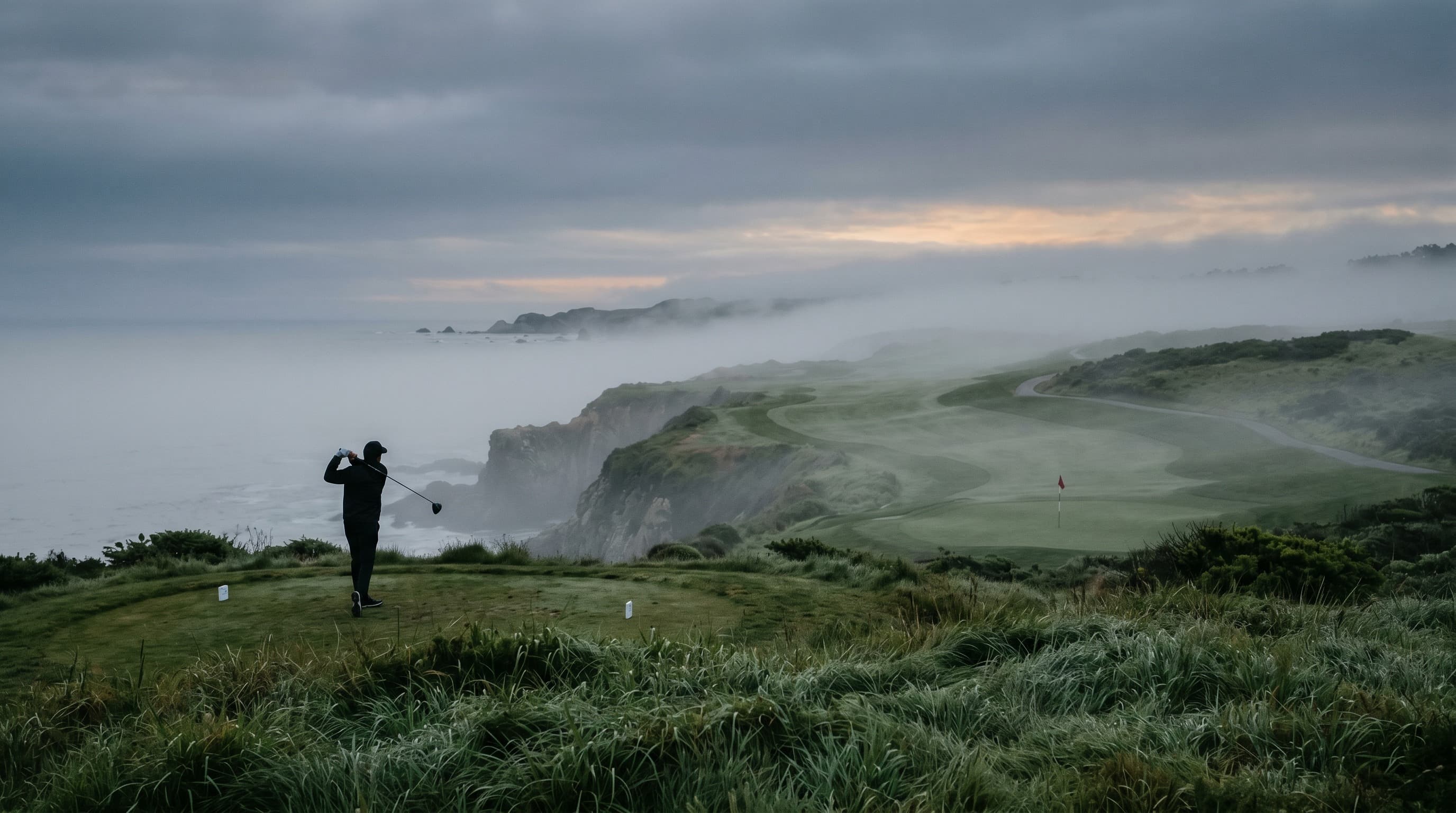
Reading Coastal Wind: How the Marine Layer Reshapes Pebble Beach, Bandon, and the Pacific Coast Game
Coastal golf does not play by inland rules. The marine layer suppresses wind in the morning, then releases it through midday in a thermal cycle that turns a calm 7am tee into a 22mph back nine. Here is the meteorology behind the pattern, the G-Score data that confirms it across the Pacific coast, and the morning workflow that turns the marine layer from a confusion into a competitive advantage.
Read Story
How to Read a G-Score: The 0–100 Golf Playability Number, Decoded
A G-Score on this site is a single 0–100 number that tells you whether today is worth tee-up. Here is exactly what each band means, what drives the calculation, and how to use it to plan a round you will actually score on.
Read StoryMinSu Kim
Founder & Golf Data Analyst
MinSu is a data analyst and golfer with 10+ years on the course. He built Golf Weather Score to answer one question: is today a good day to play? He combines weather data, course intelligence, and the proprietary G-Score algorithm to help golfers make smarter decisions.
Every Friday Morning
When BeauPre Golf Course plays best next weekend.
Friday 6am ET: peak G-Score windows for BeauPre Golf Course, wind direction by hour, and one gear call. Three minutes to read, save you the round.
One email a week. Unsubscribe in one click.
The Caddie's Oracle
Draw your luck before the tee off