
Caddie's Gear Advisor
Curated for today's 67°F · Mist
Tour-Level Drivers
Engineered for maximum distance and forgiveness
Laser Rangefinders
Pin-seeking technology for precision approaches
Premium Golf Balls
Tour-caliber spin and distance performance
Performance Sunglasses
Polarized lenses optimized for reading greens
Your Golf Trip, Handled
The Ultimate Golf Trip Planner
Everything you need to play Bella Collina Towne & Golf Club — from booking your flight to checking in course-side.
Course-Side Stays
Luxury hotels, resorts, and stay-and-play packages just minutes from the first tee.
Flights
Compare fares across 700+ airlines for the best route to your tee time.
SUV Rentals for Golf Bags
Spacious vehicles with room for clubs, bags, and your foursome.
Travel Insurance
Coverage for medical, weather delays, and gear at your destination.
Bella Collina Towne & Golf Club: Course Intelligence
Signature Setup
Bella Collina is the rare Florida course where you actually need to think about elevation. I drove out to Montverde on an October morning, 71°F at 8 a.m. with the humidity already pressing, and the first thing that struck me from the clubhouse terrace was the terrain — rolling hills tumbling down toward Lake Siena, nothing like the dead-flat Orlando tracks twenty minutes east. The Tuscan village styling gets the magazine photos, but the golf story here is the ground moving under your feet.
Sir Nick Faldo's Faldo Design firm built Bella Collina Towne & Golf Club in 2003, set in the hill country northwest of Clermont near Orlando, Florida. It plays par 72 at roughly 7,000-plus yards from the back tees, routed across what is, for this state, genuinely dramatic topography — better than 80 feet of elevation change across the property. The course has been a private, members-and-guests club for most of its life, which keeps the conditioning tight and the rounds unhurried.
Hole-by-Hole Wind & Playing Lines
The #1-handicap par-4 (front nine). The toughest hole on the card is the long uphill par-4 that climbs back toward the high ground. On a SE morning breeze pulling off Lake Siena, the uphill walk plus the headwind stacks up to a full extra club on the approach — a stock 150-yard shot played like 170 the morning I watched it. Favor the low side of the fairway off the tee for a flatter lie, and play to the front of a green that runs away from you.
The lakeside par-3. The signature one-shotter carries a ravine to a green perched above the water, with the clubhouse behind it. Wind funnels up the slope from the lake, so a club that feels right at the tee often comes up short at green level. I'd take one more and aim at the fat center — long here is a far better miss than wet-short.
A downhill par-4 turning toward the water. One of the rolling two-shotters tips downhill and bends toward the lake. With a quartering tailwind the firm Bermuda fairway runs hard, and a driver can chase through the corner into trouble — a 3-wood or long iron to the top of the hill leaves the cleaner angle in.
Green & Fairway Characteristics
The greens are TifEagle Bermuda, and in peak season they get firm, fast, and grainy — the grain matters as much as the slope, and downgrain putts sliding toward the lake will scoot well past if you trust the borrow alone. The fairways are the real character: this is hill golf, so uneven lies are constant, and you'll rarely hit an approach off perfectly level ground. Off a downhill, downgrain lie the ball comes out hot and low; off an uphill stance it stands up and lands soft. Front nine and back nine both ride the contours, so club selection has to account for stance and elevation, not just the yardage on the card. Into the firm, uphill lakeside greens, a flighted-down approach that releases up the tier holds the line better than a high one the slope-funneled breeze can shove offline. Greens are large but tiered, and a putt above the hole is a genuine three-putt risk when they're rolling out in the dry months.
Seasonal Weather Pattern
Central Florida's playing calendar inverts the northern one. The comfortable window at Montverde runs November through April — daytime highs in the 70s°F, low humidity, and stable mornings, which is why that stretch is the season here. Summer (June–September) is hot and saturated: highs in the low-to-mid 90s°F, oppressive humidity, and the daily inland convective cycle that fires afternoon thunderstorms across the Orlando ridge almost like clockwork. Those storms are the defining weather fact of this course — not coastal wind, but the 1–5 p.m. lightning risk that ends rounds early in summer. July is a gap in my own play here, and I'd rather not invent how these hillside fairways shed a tropical downpour; what the record is clear on is volume — NOAA central-Florida data attributes the bulk of the area's ~50 inches of yearly rain to the June–September wet season, nearly all of it dumped in those afternoon cells.
Local Play Tips
Here's the read no yardage book prints: people show up expecting flat Florida target golf and get caught flat-footed by the slopes. Walk the practice green for grain direction before you tee off — figure out which way "downhill" and "downgrain" line up, because on the lakeside holes they often point the same way and double the speed. And book the earliest tee time you can get from late spring onward. The afternoon storm clock is real; an 8 a.m. start in June can finish in calm sunshine while the 1 p.m. group is sheltering under the cart barn.
Pre-Round Weather Workflow
Here the lightning clock outranks the wind. From May through September, run the 7-day G-Score three days out and ask one question first: does your tee window finish before the midday convective build fires over the Orlando ridge? Clearing those 1–5 p.m. cells is the difference between a clean card and a washout — 8–12 points right there. The morning of, the windExposure panel handles the rest: a breeze off Lake Siena lifts the lakeside holes, the signature ravine par-3 and the downhill turn toward the water, so add a club on those while the high-ground inland holes stay calmer. Come peak winter, swap your worry to a post-front morning when the TifEagle Bermuda goes firm and fast — aim short of the flags and let the ball climb the tiers on the release, because anything flown long and above the hole is a three-putt waiting on these contours.
Related Reading
Before you tee off at Bella Collina Towne & Golf Club
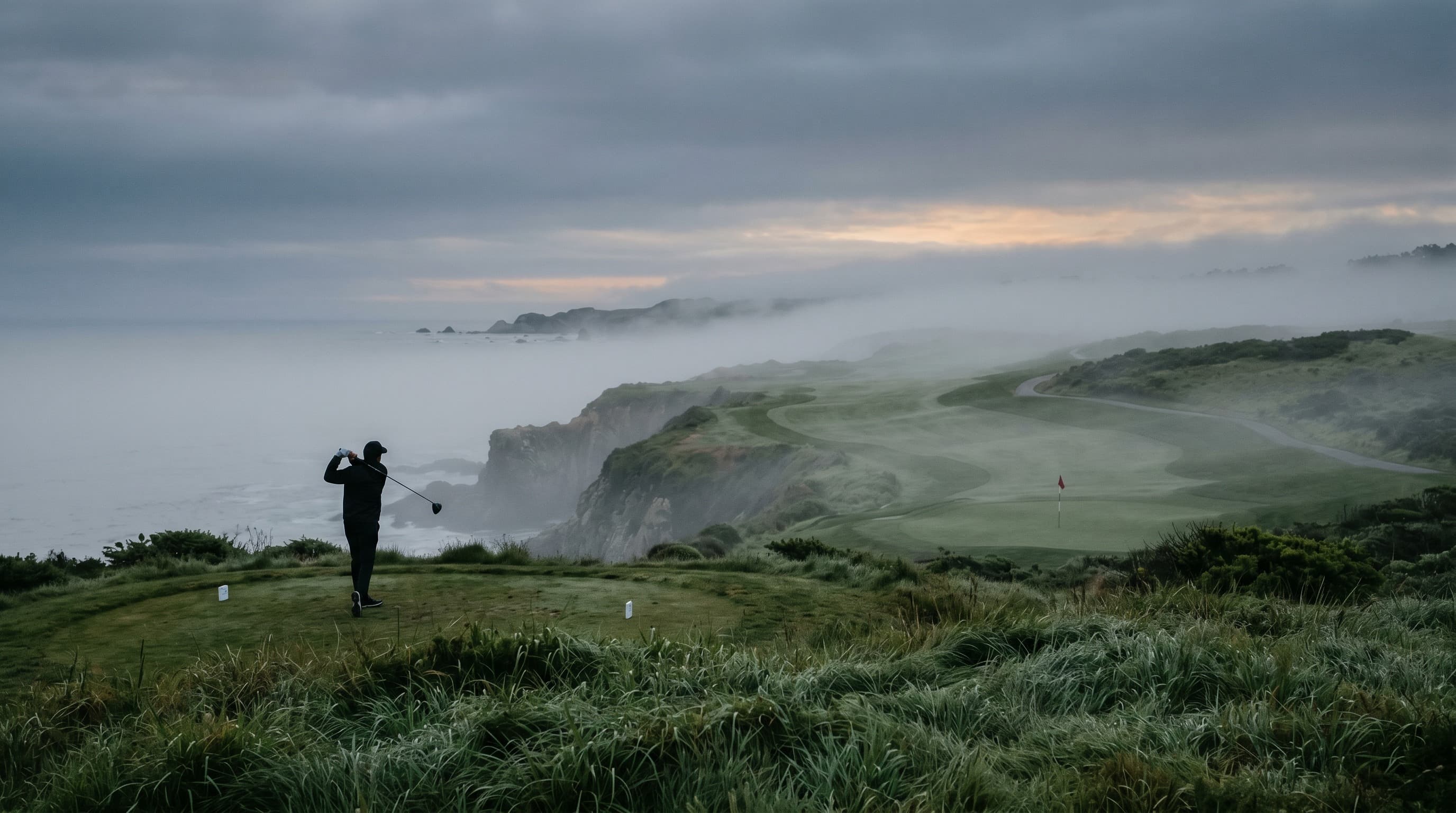
Reading Coastal Wind: How the Marine Layer Reshapes Pebble Beach, Bandon, and the Pacific Coast Game
Coastal golf does not play by inland rules. The marine layer suppresses wind in the morning, then releases it through midday in a thermal cycle that turns a calm 7am tee into a 22mph back nine. Here is the meteorology behind the pattern, the G-Score data that confirms it across the Pacific coast, and the morning workflow that turns the marine layer from a confusion into a competitive advantage.
Read Story
How to Read a G-Score: The 0–100 Golf Playability Number, Decoded
A G-Score on this site is a single 0–100 number that tells you whether today is worth tee-up. Here is exactly what each band means, what drives the calculation, and how to use it to plan a round you will actually score on.
Read StoryMinSu Kim
Founder & Golf Data Analyst
MinSu is a data analyst and golfer with 10+ years on the course. He built Golf Weather Score to answer one question: is today a good day to play? He combines weather data, course intelligence, and the proprietary G-Score algorithm to help golfers make smarter decisions.
Every Friday Morning
When Bella Collina Towne & Golf Club plays best next weekend.
Friday 6am ET: peak G-Score windows for Bella Collina Towne & Golf Club, wind direction by hour, and one gear call. Three minutes to read, save you the round.
One email a week. Unsubscribe in one click.
The Caddie's Oracle
Draw your luck before the tee off