
Caddie's Gear Advisor
Curated for today's 70°F · Mist
Tour-Level Drivers
Engineered for maximum distance and forgiveness
Laser Rangefinders
Pin-seeking technology for precision approaches
Premium Golf Balls
Tour-caliber spin and distance performance
Performance Sunglasses
Polarized lenses optimized for reading greens
Your Golf Trip, Handled
The Ultimate Golf Trip Planner
Everything you need to play Blue Heron Pines Golf Club — from booking your flight to checking in course-side.
Course-Side Stays
Luxury hotels, resorts, and stay-and-play packages just minutes from the first tee.
Flights
Compare fares across 700+ airlines for the best route to your tee time.
SUV Rentals for Golf Bags
Spacious vehicles with room for clubs, bags, and your foursome.
Travel Insurance
Coverage for medical, weather delays, and gear at your destination.
Blue Heron Pines Golf Club: Course Intelligence
Signature Setup
Straight talk before anything else: what follows is built from the scorecard, Stephen Kay's published design notes, and southern New Jersey coastal weather records — I have not walked Blue Heron Pines myself, and I'd rather say so than fake a round I never played. The facts are clean enough to be useful. The course sits in Egg Harbor City, in the Pine Barrens about fifteen minutes inland from Atlantic City, and it opened in 1993 as Stephen Kay's attempt at a Scottish-flavored layout dropped into sandy New Jersey pine country. It plays to par 72 at roughly 6,810 yards from the back tees, with a slope in the low-130s. The signature stretch is the closing par-5, a reachable hole near 520 yards that swings back toward the clubhouse past sand and water to a two-tier green. The defining trait isn't length — it's the sand-based ground, which drains fast and plays firm, and the coastal wind that finds the open holes.
TL;DR: Stephen Kay's 1993 Pine Barrens layout near Atlantic City. Par 72, ~6,810y, slope low-130s. Sandy soil means firm, fast, links-style turf; the Atlantic sea breeze from the SE is the real defense. Play early in summer, take extra club into the wind.
Hole-by-Hole Wind & Playing Lines
Blue Heron Pines doesn't publish a hole-by-hole stroke index I can verify down to the number, so rather than invent holes I'll lay out how the wind rewrites this kind of card:
- Long two-shotters into the SE sea breeze: by early afternoon in summer a 10–15 mph onshore flow stands up against the approach. A flushed 150-yard shot lands like 170, and on firm sand a high wedge that comes up short won't spin back. Take the extra club and aim for the wide side of the green.
- The closing par-5 (18th, ~520y): reachable in two on a calm morning, but with the breeze in your face the smart line is to lay back to a full wedge number rather than gamble at the water and sand fronting the two-tier green. The two tiers make distance control matter more than raw length.
- Holes running with a downwind NW flow: behind a passing front the dry northwesterly shrinks the layout and the firm fairways start to chase. Land approaches short and let the bounce feed the surface instead of flying the ball all the way to a baked green.
The portable lesson: on the first exposed hole, decide whether you're fighting an onshore sea breeze or riding a post-front NW wind, and set your club selection for the round from there.
Green & Fairway Characteristics
The greens are bentgrass laid over Pine Barrens sand, and that soil is the whole story. Sand drains almost instantly, so the fairways stay firm and run out like a links even a day after rain — your driver gets extra roll and your approaches get extra release. At a slope in the low-130s the bunkering and the green complexes carry the difficulty rather than brutal length; the closing par-5's two-tier green is the clearest example, where being on the wrong shelf leaves a putt that's hard to lag close. From the tips near 6,810 yards the card is honest for a strong player, with multiple forward sets bringing it under 6,000 for shorter hitters. The catch is that firmness makes spin and trajectory control matter more than they would on a soft parkland track.
Seasonal Weather Pattern
Egg Harbor City sits in southern New Jersey's coastal plain, close enough to the Atlantic to feel the ocean but far enough inland to bake in summer. Spring (Apr–May) brings variable winds and cool, firm mornings — good scoring weather once the frost clears, though gusts pick up ahead of fronts. Summer (Jun–Aug) is hot and humid, highs in the upper-80s°F, with the defining feature being a reliable afternoon sea breeze that fills in from the SE off the Atlantic; mornings are calmer, afternoons windier, and thunderstorms are a real risk on humid afternoons. Fall (Sep–Oct) is the sweet spot — cool, dry NW air behind departing fronts, firm fast turf, and the calmest, clearest golf of the year. Winter turns cold and damp; the course can stay open in mild stretches thanks to the sandy drainage, but for that gap I lean on NOAA Atlantic City-area historicals rather than firsthand play.
Local Play Tips
The detail that won't show up in a generic course review: because this is sand-based Pine Barrens ground only a dozen miles from the coast, it behaves like a links far more than a typical inland New Jersey course. That means two things in practice. First, after rain it's playable and firm again faster than almost any parkland track nearby, so don't write off a tee time just because it stormed the day before — the fairways will likely be running. Second, the summer sea breeze is a daily thermal pattern, not random: calm at dawn, then an onshore SE flow that builds through the afternoon. A coastal golfer's instinct to tee off early genuinely pays off here, both for the still air and for the firmer, faster morning greens before the heat softens them.
Pre-Round Weather Workflow
Use golfweatherscore's 7-day G-Score and windExposure as your decision tools, read for a coastal sand layout:
- Three days out: scan the G-Score curve. In summer the better numbers cluster in the mornings — a high score at 8 a.m. dropping by mid-afternoon usually signals the SE sea breeze filling in, not a passing front.
- The evening before: confirm wind direction. An onshore SE flow means take extra club on the long approaches and the closing par-5; a post-front NW flow means firm, fast, downwind golf where you land it short and let it run.
- Round morning: if windExposure shows the sea breeze already past ~12 mph, accept that a 6,810-yard, slope-low-130s card plays a club or two longer into the wind on the open holes, and let placement and trajectory control — not aggression at the sand and water — hold your score together.
Related Reading
Before you tee off at Blue Heron Pines Golf Club

Reading Coastal Wind: How the Marine Layer Reshapes Pebble Beach, Bandon, and the Pacific Coast Game
Coastal golf does not play by inland rules. The marine layer suppresses wind in the morning, then releases it through midday in a thermal cycle that turns a calm 7am tee into a 22mph back nine. Here is the meteorology behind the pattern, the G-Score data that confirms it across the Pacific coast, and the morning workflow that turns the marine layer from a confusion into a competitive advantage.
Read Story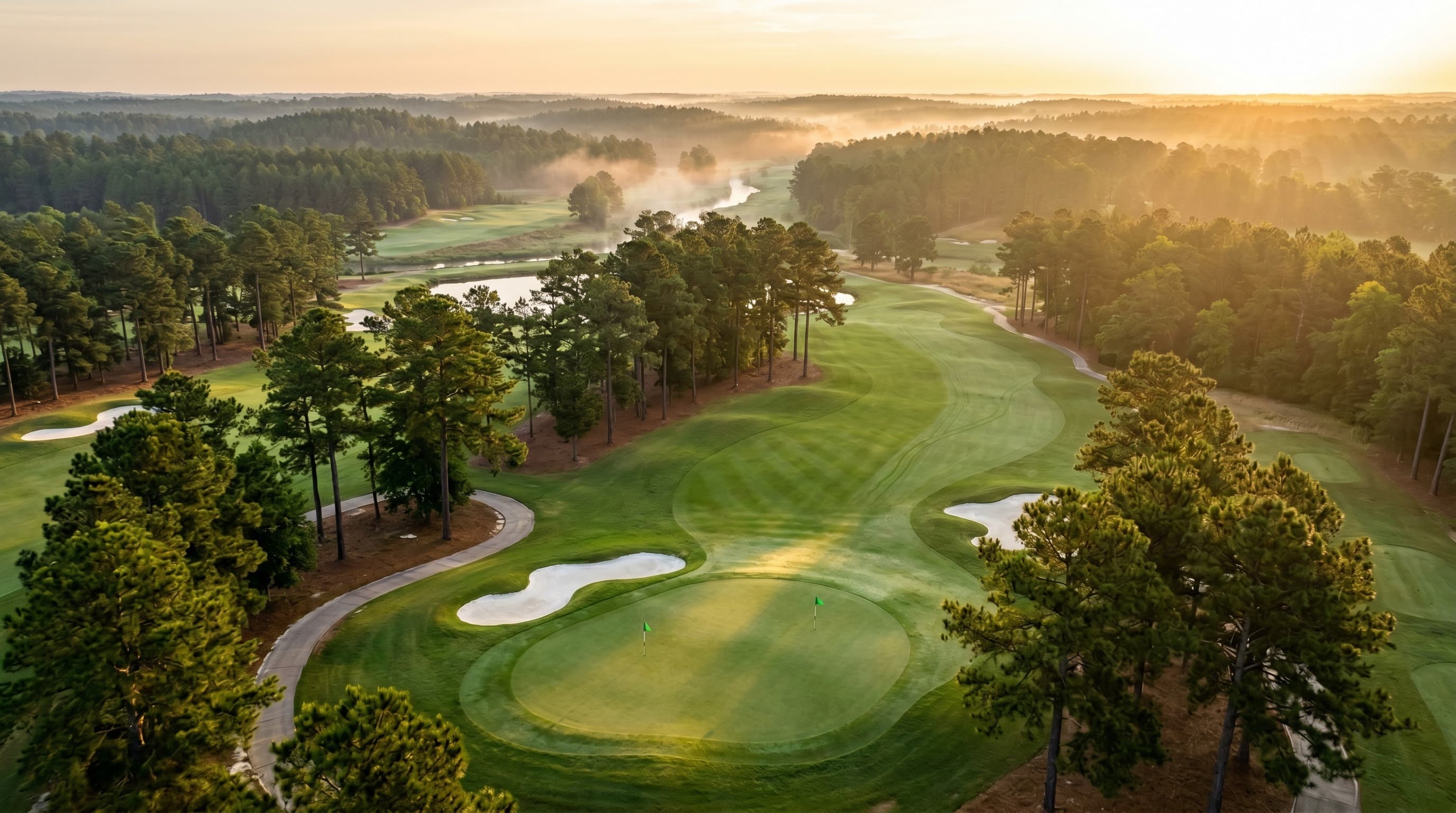
The May 2026 G-Score Heatmap: Where American Golf Peaks This Spring
May is the most underrated month on the American golf calendar. Five regions hit their annual peak this spring, three turn quietly hostile, and the data tells a clearer story than the brochures. Here is where to play, where to avoid, and how to time your booking window.
Read StoryMinSu Kim
Founder & Golf Data Analyst
MinSu is a data analyst and golfer with 10+ years on the course. He built Golf Weather Score to answer one question: is today a good day to play? He combines weather data, course intelligence, and the proprietary G-Score algorithm to help golfers make smarter decisions.
Every Friday Morning
When Blue Heron Pines Golf Club plays best next weekend.
Friday 6am ET: peak G-Score windows for Blue Heron Pines Golf Club, wind direction by hour, and one gear call. Three minutes to read, save you the round.
One email a week. Unsubscribe in one click.
The Caddie's Oracle
Draw your luck before the tee off