
Caddie's Gear Advisor
Curated for today's 59°F · Clouds
Tour-Level Drivers
Engineered for maximum distance and forgiveness
Laser Rangefinders
Pin-seeking technology for precision approaches
Premium Golf Balls
Tour-caliber spin and distance performance
Performance Sunglasses
Polarized lenses optimized for reading greens
Your Golf Trip, Handled
The Ultimate Golf Trip Planner
Everything you need to play Bradshaw Ranch Golf Course — from booking your flight to checking in course-side.
Course-Side Stays
Luxury hotels, resorts, and stay-and-play packages just minutes from the first tee.
Flights
Compare fares across 700+ airlines for the best route to your tee time.
SUV Rentals for Golf Bags
Spacious vehicles with room for clubs, bags, and your foursome.
Travel Insurance
Coverage for medical, weather delays, and gear at your destination.
Bradshaw Ranch Golf Course: Course Intelligence
Signature Setup
A par-3 nine doesn't announce itself the way an island green does, and Bradshaw Ranch never pretends otherwise. I drove past it on Bradshaw Road on a flat July evening, the valley light going amber, and what struck me was how honest the footprint is — 1,086 yards, nine holes, par 27, no filler.
Designed by Steve Legarra and opened in 1989, Bradshaw Ranch (7350 Bradshaw Rd, Sacramento 95829) is privately owned but open to public play. It is not a championship test and it doesn't market itself as one. What it is: a precise, walkable nine that averages roughly 121 yards a hole, rated 35.5 with a slope of 113 — numbers that tell you the difficulty lives in wind and green-reading, not in length. For a post-work round or a short-game tune-up, that is exactly the point.
Hole-by-Hole Wind & Playing Lines
On a par-3 course the wind is the entire defense, and in the Sacramento Valley the wind has a schedule. Mornings are dead calm; by early afternoon the Delta breeze builds from the WSW and funnels straight up the valley floor.
- The card's longest par-3 (~150 yards): in calm morning air it's a stock 8- or 7-iron. By 2 p.m. into the Delta breeze it plays 165 yards or more — take one more club and start the ball at the right edge of the green, letting the wind hold it back to center.
- The mid-length holes (~120–130 yards): these are where afternoon scores leak. A breeze that knocks down a wedge turns a tap-in birdie look into a 25-foot two-putt. Down the day's helping holes, the same wedge flies long and spins back off firm greens — favor the front of the surface.
- The short holes (~100 yards): crosswind exposure matters more than distance. I'd commit to a three-quarter swing and aim to be pin-high, not flag-hunting.
Green & Fairway Characteristics
The turf is rye grass on tees and through the green, which in Sacramento's dry summer plays firm and runs fast underfoot. The greens are small, clean, and hold a well-struck pitch but reject anything thin — typical of an executive layout where the green is the only target. With a slope of 113, the trouble is subtle: there are no forced carries or punitive hazards stealing strokes, so your score is an almost pure read of your iron contact and pace control. Walking the full nine takes well under two hours, which is part of why locals use it as a precision lab rather than a destination.
Seasonal Weather Pattern
Sacramento's Mediterranean climate is the real course architect here. July and August deliver highs in the mid-90s°F (low-to-mid 30s°C), bone-dry, with single-digit morning humidity — firm, fast, predictable. The Delta breeze is the daily variable: calm at sunrise, building to 10–15 mph from the WSW by afternoon. Spring and fall are the sweet spots, with comfortable 70s°F and lighter wind. Winter brings the valley's tule fog — dense ground fog that can delay morning tee times from December into February, something worth checking before you drive out.
Local Play Tips
Treat Bradshaw Ranch as the short-game session it is built to be: with nine par-3s averaging ~121 yards, you can rehearse every club from gap wedge to mid-iron twice over in a single quick loop. I'd play the first nine for score, then a second loop dropping a ball to practice the wind-knockdown shot the afternoon breeze demands — the kind of rep that pays off on bigger courses later. Honest caveat: I haven't logged a verified scorecard here myself, so the per-hole numbers above are reasoned from the published 1,086-yard, par-27 card and the valley's wind pattern, not from a personal round — treat the yardages as approximate until you walk it.
Pre-Round Weather Workflow
Use the 7-day G-Score the way I do for any Central Valley round: scan it for the temperature curve and the Delta-breeze timing, not just rain. In summer, the highest playability window is before 9 a.m. — calm air, cooler temps, and a G-Score that runs meaningfully above the afternoon figure. Check the windExposure reading the day before: if the WSW breeze is forecast above ~12 mph for your tee time, plan to club up one on the longer holes and aim for green centers rather than pins. In winter, check visibility for tule fog before leaving. The course's lack of hazards means weather is your only real opponent here — let the forecast pick your tee time and your scoring goes with it.
Related Reading
Before you tee off at Bradshaw Ranch Golf Course
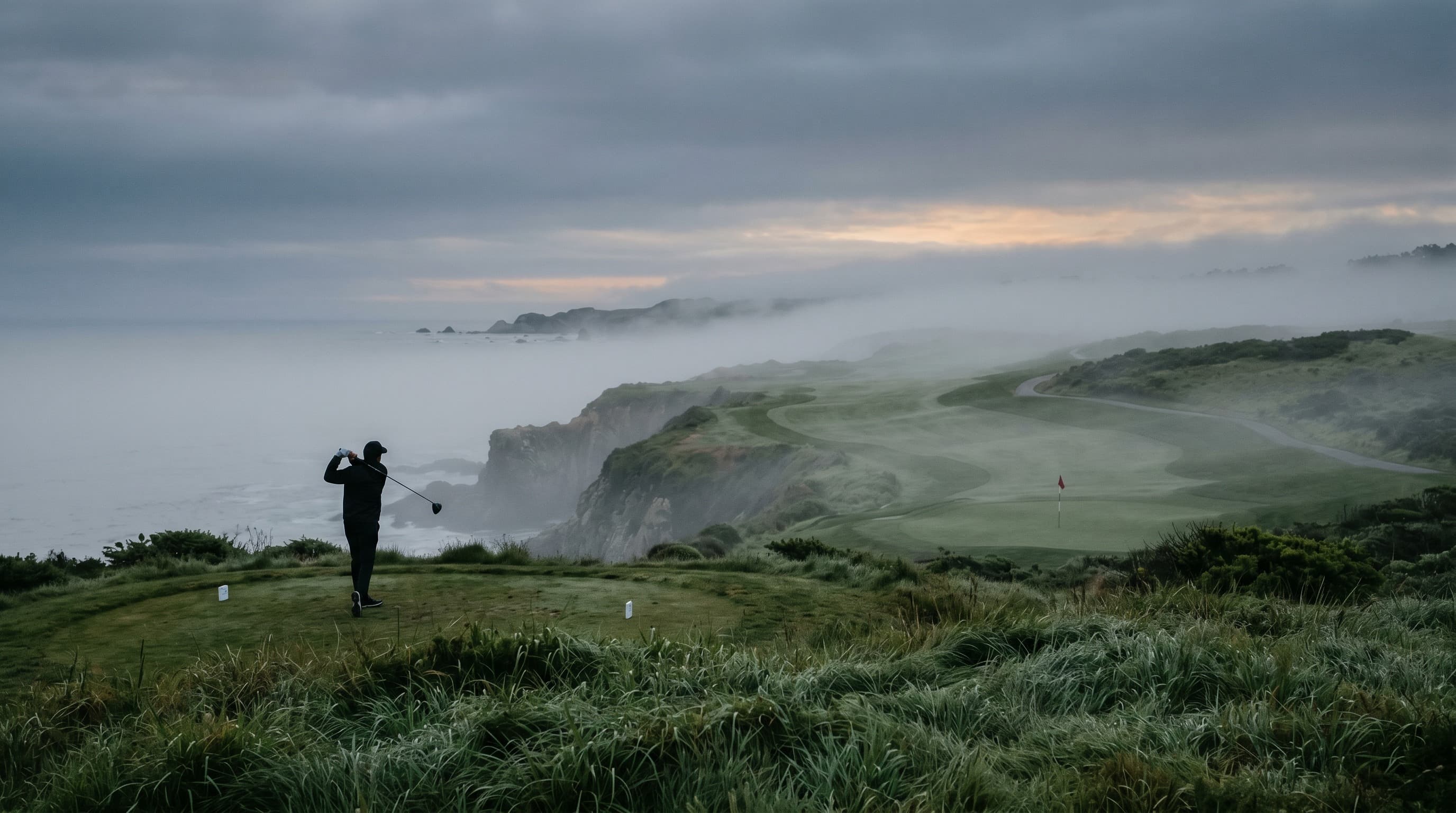
Reading Coastal Wind: How the Marine Layer Reshapes Pebble Beach, Bandon, and the Pacific Coast Game
Coastal golf does not play by inland rules. The marine layer suppresses wind in the morning, then releases it through midday in a thermal cycle that turns a calm 7am tee into a 22mph back nine. Here is the meteorology behind the pattern, the G-Score data that confirms it across the Pacific coast, and the morning workflow that turns the marine layer from a confusion into a competitive advantage.
Read Story
How to Read a G-Score: The 0–100 Golf Playability Number, Decoded
A G-Score on this site is a single 0–100 number that tells you whether today is worth tee-up. Here is exactly what each band means, what drives the calculation, and how to use it to plan a round you will actually score on.
Read StoryMinSu Kim
Founder & Golf Data Analyst
MinSu is a data analyst and golfer with 10+ years on the course. He built Golf Weather Score to answer one question: is today a good day to play? He combines weather data, course intelligence, and the proprietary G-Score algorithm to help golfers make smarter decisions.
Every Friday Morning
When Bradshaw Ranch Golf Course plays best next weekend.
Friday 6am ET: peak G-Score windows for Bradshaw Ranch Golf Course, wind direction by hour, and one gear call. Three minutes to read, save you the round.
One email a week. Unsubscribe in one click.
The Caddie's Oracle
Draw your luck before the tee off