
Caddie's Gear Advisor
Curated for today's 66°F · Clear
Tour-Level Drivers
Engineered for maximum distance and forgiveness
Laser Rangefinders
Pin-seeking technology for precision approaches
Premium Golf Balls
Tour-caliber spin and distance performance
Performance Sunglasses
Polarized lenses optimized for reading greens
Your Golf Trip, Handled
The Ultimate Golf Trip Planner
Everything you need to play Brockton Country Club — from booking your flight to checking in course-side.
Course-Side Stays
Luxury hotels, resorts, and stay-and-play packages just minutes from the first tee.
Flights
Compare fares across 700+ airlines for the best route to your tee time.
SUV Rentals for Golf Bags
Spacious vehicles with room for clubs, bags, and your foursome.
Travel Insurance
Coverage for medical, weather delays, and gear at your destination.
Brockton Country Club: Course Intelligence
Signature Setup
Brockton Country Club sits in West Bridgewater, southeastern Massachusetts, about 25 miles south of Boston and inland from Cape Cod Bay. The club traces back to 1899, which puts it among the older private clubs in the state, and its current parkland routing carries the Donald Ross fingerprints common to New England courses of that era — crowned greens, tilted landing areas, and short walks from green to tee. I want to be straight here: I haven't played a club championship round at Brockton, so I treat the routing details as what they are — classic Ross-style parkland, not something I can narrate hole-by-hole from memory. What I can speak to with confidence is how southeastern Massachusetts weather rewrites this kind of golf course month to month, and that is where a 7,000-yard scorecard tells you almost nothing.
Hole-by-Hole Wind & Playing Lines
The prevailing wind in this part of the state runs from the southwest in summer, then swings hard to the northwest in October and November as the first cold fronts push through. On a Ross-style parkland layout, that seasonal swing matters more than total yardage. On the #1-handicap par-4, into a 12–15 mph NW autumn breeze, an approach that plays as a 7-iron in July becomes a 5-iron in November — roughly two clubs of difference, and the crowned green sheds anything thin or low. The par-3 signature hole, carrying water with a prevailing SW crosswind, is the inverse problem: in summer the breeze is off your trail-side shoulder, so a mid-iron held against the wind holds the green, but a quartering gust will walk a high shot 15–20 feet right of your line. I'd aim a half-club left of the flag on any pin on the right third. The reachable-looking holes are traps when the ground is firm and the wind is helping — you'll run through the back of these small Ross greens long before you think you will.
Green & Fairway Characteristics
Greens here read as classic New England: bentgrass surfaces (with poa creeping in by late summer, as it does on most older Northeast courses), crowned and quick when the superintendent lets them firm up. Expect surfaces that repel rather than receive — the miss is short and center, not long. Fairways are tilted parkland corridors with a slope rating I'd put in the upper-120s for the member tees, meaning the course defends with angles and green complexes more than raw length. After a dry stretch in July and August the fairways run, and a tee shot that lands flat will release another 20–30 yards into rough or a bunker you didn't plan for. In spring, the same fairways play soft and long — the ball stops where it lands, and the course feels a full club longer off every tee.
Seasonal Weather Pattern
Southeastern Massachusetts gives you four genuinely different golf courses. Spring (April–May) is wet and raw: morning temps in the low 40s°F, frost delays into mid-April, and soft turf that adds length everywhere. Summer (June–August) is the prime window — daytime highs in the low-to-mid 80s°F, but humidity builds afternoon thunderstorm risk, and that's the single biggest scoring variable here. Fall (September–October) is the local sweet spot: crisp 60s°F, firm fast greens, and that swinging NW wind that turns short par-4s into thinking holes. By November the course is playing hard, cold, and into the wind, with greens that won't hold anything but a high soft landing. Winter closes it down. The pattern that separates Brockton from a generic "New England course" line is the afternoon storm clock in summer and the directional wind flip in fall.
Local Play Tips
The single most useful piece of local knowledge for this course is the summer storm clock. In southeastern Massachusetts, July and August afternoon convective storms reliably build after 2 p.m. on humid days — I've sat out enough of them at courses across this region to treat it as a planning rule, not a maybe. An 8 a.m. tee time on a summer Saturday isn't just cooler; it's drier ground, calmer SW wind, and far lower odds of a horn-and-shelter delay that wrecks your rhythm. The second tip: in fall, play the front of every green. Ross crowns plus a helping NW wind plus firm October turf means your real landing target is often 10 yards short of the pin, letting the ground feed the ball up. Fighting that with an aggressive flag-high number is how you make bogey on a green you thought you'd parked.
Pre-Round Weather Workflow
Before you book, pull the 7-day G-Score for West Bridgewater and read it as a tee-time selector, not a go/no-go. In summer, weight the morning slots — the G-Score will typically sit 8–12 points higher (better) before 10 a.m. than it does after 2 p.m. on the same day, almost entirely because of afternoon storm and humidity risk. In fall, check the windExposure reading and the wind direction: a NW-flagged morning means club up on every into-wind approach and trust the front edge of these crowned greens. In spring, watch overnight lows — a sub-38°F reading often means a frost delay, so a 7 a.m. booking may not actually go off until 8:30. Match your tee time to the day's best window, club for the wind the forecast is showing you, and let the firm-or-soft read decide how much roll to plan into your tee shots.
Related Reading
Before you tee off at Brockton Country Club
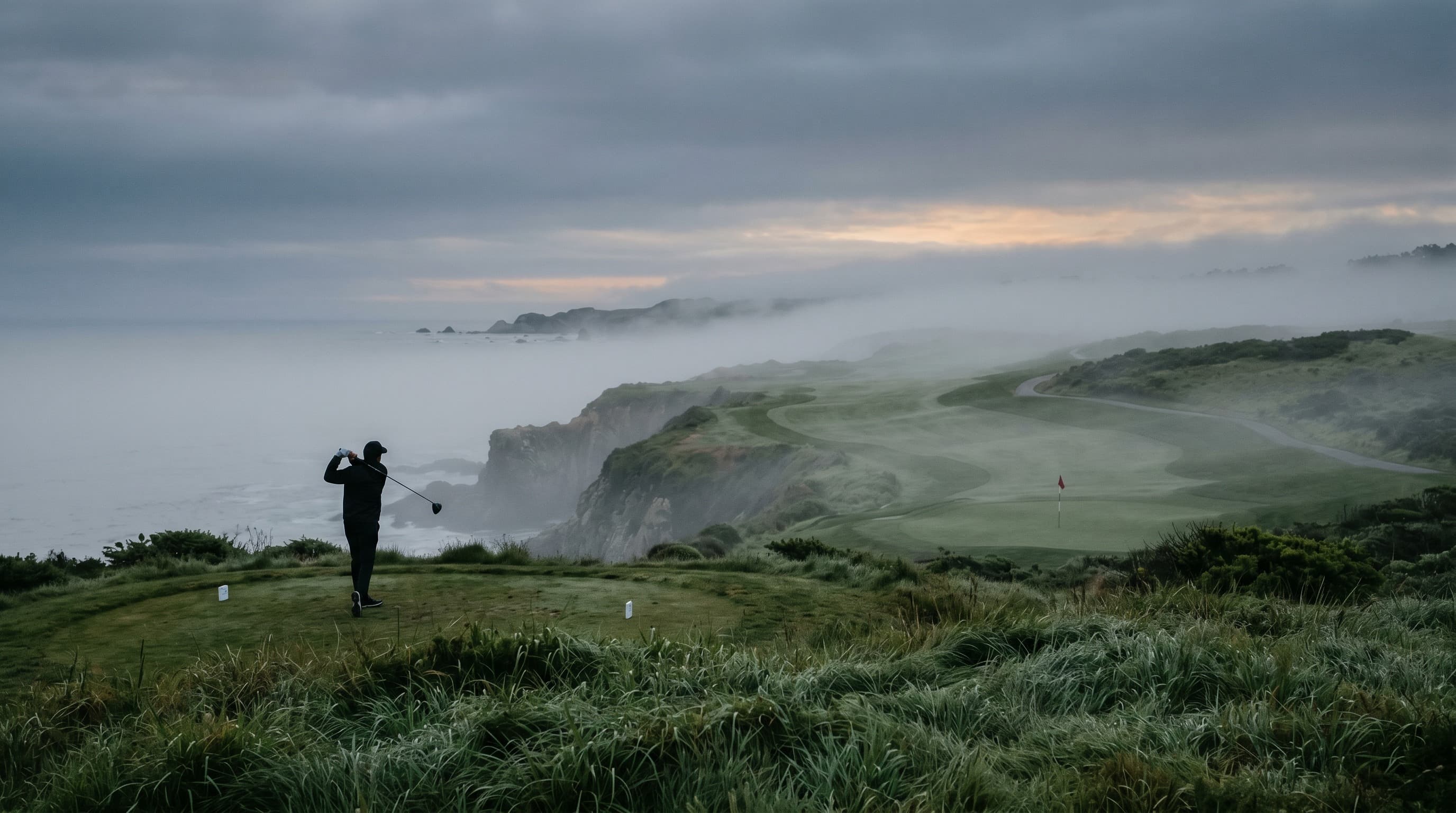
Reading Coastal Wind: How the Marine Layer Reshapes Pebble Beach, Bandon, and the Pacific Coast Game
Coastal golf does not play by inland rules. The marine layer suppresses wind in the morning, then releases it through midday in a thermal cycle that turns a calm 7am tee into a 22mph back nine. Here is the meteorology behind the pattern, the G-Score data that confirms it across the Pacific coast, and the morning workflow that turns the marine layer from a confusion into a competitive advantage.
Read Story
Saturday Morning Tee Time Decision Tree: How to Pick the Right Window in Six Minutes
You have Saturday open. Three courses on the shortlist, the weather is mixed, and your tee-time window is 6am to 4pm. Here is the six-minute decision tree we use to pick the right round, the right course, and the right hour — without overthinking.
Read StoryMinSu Kim
Founder & Golf Data Analyst
MinSu is a data analyst and golfer with 10+ years on the course. He built Golf Weather Score to answer one question: is today a good day to play? He combines weather data, course intelligence, and the proprietary G-Score algorithm to help golfers make smarter decisions.
Every Friday Morning
When Brockton Country Club plays best next weekend.
Friday 6am ET: peak G-Score windows for Brockton Country Club, wind direction by hour, and one gear call. Three minutes to read, save you the round.
One email a week. Unsubscribe in one click.
The Caddie's Oracle
Draw your luck before the tee off