
Caddie's Gear Advisor
Curated for today's 102°F · Clear
Ultralight Distance Drivers
Maximum carry in hot, low-drag conditions
UV Protection Apparel
UPF 50+ cooling fabrics for peak-sun rounds
Precision Rangefinders
Slope-adjusted yardage in any condition
Hydration & Cooling
Insulated bottles and cooling towels
Your Golf Trip, Handled
The Ultimate Golf Trip Planner
Everything you need to play Calabasas Golf and Country Club — from booking your flight to checking in course-side.
Course-Side Stays
Luxury hotels, resorts, and stay-and-play packages just minutes from the first tee.
Flights
Compare fares across 700+ airlines for the best route to your tee time.
SUV Rentals for Golf Bags
Spacious vehicles with room for clubs, bags, and your foursome.
Travel Insurance
Coverage for medical, weather delays, and gear at your destination.
Calabasas Golf and Country Club: Course Intelligence
Signature Setup
The scorecard at Calabasas reads short — about 6,323 yards, par 72 — and first-timers assume that means easy. It doesn't. Robert Trent Jones Sr. routed the course in 1968 with his son Robert Trent Jones Jr. involved, and the Joneses never gave away yardage for free: what Calabasas lacks in length it takes back with elevation change and a wind that funnels through the Santa Monica Mountains every afternoon. The front nine sits lower and flatter near the valley floor; the back nine climbs into the foothills, and that is where the round is decided.
Hole-by-Hole Wind & Playing Lines
The defining variable here is the WSW canyon wind that builds most afternoons once the morning marine layer burns off. The longer back-nine par-4s play uphill and into that wind — a double penalty. On a calm 8 a.m. tee time, a mid-iron approach is a mid-iron approach. By 1–2 p.m., the same shot needs one to two extra clubs, and a ball that lands short rolls back down the slope rather than releasing forward. The smart play on the uphill approaches is to take more club than your eyes want and aim for the back-center of the green; short-siding yourself below a pin on a firm, grainy surface is how good rounds leak strokes.
Green & Fairway Characteristics
Like most LA-basin parkland courses, Calabasas runs kikuyu-dominant fairways. Kikuyu sits the ball up nicely in the morning but grabs the clubhead through impact, so it rewards a steeper, ball-first strike over a sweeping one. The greens are mid-speed and, by midsummer, firm with noticeable grain — putts that look downhill can be slowed by grain running into you, and vice versa. Read the grain, not just the slope. With the course measuring only ~6,323 yards, your scoring clubs are wedges and short irons, so spin and trajectory control matter more than driver distance.
Seasonal Weather Pattern
Calabasas (34.14°N) is hot-dry Mediterranean. Summer afternoons regularly hit the high 80s to mid-90s°F, while mornings start near 60°F under the coastal marine layer that pushes inland overnight. Fall brings Santa Ana events — dry offshore winds that flip the usual pattern and can gust hard from the NE for a day or two at a stretch. Winter is the sleeper season: daytime highs in the 60s, soft turf, almost no wind in the mornings, and the foothills at their greenest after rain.
Local Play Tips
I haven't teed it up at Calabasas myself, so I'm leaning on regional weather records and a decade of playing Santa Monica Mountains golf rather than a personal scorecard here — and the single most reliable lever in this corridor is the clock. The marine layer that sits over Calabasas until mid-to-late morning is your friend: it keeps the kikuyu soft and the greens slow. Get out before 9 a.m. and you play a different, gentler course than the afternoon group does. If you can only get an afternoon slot, accept that the wind will cost you and play more conservative target lines into the foothill greens.
Pre-Round Weather Workflow
Check the 7-day G-Score for Calabasas the night before and the morning of. Watch two things specifically: (1) marine layer / morning low — a cooler, cloudier morning means softer, slower conditions, so trust your normal yardages; (2) afternoon wind and Santa Ana flag — if the windExposure reading spikes WSW (or NE during a Santa Ana), add a club to every uphill back-nine approach and expect 2–4 more strokes than a calm round. The pattern in this canyon is consistent: calm and soft early, firm and breezy late. Let the G-Score tell you which course you're going to get.
> Sources: course facts via GolfLink and GOLF Course Finder; regional climate from NOAA/NWS Los Angeles historical norms.
Related Reading
Before you tee off at Calabasas Golf and Country Club
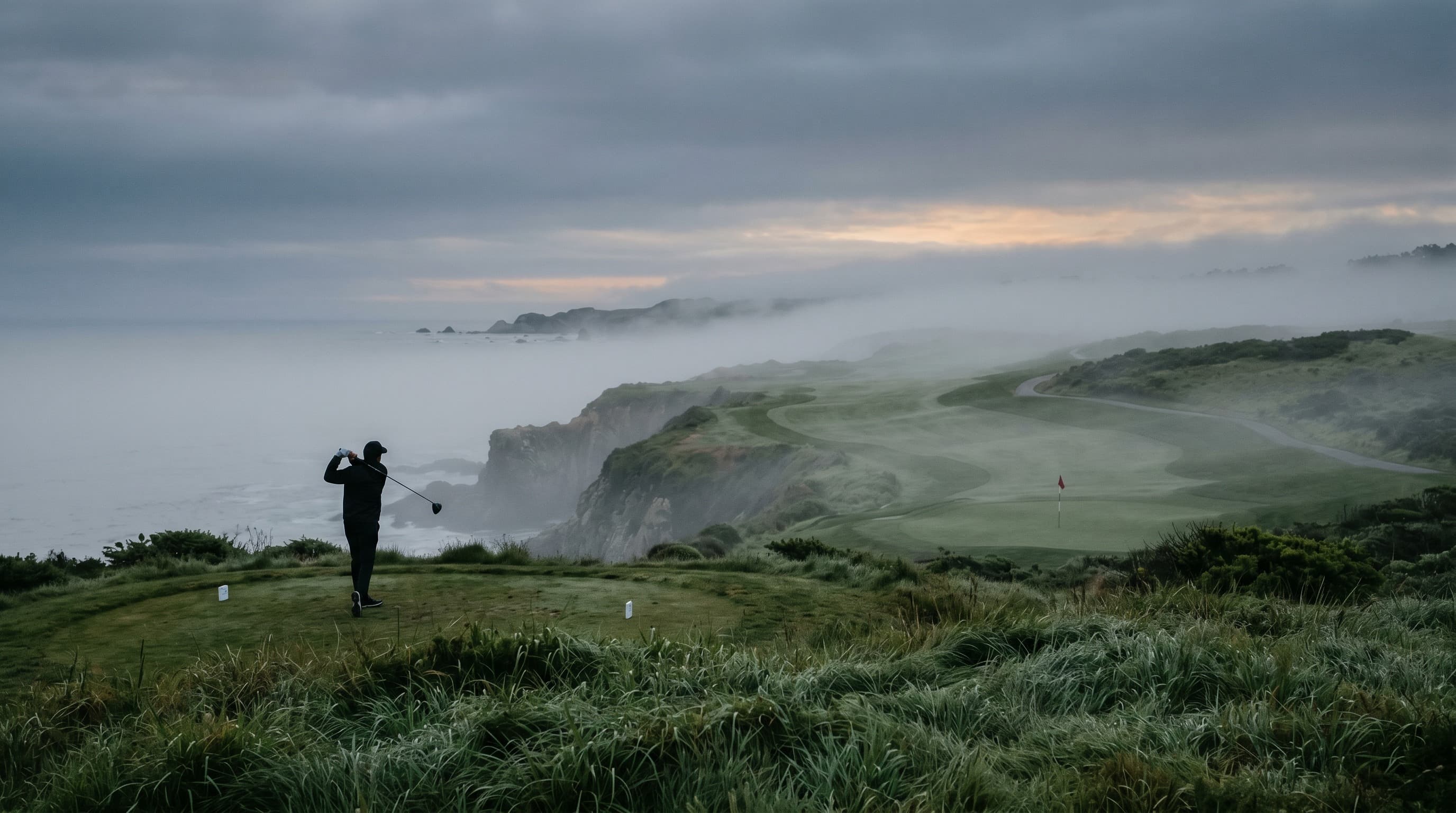
Reading Coastal Wind: How the Marine Layer Reshapes Pebble Beach, Bandon, and the Pacific Coast Game
Coastal golf does not play by inland rules. The marine layer suppresses wind in the morning, then releases it through midday in a thermal cycle that turns a calm 7am tee into a 22mph back nine. Here is the meteorology behind the pattern, the G-Score data that confirms it across the Pacific coast, and the morning workflow that turns the marine layer from a confusion into a competitive advantage.
Read Story
How to Read a G-Score: The 0–100 Golf Playability Number, Decoded
A G-Score on this site is a single 0–100 number that tells you whether today is worth tee-up. Here is exactly what each band means, what drives the calculation, and how to use it to plan a round you will actually score on.
Read StoryMinSu Kim
Founder & Golf Data Analyst
MinSu is a data analyst and golfer with 10+ years on the course. He built Golf Weather Score to answer one question: is today a good day to play? He combines weather data, course intelligence, and the proprietary G-Score algorithm to help golfers make smarter decisions.
Every Friday Morning
When Calabasas Golf and Country Club plays best next weekend.
Friday 6am ET: peak G-Score windows for Calabasas Golf and Country Club, wind direction by hour, and one gear call. Three minutes to read, save you the round.
One email a week. Unsubscribe in one click.
The Caddie's Oracle
Draw your luck before the tee off