
Caddie's Gear Advisor
Curated for today's 90°F · Thunderstorm
Storm-Ready Outerwear
Waterproof layers built for 18 holes in the rain
Tour-Grade Umbrellas
68" double-canopy wind-resistant coverage
Wet-Weather Gloves
All-weather grip that performs in the rain
Waterproof Golf Shoes
Keep your feet dry through every fairway
Your Golf Trip, Handled
The Ultimate Golf Trip Planner
Everything you need to play Cypress Point Golf Club — from booking your flight to checking in course-side.
Best time to golf in FloridaCourse-Side Stays
Luxury hotels, resorts, and stay-and-play packages just minutes from the first tee.
Flights
Compare fares across 700+ airlines for the best route to your tee time.
SUV Rentals for Golf Bags
Spacious vehicles with room for clubs, bags, and your foursome.
Travel Insurance
Coverage for medical, weather delays, and gear at your destination.
Cypress Point Golf Club: Course Intelligence
Signature Setup
The 16th at Cypress Point is shorter in the photographs than it feels when you are standing on the tee with the Pacific between you and the green. I have not played Cypress — it is invitation-only, one of the most closed clubs in American golf — but I have walked the Monterey Peninsula in October at 52°F with the marine layer still hanging over the cypress, and I know what 231 yards of open-ocean carry asks of a 9-handicap.
Alister MacKenzie routed the course in 1928 across three distinct landscapes — inland forest, sand dunes, and the rocky Pacific shelf — and that variety is the design's whole identity. The club hosted the Bing Crosby Pro-Am from 1947 until it withdrew in 1991, and it has stayed deliberately small and private ever since. Par is 72 over roughly 6,524 yards, which sounds short until the wind arrives.
Hole-by-Hole Wind & Playing Lines
Hole 16 (par-3, 231y). MacKenzie's most photographed hole and a genuine decision, not a formality. On a calm morning a long player can take the direct line across the water; into a 15 mph onshore NW wind the carry becomes unreasonable, and the smart play is the bail-out left toward the safe landing area, accepting a pitch-and-putt for par.
Hole 17 (par-4, 393y). A double dogleg that bends around the cove with a stand of cypress guarding the right side of the fairway. Into the quartering NW wind the tee shot is the hardest swing on the property — I would lay back to a 150-yard approach rather than gamble on a longer carry that the wind can knock down into the rocks.
Hole 15 (par-3, 143y). The short ocean par-3 just before its famous big brother. It looks like a flick wedge, but the same onshore wind that builds across the cove can turn 143 yards into a committed 8-iron, and the green falls away toward the water on the right.
Green & Fairway Characteristics
The greens are a Poa-and-bent surface that rolls true in the cool morning and gets grainier as the marine layer burns off. The dunes fairways through the middle of the round drain and firm up faster than Pebble's heavier turf, so a well-struck drive releases hard — plan for extra roll, not soft landings. The slope sits around 136 with a course rating near 71.5 from the back, numbers that read modest but understate how exposed the closing ocean holes are once the wind is up.
Seasonal Weather Pattern
Monterey's coast stays mild year-round, generally 50–63°F, but Cypress sits where forest, dune, and ocean meet, so the microclimate shifts hole to hole. The cypress-forest holes hold morning fog and damp longer; the dune holes dry first; the three ocean holes feel the onshore wind earliest and hardest. Summer (June–August) brings the heaviest marine layer, often lingering past 11 a.m. The clearest, calmest windows I have found on this peninsula are late September through early November.
Local Play Tips
Here is the read that matters: the wind on 16 and 17 is consistently stronger and more directional than what you feel on the inland front nine, because the cove funnels it. Whatever the tee-box flag suggests, add a club and a half on the ocean approaches. And do not trust a "safe right" miss on 17 — the cypress and the rocks both live on that side.
Pre-Round Weather Workflow
Use the 7-day G-Score on this page the way I would. Three days out, check whether your round reaches the 15–16–17 stretch before or after the late-morning onshore build — that single timing factor moves the score 7–10 points. The morning of, read the windExposure panel: an NW or W reading means the ocean holes play into the teeth of it, so favor conservative lines and club up. If the marine layer reads heavy and temperatures sit below 55°F, expect zero release on the shaded forest holes and one extra club into every green.
Related Reading
Before you tee off at Cypress Point Golf Club
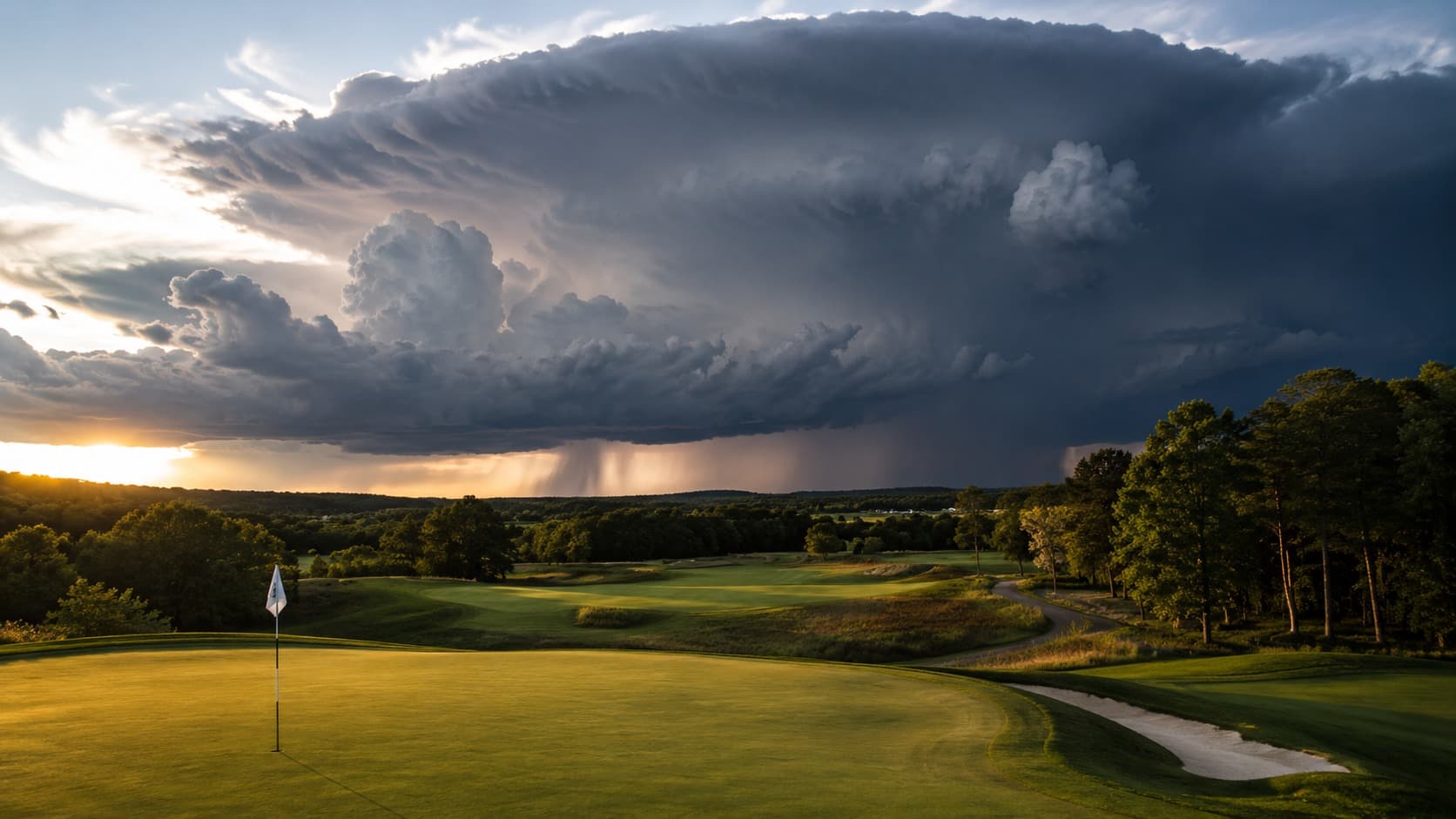
The Three O’Clock Storm: Reading Summer’s Convective Cycle to Protect Your Round
A 40% chance of afternoon thunderstorms does not mean a 40% chance of getting rained on. In the summer convective season it means the morning is nearly clear and the afternoon carries a fast-building, high-energy storm risk driven by a daily heating cycle. Here is the meteorology behind the pattern, the G-Score data on how the storm cycle punishes afternoon tee times across the Southeast, Midwest, and desert Southwest, the lightning-safety decision tree that actually matters, and the workflow that gets you off the course before the first bolt.
Read Story
How to Read a G-Score: The 0–100 Golf Playability Number, Decoded
A G-Score on this site is a single 0–100 number that tells you whether today is worth tee-up. Here is exactly what each band means, what drives the calculation, and how to use it to plan a round you will actually score on.
Read StoryDanorie
Editorial & Data
Golf Weather Score is built by Danorie. We compute the G-Score — our own playability rating — from live NOAA forecasts and published course scorecards, so any US course can be compared on any day with a single number. Methodology and data sources are documented on every page.
Every Friday Morning
When Cypress Point Golf Club plays best next weekend.
Friday 6am ET: peak G-Score windows for Cypress Point Golf Club, wind direction by hour, and one gear call. Three minutes to read, save you the round.
One email a week. Unsubscribe in one click.
The Caddie's Oracle
Draw your luck before the tee off