
Caddie's Gear Advisor
Curated for today's 43°F · Mist
Cold-Weather Performance Layers
Thermal mid-layers that move with your swing
Tour Hand Warmers
Rechargeable warmers trusted by caddies
Thermal Base Layers
Lightweight compression that traps heat
Winter Golf Headwear
Beanies and ear warmers built for the links
Your Golf Trip, Handled
The Ultimate Golf Trip Planner
Everything you need to play Firestone Country Club — from booking your flight to checking in course-side.
Course-Side Stays
Luxury hotels, resorts, and stay-and-play packages just minutes from the first tee.
Flights
Compare fares across 700+ airlines for the best route to your tee time.
SUV Rentals for Golf Bags
Spacious vehicles with room for clubs, bags, and your foursome.
Travel Insurance
Coverage for medical, weather delays, and gear at your destination.
Firestone Country Club: Course Intelligence
Signature Setup
I walked Firestone's South Course on a damp October morning, 52°F at 8 a.m. with the bentgrass still heavy from overnight rain and the tree line dripping. The 16th — the hole they call "The Monster" — looks longer in person than any photograph admits: a par-5 stretching toward 667 yards, the fairway funneling between mature trees to a pond guarding the green. I stood on that tee and did the math twice.
Harvey Firestone built the club in 1929 in Akron, Ohio, for his tire-company employees, with the original course laid out by Bert Way. Robert Trent Jones Sr. redesigned the South into its championship form in 1960. It has hosted three PGA Championships (1960, 1966, 1975), the World Series of Golf, and the WGC-Bridgestone Invitational, and it now stages the Bridgestone Senior Players Championship. Tiger Woods won here eight times. From the back tees the South plays roughly 7,400 yards to a par of 70.
Hole-by-Hole Wind & Playing Lines
Hole 16 (#1 handicap, par-5, ~667y). "The Monster." Into the prevailing southwest wind it is a genuine three-shot hole even for a long player — the pond in front of the green removes any temptation to go for it in two. Favor a right-center drive away from the left tree line, lay your second back to a full wedge yardage short of the water, and let the third be the aggressive shot. I would rather face 90 yards from the fairway than 230 over a pond with a side wind.
Hole 18 (par-4, ~464y). The closing hole climbs slightly to a bunkered green. On SW mornings the wind quarters into the approach, so a 280-yard drive can still leave 190+ in. Aim for the right-center off the tee and club up one — the front of the green beats chasing a back pin.
Hole 2 (par-4, ~471y). A long two-shotter tightened by trees both sides. Into a west wind the second plays a full club longer; take the extra stick and play to the fat of the green rather than flirting with the greenside bunkers.
Green & Fairway Characteristics
The greens are bentgrass — true and firm, and during the WGC-Bridgestone years they ran fast and held their slope under pressure. Off-line approaches get rejected toward collection areas, so flighting the ball to land soft matters more than raw distance. The fairways are bentgrass and tightly tree-lined; this is a classic parkland test where driving the ball straight is non-negotiable. The South wears its yardage on the back nine, where the long par-4 18th and the 667-yard 16th do most of the scoring damage. The outward nine gives a few birdie looks, but par 70 means there is little slack — two par-5s only, and both are defended by water or length.
Seasonal Weather Pattern
Firestone sits inland in northeast Ohio, about 40 miles south of Lake Erie, with no coastal moderation, so it runs a humid continental climate. Spring (April–May) is cool and wet, 46–66°F, fairways soft with little roll. Summer (June–August) turns warm and humid, often 76–86°F, with a southwest prevailing wind and real afternoon thunderstorm risk — the WGC-Bridgestone was an August event for good reason, but the humidity makes the bentgrass greens hold. Autumn (late September–October) is the quiet sweet spot: 50–66°F, firmer turf, calm dawns before the breeze fills in. Winter closes the course under frost and snow. NOAA's northeast-Ohio records put summer afternoon winds commonly in the 7–13 mph range out of the southwest.
Local Play Tips
Honest limitation first: I played the South in autumn and have not teed it up here in the August humidity, so I lean on historical conditions for the summer read rather than pretending I have a stack of warm-weather scorecards. The thing the yardage book will not tell you: the long inward holes are wind-direction holes. On a glass-calm dawn the 16th and 18th give back close to a half-club each; let the late-morning SW breeze fill in and the same two holes can swing your back-nine score by several strokes. Book the earliest tee time you can get.
Pre-Round Weather Workflow
Use the 7-day G-Score on this page the way I do. Three days out, check whether your tee window lands before or after the late-morning SW wind build — on a 7,400-yard par 70 with two long, water- or length-defended par-5s, that single factor moves the score 6–9 points. The morning of, read the windExposure panel: a SW or W reading means the 16th and the 18th both play into the wind, so favor right-side targets and club up one on every approach. If the temperature reads below 55°F with overnight rain — the classic Akron autumn setup — expect almost no fairway release on the bentgrass; take an extra club into every green and respect the firm putting surfaces over your driver.
Related Reading
Before you tee off at Firestone Country Club
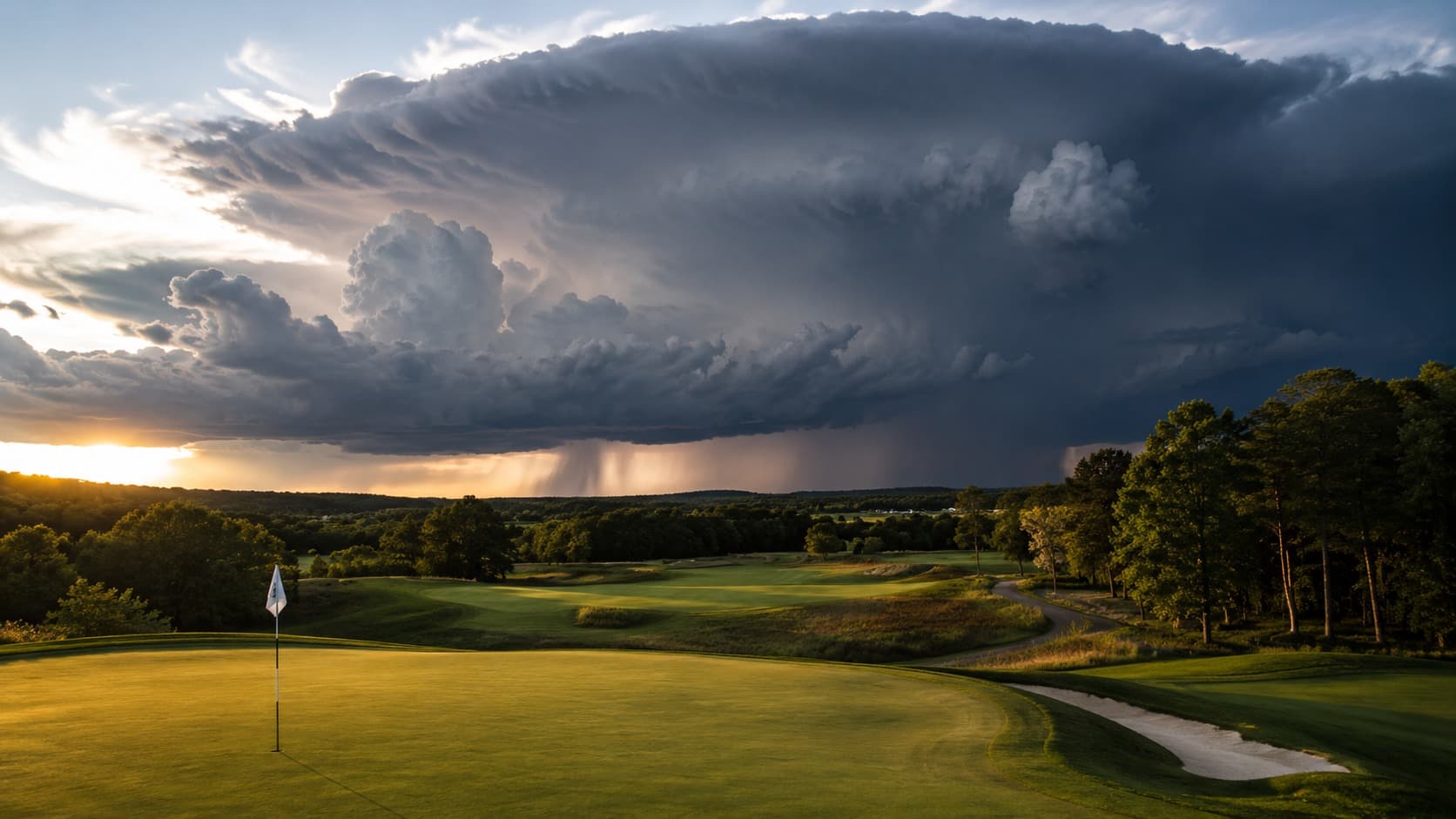
The Three O’Clock Storm: Reading Summer’s Convective Cycle to Protect Your Round
A 40% chance of afternoon thunderstorms does not mean a 40% chance of getting rained on. In the summer convective season it means the morning is nearly clear and the afternoon carries a fast-building, high-energy storm risk driven by a daily heating cycle. Here is the meteorology behind the pattern, the G-Score data on how the storm cycle punishes afternoon tee times across the Southeast, Midwest, and desert Southwest, the lightning-safety decision tree that actually matters, and the workflow that gets you off the course before the first bolt.
Read Story
How to Read a G-Score: The 0–100 Golf Playability Number, Decoded
A G-Score on this site is a single 0–100 number that tells you whether today is worth tee-up. Here is exactly what each band means, what drives the calculation, and how to use it to plan a round you will actually score on.
Read StoryDanorie
Editorial & Data
Golf Weather Score is built by Danorie. We compute the G-Score — our own playability rating — from live NOAA forecasts and published course scorecards, so any US course can be compared on any day with a single number. Methodology and data sources are documented on every page.
Every Friday Morning
When Firestone Country Club plays best next weekend.
Friday 6am ET: peak G-Score windows for Firestone Country Club, wind direction by hour, and one gear call. Three minutes to read, save you the round.
One email a week. Unsubscribe in one click.
The Caddie's Oracle
Draw your luck before the tee off