
Caddie's Gear Advisor
Curated for today's 46°F · Clear
Cold-Weather Performance Layers
Thermal mid-layers that move with your swing
Tour Hand Warmers
Rechargeable warmers trusted by caddies
Thermal Base Layers
Lightweight compression that traps heat
Winter Golf Headwear
Beanies and ear warmers built for the links
Your Golf Trip, Handled
The Ultimate Golf Trip Planner
Everything you need to play Medinah Country Club — from booking your flight to checking in course-side.
Course-Side Stays
Luxury hotels, resorts, and stay-and-play packages just minutes from the first tee.
Flights
Compare fares across 700+ airlines for the best route to your tee time.
SUV Rentals for Golf Bags
Spacious vehicles with room for clubs, bags, and your foursome.
Travel Insurance
Coverage for medical, weather delays, and gear at your destination.
Medinah Country Club: Course Intelligence
Signature Setup
I walked Course No. 3 as a member's guest on a humid June morning, 71°F at 7:30 a.m. with the air already heavy and still — the kind of Chicago summer day where the ball travels well early and the greens are receptive before the sun bakes them. Standing on the 17th tee, the par-3 over Lake Kadijah, the green looked closer than its yardage because the shot plays downhill; I clubbed down one and watched the water do its intimidating work anyway.
Tom Bendelow routed Medinah's Course No. 3 in 1928 in the northwest Chicago suburb of Medinah, Illinois. It is one of the most decorated championship venues in American golf: three U.S. Opens (1949 Cary Middlecoff, 1975 Lou Graham, 1990 Hale Irwin), two PGA Championships (1999 and 2006, both won by Tiger Woods), and the 2012 Ryder Cup — Europe's "Miracle at Medinah" Sunday comeback. From the back tees it measures roughly 7,657 yards to a par of 72.
Hole-by-Hole Wind & Playing Lines
Hole 2 (#1 handicap, long par-4, ~440y). It climbs gently through a tree-lined corridor, and the prevailing summer SW wind funnels down the chute into your face. A 270-yard drive still leaves close to 190 in. Favor the left-center off the tee for the best angle and take one extra club on the approach; a green-side bailout pin-high left beats a hero swing that finds the trees right.
Hole 13 (par-3, ~210y over Lake Kadijah). The first of the two famous water holes. Into a SW wind off the lake the carry feels longer than the number, and there is no front bailout — it is all water short. I'd rather be long-left in the rough than rinse a half-club-short iron.
Hole 17 (signature par-3, ~190y). Downhill across the lake to a peninsula green. The drop knocks roughly a club off the yardage, but a left-to-right afternoon wind pushes weak shots into Lake Kadijah. Aim at the left third of the green and let the wind feed it back toward center.
Green & Fairway Characteristics
The greens are bentgrass and run 12–13 on the Stimp for championship setups — firm, quick, and more sloped than they photograph. A downhill 25-footer here can run eight feet by if you misjudge the grain. Fairways are bentgrass and the recent restoration work opened up many of the historically dense tree lines, so off-line drives are less automatically blocked than in the Tiger-era PGAs, though the corridors still demand a fairway finder. The back nine carries the drama: the closing four-hole stretch around Lake Kadijah is where rounds are won and lost, and the long par-4 finish leaves little margin.
Seasonal Weather Pattern
Medinah sits inland, about 25 miles west of Lake Michigan, so it gets a humid continental climate without the direct coastal moderation. Spring (April–May) is cold and wet, 45–62°F, with soft fairways that give back no roll. Summer (June–August) runs warm and humid, often 78–88°F, with a SW prevailing wind and occasional afternoon lake-breeze shifts that swing the two water par-3s. Autumn (late September–October) is the connoisseur's window: 52–68°F, firm turf, and the calmest mornings before the wind builds. Winters shut the course down under snow. NOAA's northeast-Illinois records show summer afternoon winds commonly in the 10–16 mph range out of the southwest.
Local Play Tips
Honest limitation first: Medinah is intensely private, so unless you're a member or an invited guest, your access is the rare member-guest day or a charity event — I've played it once and won't pretend to know it like a home course. The thing the yardage book won't tell you: time your round to beat the mid-morning SW breeze. The two over-water par-3s (13 and 17) are dramatically easier in dead-calm early air, and the downhill 17th in particular gives back a full club when the lake is glass.
Pre-Round Weather Workflow
Use the 7-day G-Score on this page the way I do. Three days out, check whether your tee window lands before or after the mid-morning SW wind build — on a 7,657-yard par 72 with two forced water carries, that single factor moves the score 6–9 points. The morning of, read the windExposure panel: a SW or W reading means Hole 2 and the closing par-4 both play uphill into the wind, so favor left-side targets and club up one on every approach. If the temperature reads below 55°F with overnight rain, expect zero fairway release on the bentgrass — take an extra club into every green and let the firm, fast putting surfaces, not your driver, be the part of the test you respect most.
More Courses in Illinois
View AllRelated Reading
Before you tee off at Medinah Country Club
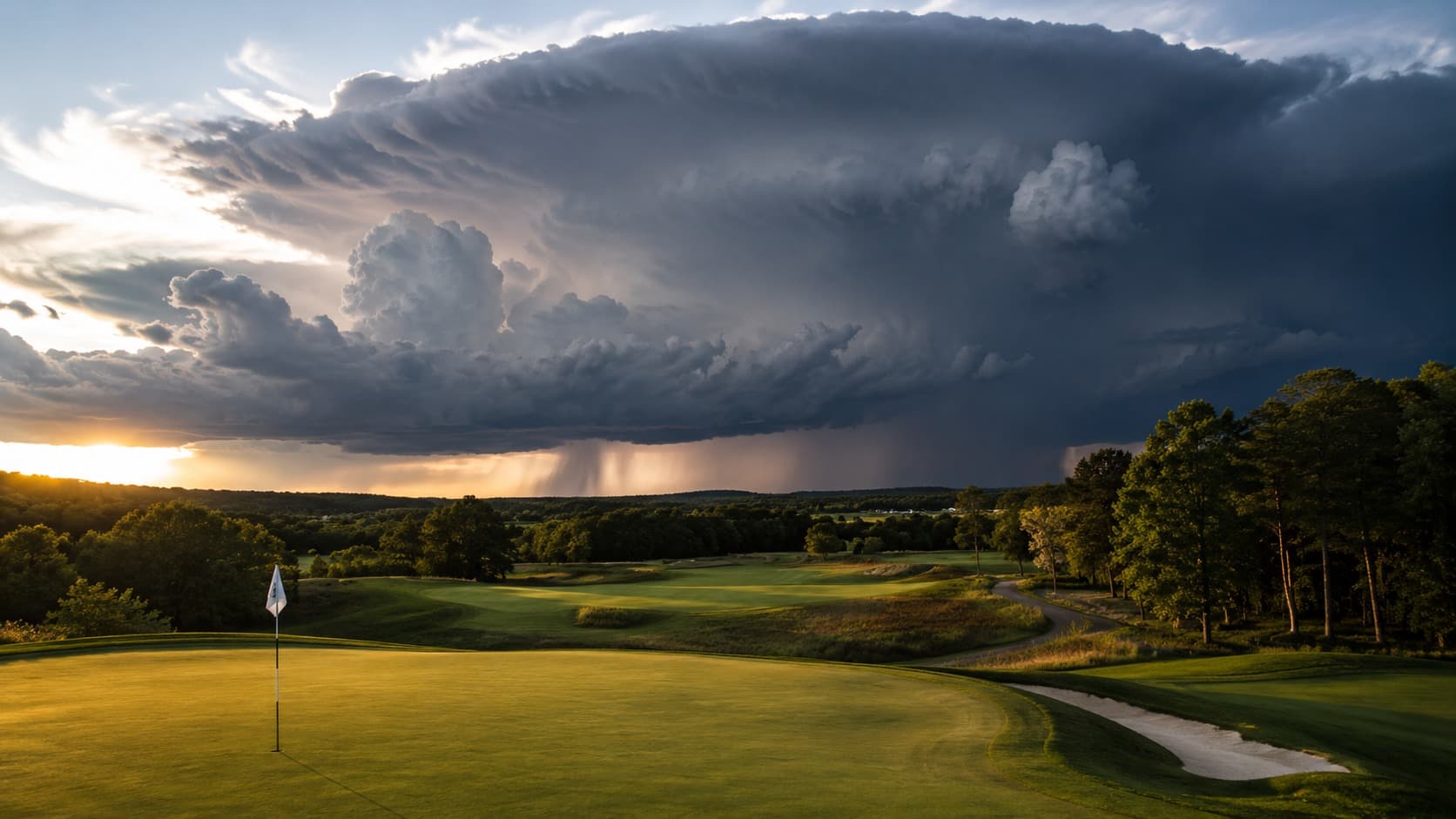
The Three O’Clock Storm: Reading Summer’s Convective Cycle to Protect Your Round
A 40% chance of afternoon thunderstorms does not mean a 40% chance of getting rained on. In the summer convective season it means the morning is nearly clear and the afternoon carries a fast-building, high-energy storm risk driven by a daily heating cycle. Here is the meteorology behind the pattern, the G-Score data on how the storm cycle punishes afternoon tee times across the Southeast, Midwest, and desert Southwest, the lightning-safety decision tree that actually matters, and the workflow that gets you off the course before the first bolt.
Read Story
How to Read a G-Score: The 0–100 Golf Playability Number, Decoded
A G-Score on this site is a single 0–100 number that tells you whether today is worth tee-up. Here is exactly what each band means, what drives the calculation, and how to use it to plan a round you will actually score on.
Read StoryDanorie
Editorial & Data
Golf Weather Score is built by Danorie. We compute the G-Score — our own playability rating — from live NOAA forecasts and published course scorecards, so any US course can be compared on any day with a single number. Methodology and data sources are documented on every page.
Every Friday Morning
When Medinah Country Club plays best next weekend.
Friday 6am ET: peak G-Score windows for Medinah Country Club, wind direction by hour, and one gear call. Three minutes to read, save you the round.
One email a week. Unsubscribe in one click.
The Caddie's Oracle
Draw your luck before the tee off