
Caddie's Gear Advisor
Curated for today's 77°F · Clear
Tour-Level Drivers
Engineered for maximum distance and forgiveness
Laser Rangefinders
Pin-seeking technology for precision approaches
Premium Golf Balls
Tour-caliber spin and distance performance
Performance Sunglasses
Polarized lenses optimized for reading greens
Your Golf Trip, Handled
The Ultimate Golf Trip Planner
Everything you need to play Pikewood National Golf Club — from booking your flight to checking in course-side.
Course-Side Stays
Luxury hotels, resorts, and stay-and-play packages just minutes from the first tee.
Flights
Compare fares across 700+ airlines for the best route to your tee time.
SUV Rentals for Golf Bags
Spacious vehicles with room for clubs, bags, and your foursome.
Travel Insurance
Coverage for medical, weather delays, and gear at your destination.
Pikewood National Golf Club: Course Intelligence
Bob Cupp and Mark Hampton designed Pikewood National in West Virginia on a piece of Morgantown mountain land that the founding members had bought specifically to build one of the most-difficult private golf courses in the eastern United States. The course opened in 2007 on a property where the elevation changes through the routing exceed three hundred feet from the highest tee to the lowest fairway. The result is one of the longest American golf courses — 7,681 yards from the back markers — combined with one of the highest slope ratings the USGA has issued to a private club: 155, which is the maximum the slope rating system allows.
The scorecard reads 7,681 yards, par 72, with a slope of 155 and a course rating of 79.7. The course rating of 79.7 is among the highest the USGA has assigned to any American private course. The four par-3s sit between 169 and 257 yards. The 257-yard fourth is the longest one-shotter on the routing and plays uphill across a mountain saddle into prevailing northwest wind. The four par-5s range from 562 to 583 yards.
The number-one handicap is the 515-yard third — a long par-4 with a tee shot that drops one hundred feet from an elevated tee down to a fairway carved into the mountain side. The 433-yard second-hardest is the par-4 sixteenth; the 583-yard third-hardest is the long par-5 ninth — the only par-5 in the top-three hardest. The course's defense at mountain elevation is the combination of distance, vertical change, and the consistent ridge-line wind that pulls full-club approaches off-line.
The West Virginia Appalachian climate keeps Pikewood playable from April through October, with the firmest fairway conditions arriving in late September and through October when the autumn temperatures lock in. The course is private and access is members-and-guests only. Walking is allowed but unusual given the elevation; carts are standard.
Related Reading
Before you tee off at Pikewood National Golf Club
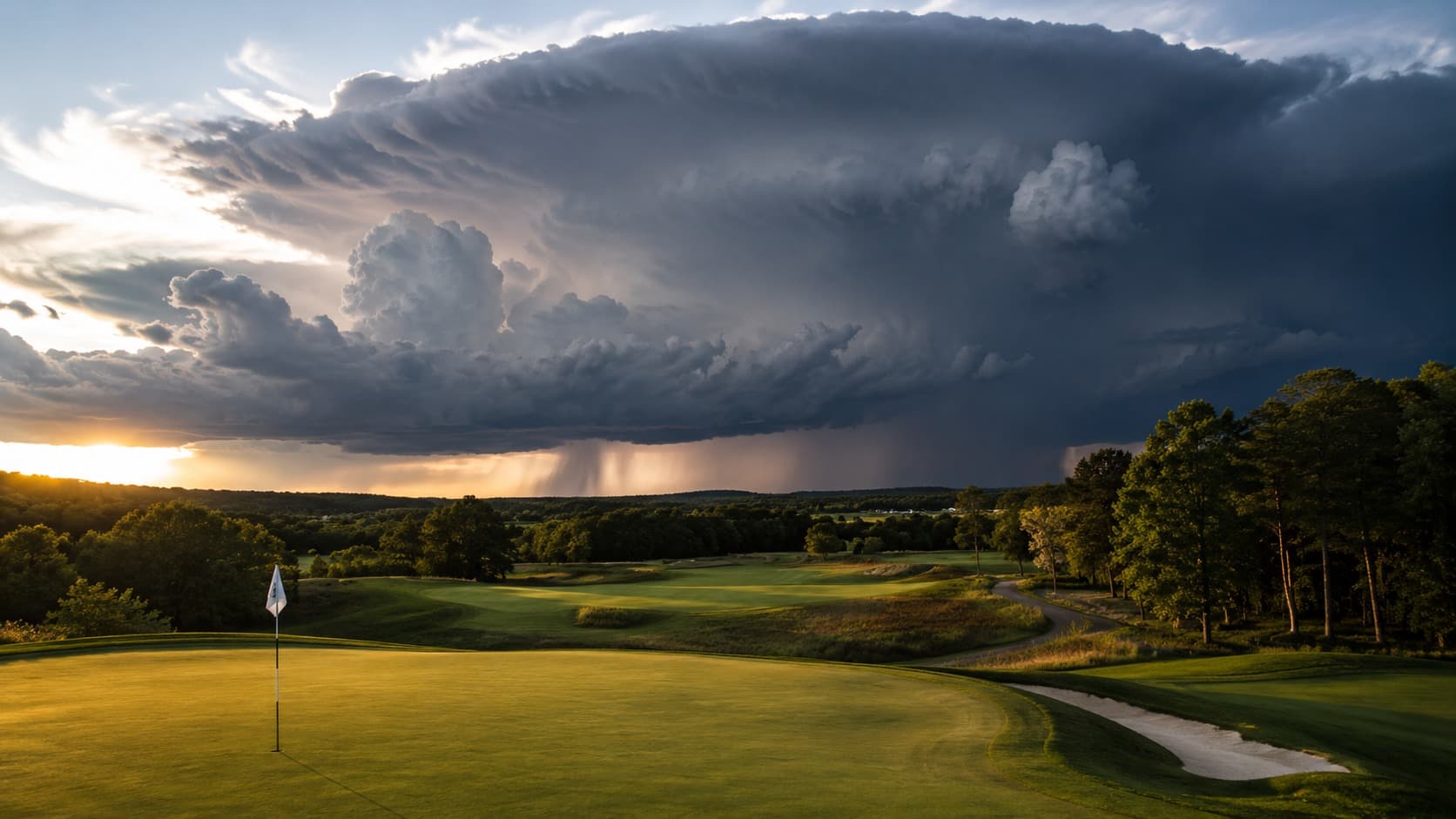
The Three O’Clock Storm: Reading Summer’s Convective Cycle to Protect Your Round
A 40% chance of afternoon thunderstorms does not mean a 40% chance of getting rained on. In the summer convective season it means the morning is nearly clear and the afternoon carries a fast-building, high-energy storm risk driven by a daily heating cycle. Here is the meteorology behind the pattern, the G-Score data on how the storm cycle punishes afternoon tee times across the Southeast, Midwest, and desert Southwest, the lightning-safety decision tree that actually matters, and the workflow that gets you off the course before the first bolt.
Read Story
How to Read a G-Score: The 0–100 Golf Playability Number, Decoded
A G-Score on this site is a single 0–100 number that tells you whether today is worth tee-up. Here is exactly what each band means, what drives the calculation, and how to use it to plan a round you will actually score on.
Read StoryMinSu Kim
Founder & Golf Data Analyst
MinSu is a data analyst and golfer with 10+ years on the course. He built Golf Weather Score to answer one question: is today a good day to play? He combines weather data, course intelligence, and the proprietary G-Score algorithm to help golfers make smarter decisions.
Every Friday Morning
When Pikewood National Golf Club plays best next weekend.
Friday 6am ET: peak G-Score windows for Pikewood National Golf Club, wind direction by hour, and one gear call. Three minutes to read, save you the round.
One email a week. Unsubscribe in one click.
The Caddie's Oracle
Draw your luck before the tee off