
Caddie's Gear Advisor
Curated for today's 65°F · Clear
Tour-Level Drivers
Engineered for maximum distance and forgiveness
Laser Rangefinders
Pin-seeking technology for precision approaches
Premium Golf Balls
Tour-caliber spin and distance performance
Performance Sunglasses
Polarized lenses optimized for reading greens
Your Golf Trip, Handled
The Ultimate Golf Trip Planner
Everything you need to play St Andrews Golf Club — from booking your flight to checking in course-side.
Course-Side Stays
Luxury hotels, resorts, and stay-and-play packages just minutes from the first tee.
Flights
Compare fares across 700+ airlines for the best route to your tee time.
SUV Rentals for Golf Bags
Spacious vehicles with room for clubs, bags, and your foursome.
Travel Insurance
Coverage for medical, weather delays, and gear at your destination.
St Andrews Golf Club: Course Intelligence
Signature Setup
The first time golf in America had a fixed home, it was here. I have not had a tee time at Saint Andrew's — it's a private club — but I have stood at the bottom of these Hudson Valley hills on neighboring Westchester courses on a 54°F October morning, and the terrain tells you everything about how this place plays before you ever see a scorecard.
The Saint Andrew's Golf Club was founded in 1888 by John Reid, a Scot from Dunfermline remembered as the father of American golf, and it is the oldest continuously operating golf club in the United States — one of the five charter members that formed the USGA in 1894. The club settled at its present site in Hastings-on-Hudson in 1897. The original 18 was laid out by William H. Tucker and Harry Tallmadge; what members play today is a Jack Nicklaus Signature redesign completed in 1983–85 and refined by Nicklaus again in 1996. The numbers that matter: 6,670 yards, par 71, a course rating of 73.6, and a slope of 145 — a slope that high on a course this short tells you the defense is terrain and green complexes, not length.
Hole-by-Hole Wind & Playing Lines
Honest framing first: I'm describing playing lines from the course record, the topography, and the same Hudson-side microclimate I've played at neighboring clubs — not from a personal round at Saint Andrew's. What that regional experience teaches transfers directly on a hill course like this one.
The uphill two-shotters. A 73.6 rating on 6,670 yards means several approaches climb, and an uphill green eats roughly a half-club in still air. Into the prevailing SW afternoon breeze that funnels up the Hudson Valley, that becomes a full club. Play a card 150 as a real 165–170 and favor the front edge.
The downhill Nicklaus holes. Where the fairway falls away, the breeze helps off the tee but firms the approach and leaves a downhill stance above a quick green. Take less club into these and accept the uphill putt.
Exposed ridge tees. On a NNW calm morning the ball flies one number; once the valley breeze builds by early afternoon it flies another. Club selection here is a wind read, not a yardage read.
Green & Fairway Characteristics
The defining trait is the grade. Saint Andrew's is routed across genuine Hudson Valley hillside, so there is rarely a flat lie, and the bentgrass/Poa greens are pitched with that natural fall rather than flattened — a ball above the hole is a three-putt risk. The fairways are tight parkland corridors over severe elevation change, which is exactly where a slope of 145 comes from on a 6,670-yard, par-71 card. This is not a course that rewards a bomber; it rewards a player who can flight the ball, judge an uneven stance, and keep approaches below the hole.
Seasonal Weather Pattern
Hastings-on-Hudson sits on the east bank of the Hudson River, so the river moderates the air and channels the afternoon breeze up the valley. Summers (June–August) run humid, often 80–88°F, with soft turf and the year's deepest rough. The prime window is September–October: 52–70°F mornings, firm greens, the steadiest air of the year. Spring (April–May) brings cool, gusty days as the still-cold river exaggerates the onshore afternoon breeze. Per NOAA's lower-Hudson records, the recurring daily pattern is a calm NNW morning giving way to a SW breeze of roughly 8–14 mph by early afternoon. Frost typically closes the course from December into March.
Local Play Tips
The members' edge here is patience on the hills. On a course where the difficulty is a slope of 145 rather than raw distance, the player who shoots their handicap is the one who stops attacking tucked pins on pitched greens and starts managing stance and leave. Before every approach, read whether your feet are above or below the ball and whether the green sits above or below you, then commit to leaving the ball under the hole. Distance control on this property is downstream of stance reading — a fact the original 1888 routing and the modern Nicklaus greens agree on completely.
Pre-Round Weather Workflow
Use the 7-day G-Score on this page the way I would for any river-valley hill course. Three days out, check whether your tee window lands before or after the SW valley breeze builds off the Hudson — on a 6,670-yard course with a 73.6 rating, that breeze adds a club to every uphill approach. The morning of, read the windExposure panel: a SW reading means the climbing holes and exposed ridge tees all stretch out, so club up and aim for the fat, low side of these pitched greens. If the temperature reads below 52°F with overnight rain, expect little release on the bentgrass/Poa surfaces — land short, let the grade feed the ball, and keep every putt below the hole.
Related Reading
Before you tee off at St Andrews Golf Club
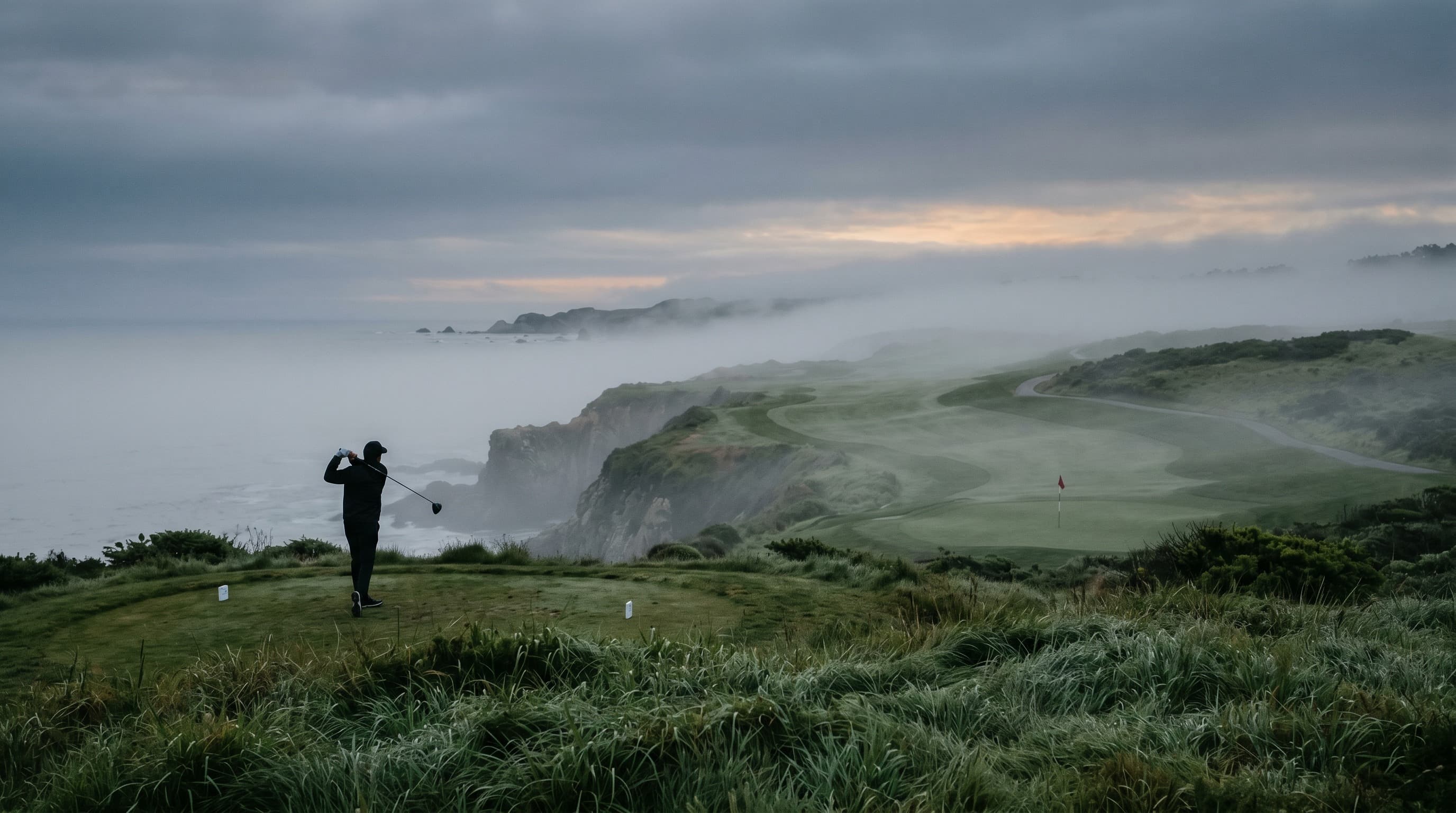
Reading Coastal Wind: How the Marine Layer Reshapes Pebble Beach, Bandon, and the Pacific Coast Game
Coastal golf does not play by inland rules. The marine layer suppresses wind in the morning, then releases it through midday in a thermal cycle that turns a calm 7am tee into a 22mph back nine. Here is the meteorology behind the pattern, the G-Score data that confirms it across the Pacific coast, and the morning workflow that turns the marine layer from a confusion into a competitive advantage.
Read Story
Saturday Morning Tee Time Decision Tree: How to Pick the Right Window in Six Minutes
You have Saturday open. Three courses on the shortlist, the weather is mixed, and your tee-time window is 6am to 4pm. Here is the six-minute decision tree we use to pick the right round, the right course, and the right hour — without overthinking.
Read StoryMinSu Kim
Founder & Golf Data Analyst
MinSu is a data analyst and golfer with 10+ years on the course. He built Golf Weather Score to answer one question: is today a good day to play? He combines weather data, course intelligence, and the proprietary G-Score algorithm to help golfers make smarter decisions.
Every Friday Morning
When St Andrews Golf Club plays best next weekend.
Friday 6am ET: peak G-Score windows for St Andrews Golf Club, wind direction by hour, and one gear call. Three minutes to read, save you the round.
One email a week. Unsubscribe in one click.
The Caddie's Oracle
Draw your luck before the tee off