
Caddie's Gear Advisor
Curated for today's 77°F · Clear
Tour-Level Drivers
Engineered for maximum distance and forgiveness
Laser Rangefinders
Pin-seeking technology for precision approaches
Premium Golf Balls
Tour-caliber spin and distance performance
Performance Sunglasses
Polarized lenses optimized for reading greens
Your Golf Trip, Handled
The Ultimate Golf Trip Planner
Everything you need to play Torrey Pines South Course — from booking your flight to checking in course-side.
Best time to golf in CaliforniaCourse-Side Stays
Luxury hotels, resorts, and stay-and-play packages just minutes from the first tee.
Flights
Compare fares across 700+ airlines for the best route to your tee time.
SUV Rentals for Golf Bags
Spacious vehicles with room for clubs, bags, and your foursome.
Travel Insurance
Coverage for medical, weather delays, and gear at your destination.
Torrey Pines South Course: Course Intelligence
Signature Setup
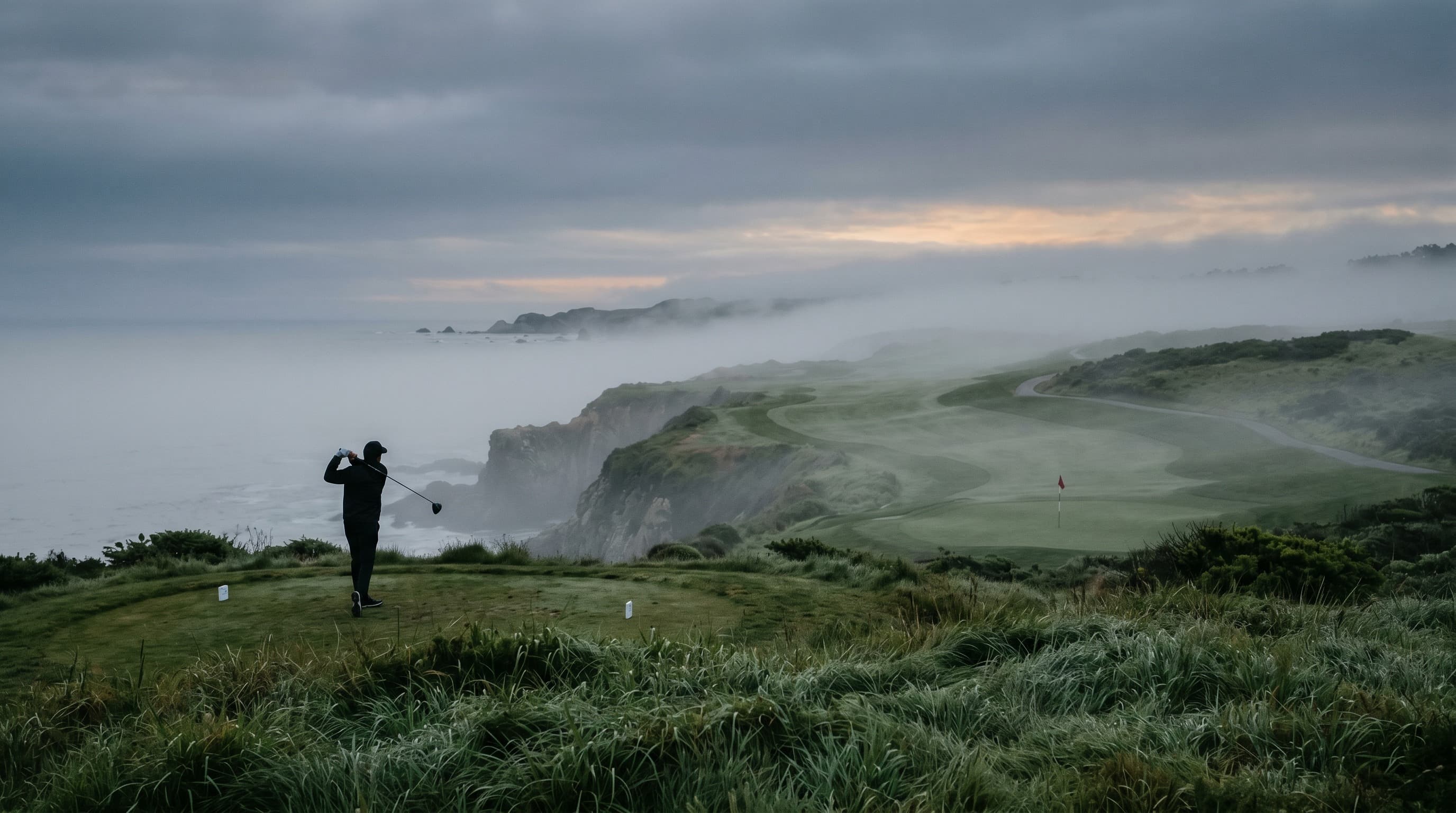
I drove down from Irvine for a 7:10 a.m. tee time in early February, and the marine layer was still sitting on the La Jolla cliffs — 56°F, no shadows, the Pacific 300 feet below the 3rd tee just a gray smear. That's the Torrey Pines most out-of-towners don't expect: it photographs like a resort and plays like a municipal U.S. Open course, because that is exactly what it is.
William F. Bell laid out the South Course in 1957 on city land above Black's Beach, and Rees Jones rebuilt it in 2001 to championship length. It is a public course owned by the City of San Diego that has hosted two U.S. Opens — Tiger Woods over Rocco Mediate in the 2008 playoff, and Jon Rahm in 2021 — plus the Farmers Insurance Open every January. From the back it stretches to about 7,765 yards, par 72.
Hole-by-Hole Wind & Playing Lines
Hole 12 (#1 handicap, par-4, 504y from the back). The longest par-4 on the card and the hole that breaks scorecards. It runs slightly uphill and usually plays into the prevailing W/SW onshore breeze that builds through the day. On a 12–15 mph afternoon wind I hit driver and still had a 4-iron left; the smart play is left-center off the tee and a two-putt bogey you walk away grateful for.
Hole 3 (par-3, 198y). The signature shot — downhill to a green perched on the cliff edge with nothing but ocean behind it. At dawn with the marine layer flat and calm it's a stock 6-iron. By mid-afternoon, into a freshening W wind off the water, the same 198 yards becomes a hard 4-iron, and anything thin rides the gust long into the back bunkers.
Hole 18 (par-5, 571y). The famous finisher, bending left with a pond guarding the front-right of the green. Downwind in the morning the green is reachable for long hitters; into the afternoon breeze it's a lay-up to a full wedge. The kikuyu rough left of the fairway is thick enough to stop a club dead — bail right of the pond, never short.
Green & Fairway Characteristics
Forget the cliffs for a second — what really shapes scores at Torrey is the kikuyu underfoot. Both fairway and rough are kikuyu, a dense, sticky, grabby grass that perches the ball up beautifully in the short stuff but coils around the hosel and bleeds clubhead speed the instant you're in the longer cut. Out of any kikuyu lie I budget for 15–20% less carry and assume a flyer will never come. The greens switch to poa annua, stimped near 11 for tournament weeks; cool and damp in the morning they're true and willing, then as the poa stirs under the afternoon sun they quicken and grow bumpy. The inward nine carries the longer yardage on the card, and since the wind is usually up by the turn, that's the stretch where the day is won or lost.
Seasonal Weather Pattern
The thermometer barely moves at Torrey — La Jolla holds 58–70°F across most of the year — so once again it's the marine layer, not the high, that you actually plan around. The thickest morning overcast comes in May and June, the "May Gray / June Gloom" that frequently hangs on past mid-morning. The Farmers Insurance Open window in January and February delivers the opposite: cool, dead-calm, clear mornings that stiffen into a breeze by noon. NOAA's coastal record shows the onshore W/SW wind routinely climbing to 12–18 mph from late morning on through the dry months, which is exactly why your spot on the tee sheet decides more than the forecast high ever will.
Local Play Tips
One thing the yardage book won't tell you: the cliff-edge holes — 3, 4, and the run home along the ocean — sit in 3–5 mph more wind than you feel standing on a sheltered inland tee, and the breeze swirls right-to-left off the bluff on the 4th. I add half a club into every ocean-side green regardless of what the flag at my feet shows. Also, the kikuyu around the greens is its own short game — putt or bump-and-run from the fringe rather than trying to flop, because the grass grabs an open face and snaps it shut.
Pre-Round Weather Workflow
I work off the 7-day G-Score at the top of this page every time. Three days out, the one thing I'm checking is whether my tee window beats the late-morning sea-breeze build or gets caught behind it — on the South that swing alone is worth 8–14 G-Score points. Come the morning, windExposure hands me direction: a W or SW onshore wind drives the signature 3rd, the brutal 12th, and the closing 18th straight into its teeth, so I aim left and add a club through the homeward holes. And when the marine layer reads heavy with the temperature under 58°F, I count on the kikuyu fairways giving zero release and take one more club into every green.
Related Reading
Before you tee off at Torrey Pines South Course
Reading Coastal Wind: How the Marine Layer Reshapes Pebble Beach, Bandon, and the Pacific Coast Game
Coastal golf does not play by inland rules. The marine layer suppresses wind in the morning, then releases it through midday in a thermal cycle that turns a calm 7am tee into a 22mph back nine. Here is the meteorology behind the pattern, the G-Score data that confirms it across the Pacific coast, and the morning workflow that turns the marine layer from a confusion into a competitive advantage.
Read Story
America's 20 Windiest Golf Courses: A G-Score Wind Analysis
We ranked America's 20 windiest golf courses using G-Score wind penalty data. See how coastal gusts and prairie gales reshape playability scores.
Read StoryDanorie
Editorial & Data
Golf Weather Score is built by Danorie. We compute the G-Score — our own playability rating — from live NOAA forecasts and published course scorecards, so any US course can be compared on any day with a single number. Methodology and data sources are documented on every page.
Every Friday Morning
When Torrey Pines South Course plays best next weekend.
Friday 6am ET: peak G-Score windows for Torrey Pines South Course, wind direction by hour, and one gear call. Three minutes to read, save you the round.
One email a week. Unsubscribe in one click.
The Caddie's Oracle
Draw your luck before the tee off