
Caddie's Gear Advisor
Curated for today's 46°F · Clear
Cold-Weather Performance Layers
Thermal mid-layers that move with your swing
Tour Hand Warmers
Rechargeable warmers trusted by caddies
Thermal Base Layers
Lightweight compression that traps heat
Winter Golf Headwear
Beanies and ear warmers built for the links
Your Golf Trip, Handled
The Ultimate Golf Trip Planner
Everything you need to play TPC Deere Run — from booking your flight to checking in course-side.
Course-Side Stays
Luxury hotels, resorts, and stay-and-play packages just minutes from the first tee.
Flights
Compare fares across 700+ airlines for the best route to your tee time.
SUV Rentals for Golf Bags
Spacious vehicles with room for clubs, bags, and your foursome.
Travel Insurance
Coverage for medical, weather delays, and gear at your destination.
TPC Deere Run: Course Intelligence
Signature Setup
The 16th at TPC Deere Run tilts away from you toward the Rock River, and from the tee the green looks like it wants to feed every ball off its back edge. I walked it on a July morning in Silvis, 64°F at 7 a.m. with mist still hanging in the ravines and the bentgrass holding dew — the soft window before the valley heat wakes up.
TPC Deere Run was designed by D.A. Weibring, a Quad Cities native and former PGA Tour winner, and it opened in 2000. It plays to a par of 71 at roughly 7,289 yards from the championship tees, routed across rolling, wooded land along the Rock River that once belonged to the Deere family. It has been the home of the PGA Tour's John Deere Classic since 2000, staged in mid-July, and it is famous as a birdie course — winning scores routinely land near 20-under, so the separation here is small and the margins are weather-driven.
Hole-by-Hole Wind & Playing Lines
Hole 14 (#1 handicap, par-4, ~470y). The longest sustained test on the card. Into the prevailing summer SW wind it stretches well past its yardage — driver up the left, then a long iron in. The smart play is the fat front-center of the green, not a tucked flag, and a clean par here is a stroke gained on a field that goes low everywhere else.
Hole 16 (par-4, ~410y). The signature falls downhill toward the river valley and the green sheds anything long. With a helping wind at your back the temptation is to bomb it close, but the safe number is short of the green's back edge; a ball over the back leaves a downhill chip that races away. Land it front-center and let the slope work.
Hole 17 (par-3, ~200y). A long one-shotter exposed to the breeze coming up the valley. On a crossing SW wind the ball drifts toward the bunkering, so club up, aim at the center, and accept the two-putt — this is not a hole to chase.
Green & Fairway Characteristics
Bentgrass covers greens and fairways alike, kept fast and firm for tournament week and framed by mature oak and hickory with ravines slicing through several holes. Slope runs in the high-130s from the back tees. The front nine rolls up and down the wooded high ground while the back nine spills toward the Rock River, so the closing stretch plays more open to the wind and the riverside holes carry a little extra morning moisture. Here it's elevation change and tree-lined corridors — not water — that drive most decisions, which puts a premium on tee-ball position over raw length and on a flighted approach the valley breeze can't easily drag off line.
Seasonal Weather Pattern
Silvis runs a humid-continental calendar that puts its weight on the summer golf season. The mid-July tournament week sits in mid-80s°F highs with thick humidity and a near-daily chance of pop-up cells rolling up the Rock River valley — the reason the early waves play softer and calmer than anything after lunch. Late May through June, and September, are where a visitor wants to be: 70s°F highs, drier air, firmer bentgrass. Winter closes the place down, with January in the Quad Cities routinely near 20°F. I haven't played the September shoulder here, so for that window I go by the area record rather than my own round — and the NOAA data marks July and August as the wettest, most storm-prone stretch, which makes radar timing as much a part of a summer read as wind direction.
Local Play Tips
One thing the yardage book won't tell you: the back nine near the river breathes differently than the front. On that July morning the lower holes held their dew an hour longer, the greens were a shade slower early, and approaches landed softer than the same shots up on the wooded front side. By midday the valley humidity and the SW wind had firmed everything up. I haven't played here in the September shoulder season, so I lean on historical conditions for that, but the summer lesson was clear — read the river holes as a separate, slightly damper course in the first two hours, and trust your numbers more once the surfaces dry.
Pre-Round Weather Workflow
Lean on the 7-day G-Score above when you book. Three days out on a river-valley layout like this, the thing to confirm is whether you tee off before the mid-morning heat and wind wake up — that timing is worth 8–12 points on its own. Morning of, the windExposure panel sets the targets: an SW reading lengthens and exposes the 470-yard 14th, the downhill 16th, and the 200-yard closing-stretch par-3, so I aim center and add a club. Through the July storm season the radar matters as much as the breeze — a first-wave time is the best hedge against the valley humidity, the afternoon cells, and the firmer, faster surfaces that set in after 10 a.m., when the riverside holes finally dry out and start playing like the rest.
More Courses in Illinois
View AllRelated Reading
Before you tee off at TPC Deere Run
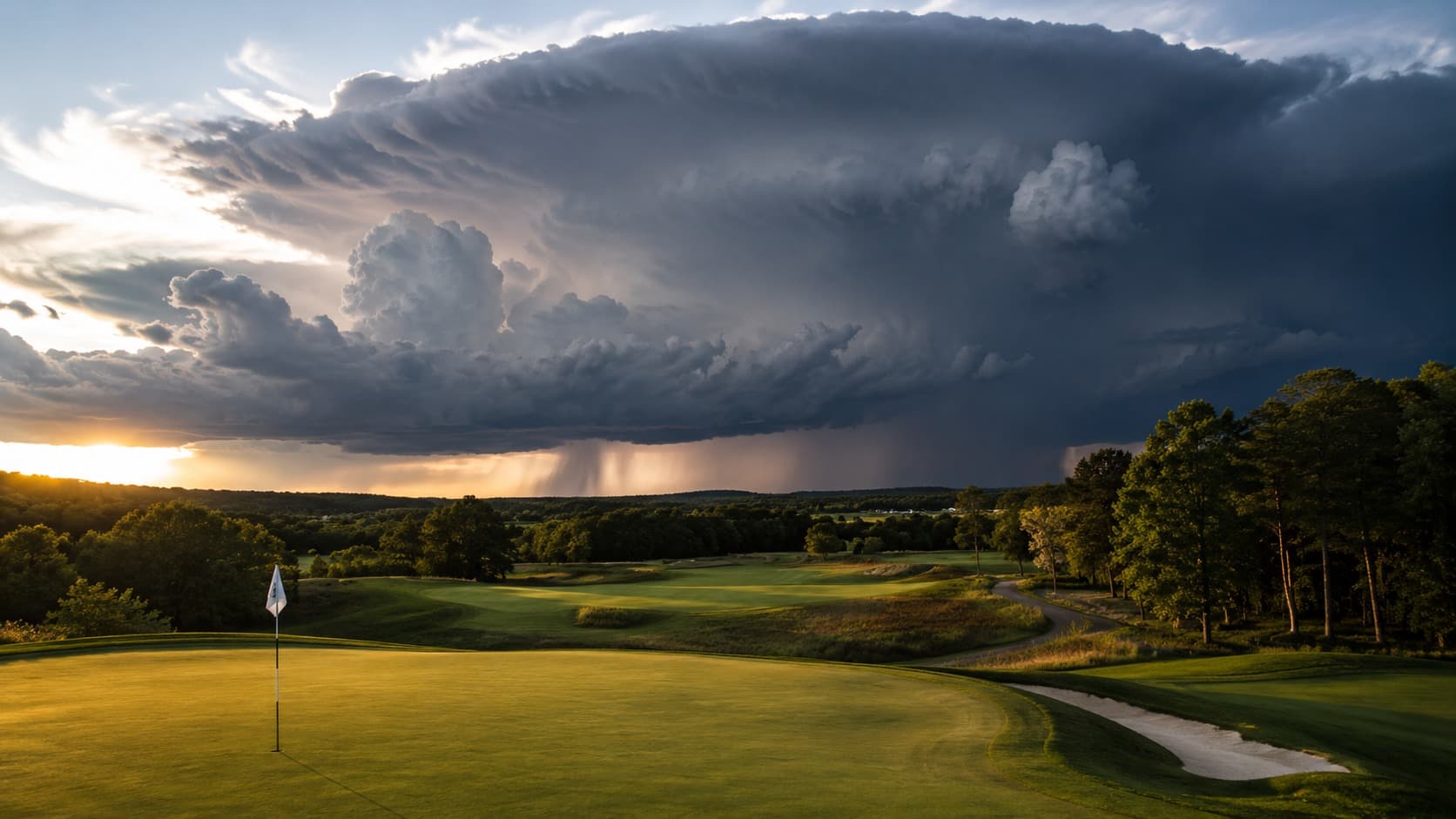
The Three O’Clock Storm: Reading Summer’s Convective Cycle to Protect Your Round
A 40% chance of afternoon thunderstorms does not mean a 40% chance of getting rained on. In the summer convective season it means the morning is nearly clear and the afternoon carries a fast-building, high-energy storm risk driven by a daily heating cycle. Here is the meteorology behind the pattern, the G-Score data on how the storm cycle punishes afternoon tee times across the Southeast, Midwest, and desert Southwest, the lightning-safety decision tree that actually matters, and the workflow that gets you off the course before the first bolt.
Read Story
How to Read a G-Score: The 0–100 Golf Playability Number, Decoded
A G-Score on this site is a single 0–100 number that tells you whether today is worth tee-up. Here is exactly what each band means, what drives the calculation, and how to use it to plan a round you will actually score on.
Read StoryDanorie
Editorial & Data
Golf Weather Score is built by Danorie. We compute the G-Score — our own playability rating — from live NOAA forecasts and published course scorecards, so any US course can be compared on any day with a single number. Methodology and data sources are documented on every page.
Every Friday Morning
When TPC Deere Run plays best next weekend.
Friday 6am ET: peak G-Score windows for TPC Deere Run, wind direction by hour, and one gear call. Three minutes to read, save you the round.
One email a week. Unsubscribe in one click.
The Caddie's Oracle
Draw your luck before the tee off