
Caddie's Gear Advisor
Curated for today's 73°F · Clouds
Tour-Level Drivers
Engineered for maximum distance and forgiveness
Laser Rangefinders
Pin-seeking technology for precision approaches
Premium Golf Balls
Tour-caliber spin and distance performance
Performance Sunglasses
Polarized lenses optimized for reading greens
Your Golf Trip, Handled
The Ultimate Golf Trip Planner
Everything you need to play TPC Sawgrass — from booking your flight to checking in course-side.
Best time to golf in FloridaCourse-Side Stays
Luxury hotels, resorts, and stay-and-play packages just minutes from the first tee.
Flights
Compare fares across 700+ airlines for the best route to your tee time.
SUV Rentals for Golf Bags
Spacious vehicles with room for clubs, bags, and your foursome.
Travel Insurance
Coverage for medical, weather delays, and gear at your destination.
TPC Sawgrass: Course Intelligence
Signature Setup
The 17th green looks even smaller from the tee than it does on television. I stood there on a March morning, 60°F at 8 a.m. with the flag barely moving, holding a wedge for a shot I'd watched a thousand times — and still felt my pulse in my hands. The water doesn't care how often you've seen it.
Pete Dye built the Stadium Course in 1980 on low, swampy ground in Ponte Vedra Beach, Florida, roughly two miles inland from the Atlantic. Alice Dye is credited with pushing the island-green idea once the routing left a flooded borrow pit where the 17th now sits. It plays as a par 72, about 7,245 yards from the tournament tees, and has hosted THE PLAYERS Championship since 1982 — moved to March in 2007, back again in March since 2019. The spectator mounding Dye shaped gave "stadium golf" its name.
Hole-by-Hole Wind & Playing Lines
Hole 18 (par-4, 462y). Water runs the full length of the left side, and the prevailing SW-to-W breeze pushes a fade straight toward it. I hit 3-wood off the tee up the right tree line on that March round and still had 195 in; aim at green center every time and let par be a great score.
Hole 17 (par-3, 137y). Pure wind math. With the flag tucked back-right behind the water, a calm 137 yards becomes a nervy decision once the Atlantic breeze lifts after late morning — into a 10–12 mph headwind it's a full pitching wedge instead of a gap. Middle of the green, never the pin.
Hole 16 (par-5, 523y). Reachable, and the smart gamble before 17. Downwind I had 235 in over the right-side water; into a quartering breeze it's a lay-up to 90 yards and a wedge. Your decision here sets your nerves for the island.
Green & Fairway Characteristics
The greens are TifEagle Bermuda, firm and fast — they roll near 12 on the Stimp for THE PLAYERS and shed anything that lands hot. Dye built sharp run-offs and collection areas, so a slightly long approach trickles into a swale rather than holding. Fairways are Bermuda, generous off several tees but framed by waste bunkers and water that punish the miss. The front nine eases you in; the back tightens hard from 16 onward. Slope is 155 with a 76.8 rating from the tips — punishing for a course that isn't especially long, the number a product of forced carries and tiny landing windows rather than yardage.
Seasonal Weather Pattern
Ponte Vedra in March — THE PLAYERS week — averages roughly 70°F highs and 50°F mornings, with the Atlantic sea breeze the daily variable. Mornings are usually slack; by midday a 10–15 mph onshore wind off the coast changes 17 entirely. Summer here is a different course: I haven't played it in July, but the historical record shows mid-90s heat, daily afternoon thunderstorms, and humidity that swells afternoon yardages and softens the greens. Spring and late fall give the firmest, fairest conditions.
Local Play Tips
The 16th green's right edge feeds toward the water more than the eye reads — on my round a putt I left above the hole slid two feet past toward the hazard side. Treat 16 as a three-shot hole if the breeze is up; spending your nerve there to chase an eagle is what leaves a shaky wedge on 17.
Pre-Round Weather Workflow
Check the 7-day G-Score and windExposure for Ponte Vedra before booking your tee time. The single highest-leverage move here is timing: an early slot gives you the 16–17–18 stretch in dead-calm air, while an afternoon tee time hands you the full Atlantic sea breeze on the most exposed holes. If the forecast shows an onshore wind building past 10 mph by noon, take the earliest tee you can get and play the closers first in your mind.
Related Reading
Before you tee off at TPC Sawgrass
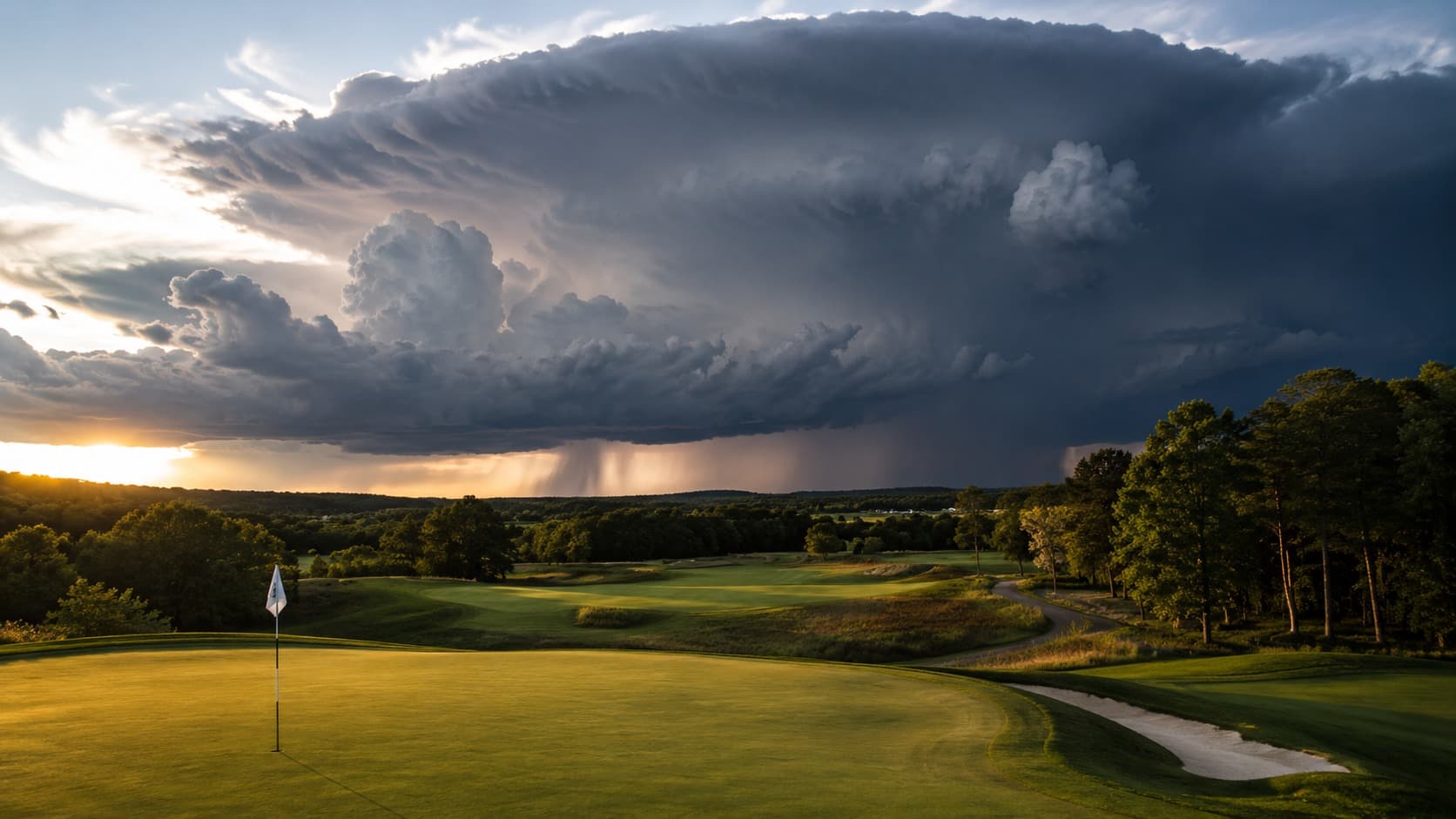
The Three O’Clock Storm: Reading Summer’s Convective Cycle to Protect Your Round
A 40% chance of afternoon thunderstorms does not mean a 40% chance of getting rained on. In the summer convective season it means the morning is nearly clear and the afternoon carries a fast-building, high-energy storm risk driven by a daily heating cycle. Here is the meteorology behind the pattern, the G-Score data on how the storm cycle punishes afternoon tee times across the Southeast, Midwest, and desert Southwest, the lightning-safety decision tree that actually matters, and the workflow that gets you off the course before the first bolt.
Read Story
How to Read a G-Score: The 0–100 Golf Playability Number, Decoded
A G-Score on this site is a single 0–100 number that tells you whether today is worth tee-up. Here is exactly what each band means, what drives the calculation, and how to use it to plan a round you will actually score on.
Read StoryDanorie
Editorial & Data
Golf Weather Score is built by Danorie. We compute the G-Score — our own playability rating — from live NOAA forecasts and published course scorecards, so any US course can be compared on any day with a single number. Methodology and data sources are documented on every page.
Every Friday Morning
When TPC Sawgrass plays best next weekend.
Friday 6am ET: peak G-Score windows for TPC Sawgrass, wind direction by hour, and one gear call. Three minutes to read, save you the round.
One email a week. Unsubscribe in one click.
The Caddie's Oracle
Draw your luck before the tee off