
Caddie's Gear Advisor
Curated for today's 49°F · Clouds
Cold-Weather Performance Layers
Thermal mid-layers that move with your swing
Tour Hand Warmers
Rechargeable warmers trusted by caddies
Thermal Base Layers
Lightweight compression that traps heat
Winter Golf Headwear
Beanies and ear warmers built for the links
Your Golf Trip, Handled
The Ultimate Golf Trip Planner
Everything you need to play Tullymore — from booking your flight to checking in course-side.
Course-Side Stays
Luxury hotels, resorts, and stay-and-play packages just minutes from the first tee.
Flights
Compare fares across 700+ airlines for the best route to your tee time.
SUV Rentals for Golf Bags
Spacious vehicles with room for clubs, bags, and your foursome.
Travel Insurance
Coverage for medical, weather delays, and gear at your destination.
Tullymore: Course Intelligence
Jim Engh designed Tullymore in 2002 on a piece of Stanwood, Michigan Lower Peninsula land in the central Michigan agricultural region. Engh — a Colorado-based architect known for dramatic moundwork and large-scale earthwork — routed the eighteen holes through created topography that bears little resemblance to the natural farmland that the property occupied before construction. The course has a distinctive visual identity within the broader Michigan resort-golf landscape, with severe mounding alongside the fairway corridors and the Engh signature of dramatic, almost cinematic routing decisions.
The course plays around 7,148 yards par 72 from the championship markers, with bent fairways and a slope in the upper 140s. Engh's design vocabulary emphasizes the visual drama of the routing as much as the strategic-play demands — the mounding alongside the fairways visually narrows the corridors while the actual playing widths remain generous. The seventh hole is a 539-yard par-5 with a fairway that bends right around an artificial mound stand; the seventeenth, a 218-yard par-3 across a natural depression, is the routing's most-discussed one-shotter. The bunkers carry Engh's signature deep, steep-walled style.
Tullymore is open to public daily-fee play at premium rates with discounts for St. Ives Resort lodging guests. The property also includes the St. Ives Course — a different routing on the same property — and visitors typically play both courses across a destination stay. The hospitality model emphasizes the multi-course property experience.
Central Lower Michigan climate gives Tullymore a playing season of April through October, with the firmest conditions in August and September. The course closes through Michigan winter and reopens when the soil thaws — typically late April. The created topography and the Engh design vocabulary give the property visual signature unlike most other Michigan resort routings.
Related Reading
Before you tee off at Tullymore
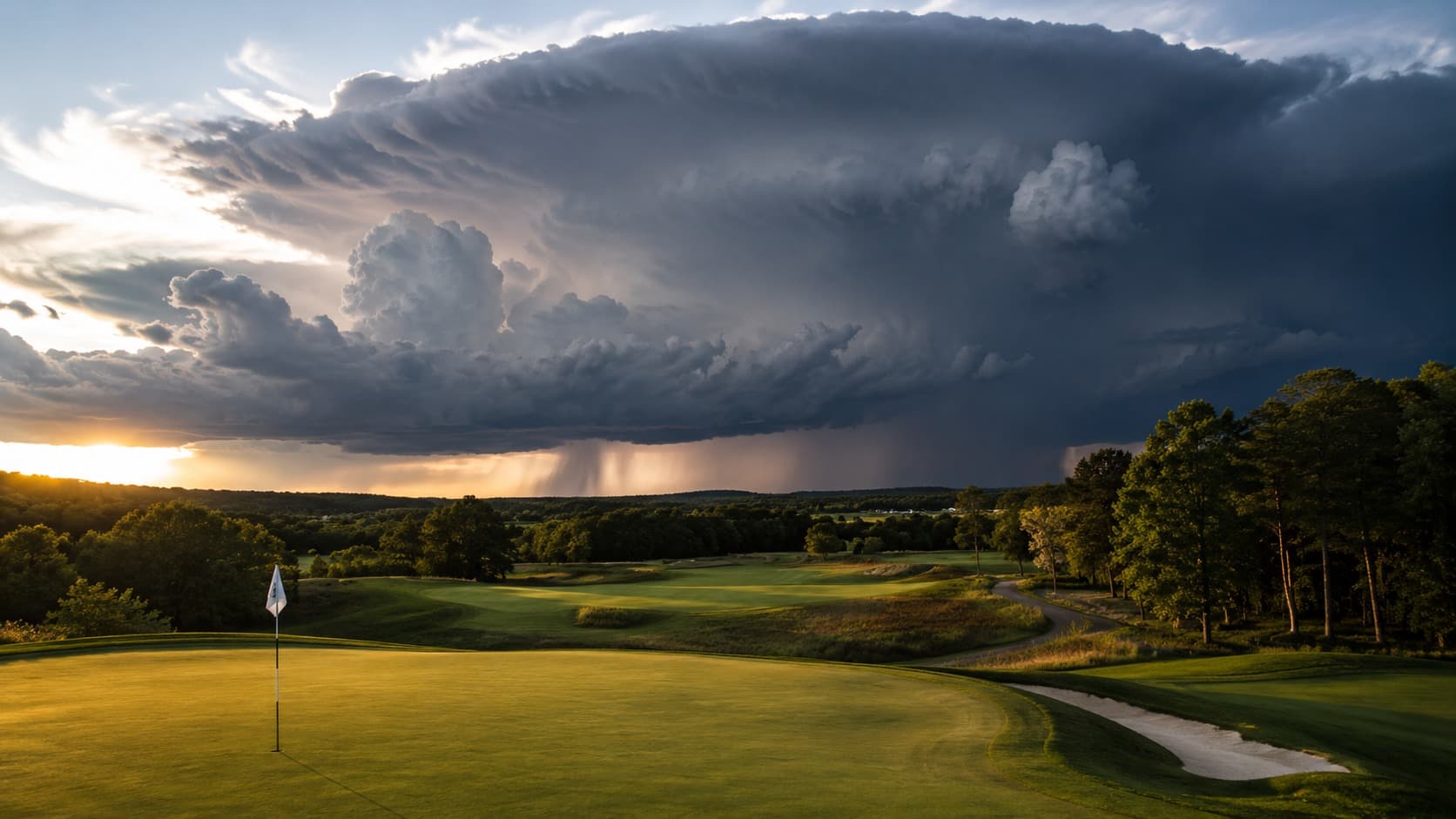
The Three O’Clock Storm: Reading Summer’s Convective Cycle to Protect Your Round
A 40% chance of afternoon thunderstorms does not mean a 40% chance of getting rained on. In the summer convective season it means the morning is nearly clear and the afternoon carries a fast-building, high-energy storm risk driven by a daily heating cycle. Here is the meteorology behind the pattern, the G-Score data on how the storm cycle punishes afternoon tee times across the Southeast, Midwest, and desert Southwest, the lightning-safety decision tree that actually matters, and the workflow that gets you off the course before the first bolt.
Read Story
How to Read a G-Score: The 0–100 Golf Playability Number, Decoded
A G-Score on this site is a single 0–100 number that tells you whether today is worth tee-up. Here is exactly what each band means, what drives the calculation, and how to use it to plan a round you will actually score on.
Read StoryMinSu Kim
Founder & Golf Data Analyst
MinSu is a data analyst and golfer with 10+ years on the course. He built Golf Weather Score to answer one question: is today a good day to play? He combines weather data, course intelligence, and the proprietary G-Score algorithm to help golfers make smarter decisions.
Every Friday Morning
When Tullymore plays best next weekend.
Friday 6am ET: peak G-Score windows for Tullymore, wind direction by hour, and one gear call. Three minutes to read, save you the round.
One email a week. Unsubscribe in one click.
The Caddie's Oracle
Draw your luck before the tee off