
Caddie's Gear Advisor
Curated for today's 97°F · Thunderstorm
Storm-Ready Outerwear
Waterproof layers built for 18 holes in the rain
Tour-Grade Umbrellas
68" double-canopy wind-resistant coverage
Wet-Weather Gloves
All-weather grip that performs in the rain
Waterproof Golf Shoes
Keep your feet dry through every fairway
Your Golf Trip, Handled
The Ultimate Golf Trip Planner
Everything you need to play Abacoa Golf Club — from booking your flight to checking in course-side.
Course-Side Stays
Luxury hotels, resorts, and stay-and-play packages just minutes from the first tee.
Flights
Compare fares across 700+ airlines for the best route to your tee time.
SUV Rentals for Golf Bags
Spacious vehicles with room for clubs, bags, and your foursome.
Travel Insurance
Coverage for medical, weather delays, and gear at your destination.
Abacoa Golf Club: Course Intelligence
Signature Setup
The first thing that surprises you at Abacoa is the ground itself. I expected the usual South Florida pancake; instead the fairways roll over old coastal sandhills, with real elevation change for Jupiter — enough that on a January morning, 61°F at 8:10 a.m., I could not see the bottom of the 5th fairway from the tee. Joe Lee designed the course and it opened in 1999 as the centerpiece of the Abacoa community in Jupiter, Florida, in northern Palm Beach County. From the back tees it measures roughly 7,200 yards, par 72, with a slope of 137. It is a daily-fee, municipally operated course rather than a private club, which keeps the conditioning honest and the tee sheet busy — but the routing through pine scrub and wetland gives it more character than its public status suggests. The par-3 11th, 205 yards across a wetland to a green ringed with bunkers, is the hole players remember.
Hole-by-Hole Wind & Playing Lines
Abacoa sits about four miles inland from the Atlantic, so the dominant force is the sea breeze — out of the east to southeast on most clear afternoons, October through April.
- 5th (par 4, 446y, #1 handicap): Plays into the SE breeze in the afternoon, stretching to 470-plus. With the wind up I take 3-wood off the tee to hold the left half of the fairway, then a full mid-iron in. Trying to flight a long knockdown over the cross-hazard is how you find the front bunkers.
- 11th (par 3, 205y): Straight into an E wind this is a 230-yard shot. The wetland carry is all front, so the miss is long and right, away from the water — never bail short.
- 18th (par 5, 545y): A reachable closer in calm air, but the SE breeze quarters into the second shot. On a windy afternoon I lay back to a 90-yard wedge rather than chase the green over the fronting bunker complex.
Green & Fairway Characteristics
The greens are TifEagle Bermuda — medium-fast and noticeably grainy by mid-afternoon when the heat dries them out, so putts late in the round break harder toward the setting sun than the slope alone suggests. The complexes are mid-sized with subtle internal movement rather than wild tiers. Fairways are Bermuda over the sandhill base, which means firm landing areas that release; a well-struck drive on the rolling 2nd or 5th can pick up 15–20 yards of run on a dry day. The front nine works through more open, residential corridors; the back nine tightens into pine scrub and wetland, with the 11th and 14th demanding precise carries. Slope from the tips is 137, which is a fair number — trouble exists, but it sits in front of you, not hidden.
Seasonal Weather Pattern
Jupiter's golf year divides cleanly. From October through April mornings start cool, often 58–65°F, with light land breeze early before the Atlantic sea breeze fills in from the east-southeast by late morning. This is the prime window — comfortable, and playable all day if you accept the afternoon wind. May through September flips entirely: mornings are humid and still, temperatures climb into the low 90s, and near-daily convective thunderstorms build off the heat by 2–3 p.m., frequently halting play. Lightning, not rain, is the real disruptor here. I have played Abacoa only in the dry-season months, so I describe the summer storm timing from NOAA Palm Beach County climate records rather than from my own scorecard.
Local Play Tips
The detail that does not show up online: because the course runs over old dune ground, the wind exposure is uneven hole to hole. The lower, sheltered stretch around the 3rd and 4th can feel calm while you are getting hammered two holes later on the exposed 5th and 11th ridges. Do not judge the day's wind from the opening holes. If you have a choice of time, take the earliest tee — not for temperature, but to clear the exposed 5th, 11th, and 18th before the sea breeze sets up firm after 10 a.m.
Pre-Round Weather Workflow
Pull the 7-day G-Score for Abacoa the night before and again at dawn. Watch two things: wind direction and, in summer, the afternoon storm probability. If the forecast shows an E or SE wind above 10 mph, plan to be through the 11th before late morning and add a club on every approach into the breeze. From May to September treat any afternoon tee time as provisional — check the lightning radar before you reach the turn, because the windExposure and storm flags on the open back nine are the ones to trust here. On a cool dry-season morning, the early calm is your scoring window; use it before the sea breeze lengthens the closing holes.
Related Reading
Before you tee off at Abacoa Golf Club
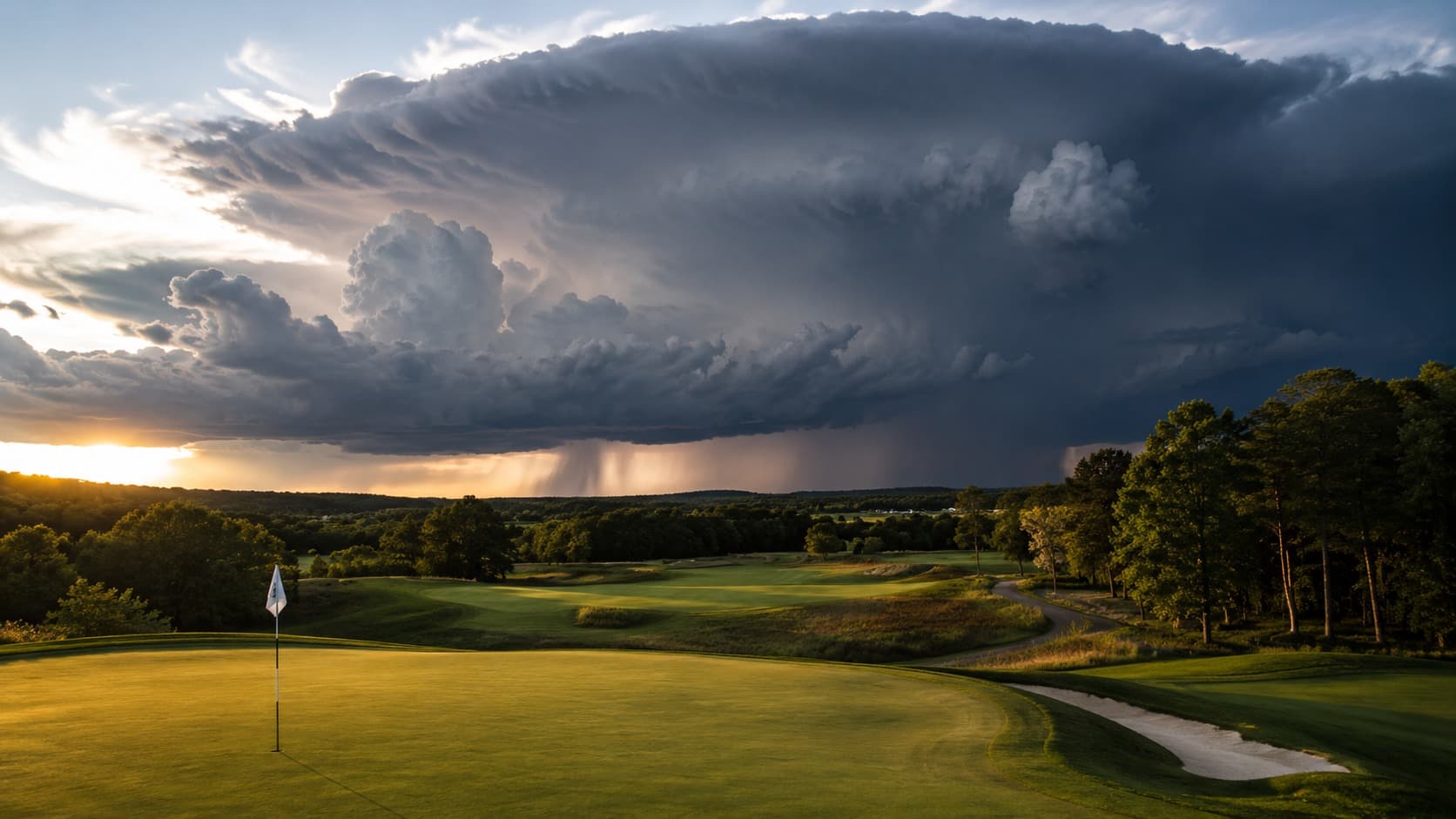
The Three O’Clock Storm: Reading Summer’s Convective Cycle to Protect Your Round
A 40% chance of afternoon thunderstorms does not mean a 40% chance of getting rained on. In the summer convective season it means the morning is nearly clear and the afternoon carries a fast-building, high-energy storm risk driven by a daily heating cycle. Here is the meteorology behind the pattern, the G-Score data on how the storm cycle punishes afternoon tee times across the Southeast, Midwest, and desert Southwest, the lightning-safety decision tree that actually matters, and the workflow that gets you off the course before the first bolt.
Read Story
How to Read a G-Score: The 0–100 Golf Playability Number, Decoded
A G-Score on this site is a single 0–100 number that tells you whether today is worth tee-up. Here is exactly what each band means, what drives the calculation, and how to use it to plan a round you will actually score on.
Read StoryMinSu Kim
Founder & Golf Data Analyst
MinSu is a data analyst and golfer with 10+ years on the course. He built Golf Weather Score to answer one question: is today a good day to play? He combines weather data, course intelligence, and the proprietary G-Score algorithm to help golfers make smarter decisions.
Every Friday Morning
When Abacoa Golf Club plays best next weekend.
Friday 6am ET: peak G-Score windows for Abacoa Golf Club, wind direction by hour, and one gear call. Three minutes to read, save you the round.
One email a week. Unsubscribe in one click.
The Caddie's Oracle
Draw your luck before the tee off