
Caddie's Gear Advisor
Curated for today's 91°F · Clear
Ultralight Distance Drivers
Maximum carry in hot, low-drag conditions
UV Protection Apparel
UPF 50+ cooling fabrics for peak-sun rounds
Precision Rangefinders
Slope-adjusted yardage in any condition
Hydration & Cooling
Insulated bottles and cooling towels
Your Golf Trip, Handled
The Ultimate Golf Trip Planner
Everything you need to play Achasta Golf Club — from booking your flight to checking in course-side.
Course-Side Stays
Luxury hotels, resorts, and stay-and-play packages just minutes from the first tee.
Flights
Compare fares across 700+ airlines for the best route to your tee time.
SUV Rentals for Golf Bags
Spacious vehicles with room for clubs, bags, and your foursome.
Travel Insurance
Coverage for medical, weather delays, and gear at your destination.
Achasta Golf Club: Course Intelligence
Signature Setup
The first tee at Achasta sits up on a ridge, and the opening par-4 falls away from you toward the valley — I stood there on an October morning, 52°F at 8 a.m. with mist still hanging in the low ground, and the drop was steeper than I expected from the scorecard. This is a Jack Nicklaus Signature design, opened in 1999 in Dahlonega, Georgia, in the southern foothills of the Blue Ridge at roughly 1,450 feet of elevation. The routing plays par 72 at just over 7,000 yards from the tips, and the back nine threads alongside the Chestatee River. Dahlonega is gold-rush country — the first major U.S. gold rush hit here in 1828 — and the course leans into that mountain-and-river terrain rather than fighting it.
Hole-by-Hole Wind & Playing Lines
The defining weather feature here is not open coastal wind — it's how the river valley channels air on the back nine. Mornings are often calm with valley fog; once the sun heats the slopes, thermal wind picks up and runs along the Chestatee corridor.
- Opening downhill par-4 (1st): Off a high tee, the ball flies farther than the number says — the elevation drop adds carry. On a still morning take less club than the yardage; on a breezy afternoon the wind aloft is stronger than what you feel on the protected tee.
- Long par-4 on the river stretch: I'm calling this by layout, not a scorecard stroke index I don't have in front of me — but the longest two-shotter along the Chestatee plays into channeled valley wind by midday. Club up one and aim to the high side; anything bailed toward the water side feeds toward trouble.
- Mid-iron par-3 over low ground: Cold morning air in the valley is dense and the ball flies shorter at first light than it will by noon. Early rounds: trust the longer club.
Green & Fairway Characteristics
You almost never get a flat lie. The fairways move with the terrain — uphill, downhill, and sidehill stances are constant, so reading the slope of your stance matters more than the wind on most holes. The greens are kept firm and fast, and the local read that holds up is that putts break toward the river even when your eye says otherwise — gravity follows the low ground. Approach shots that land long get punished off firm back edges, so favor the front-middle of the surface and let the firmness feed the ball back.
Seasonal Weather Pattern
North Georgia mountain weather is its own thing — cooler and foggier than Atlanta an hour south. Spring (April–May) and fall (Sept–Oct) are the prime windows: morning lows in the 40s–50s°F, afternoon highs 68–78°F, low wind, brilliant color on the back nine. Summer (June–Aug) brings highs in the upper 80s°F with high humidity and a daily afternoon thunderstorm risk that builds over the ridges after 2 p.m. Winter is genuinely cool at this elevation — January mornings can sit near freezing with frost delays in the river bottom, afternoon highs around 50°F. I've played North Georgia mountain golf far more in shoulder season than in deep summer, so my July read here leans on regional climate records (NOAA, north Georgia) rather than a personal round.
Local Play Tips
Watch the valley fog. On clear, cool mornings the Chestatee bottom holds mist well past sunrise — beautiful, but it kills depth perception on the low holes until it burns off, usually mid-morning. If you can choose, take a tee time about an hour after first light: the fog has lifted but the thermal afternoon wind hasn't built yet. And spend range time on lag putting, not your driver — three-putts off these firm, river-breaking greens will cost you more than any tee shot will.
Pre-Round Weather Workflow
Use the 7-day G-Score on this course page to find the calm, dry, fog-cleared morning — at Achasta the gap between a still mid-morning and a gusty, humid 3 p.m. is worth 8–12 points. Check windExposure for the back-nine river stretch and add a club on the long valley holes when the afternoon thermal is up. In summer, treat any building afternoon thunderstorm over the ridges as a hard stop: book the first available window, watch the radar, and don't chase the river holes into a mountain storm.
Related Reading
Before you tee off at Achasta Golf Club
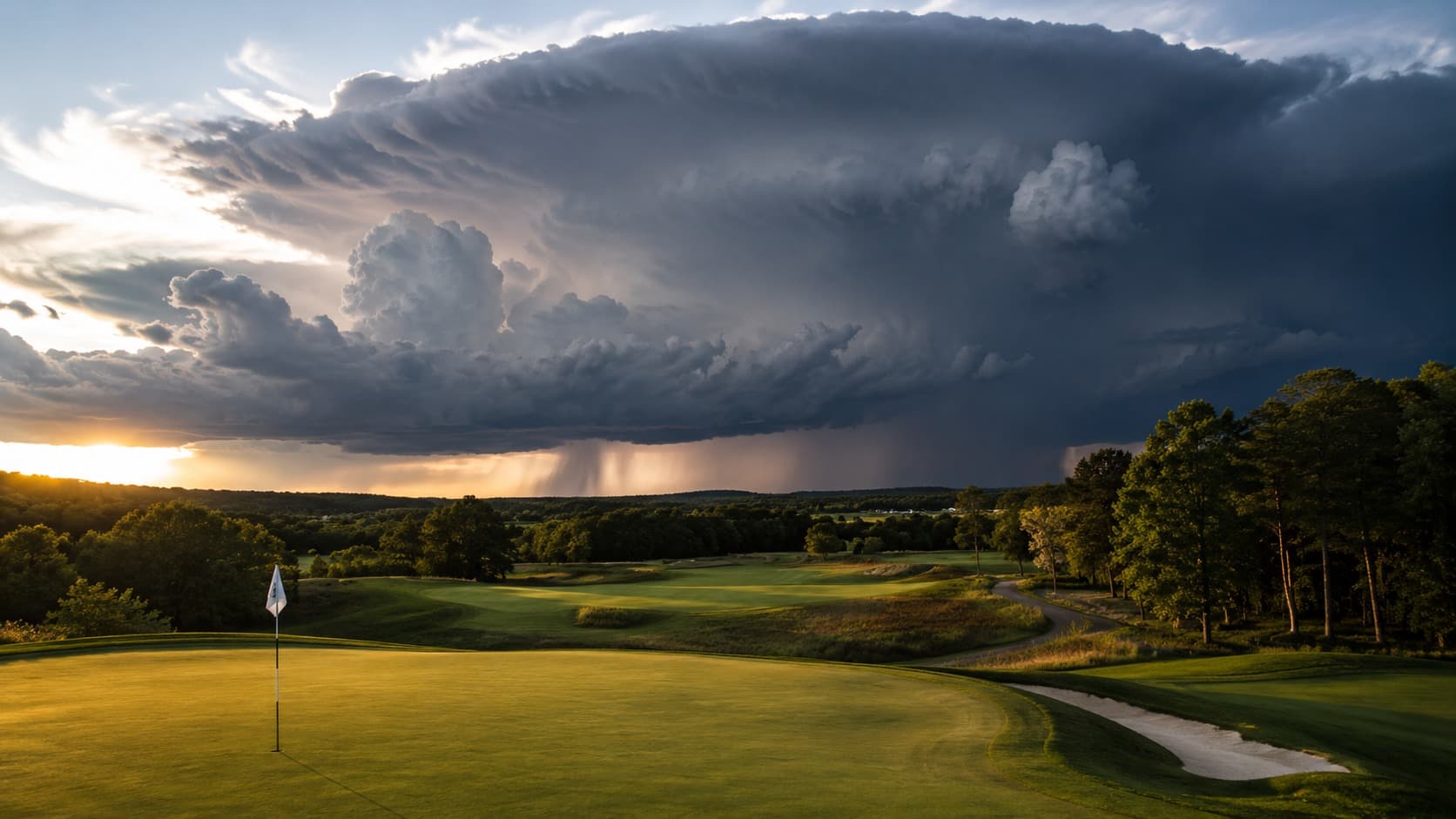
The Three O’Clock Storm: Reading Summer’s Convective Cycle to Protect Your Round
A 40% chance of afternoon thunderstorms does not mean a 40% chance of getting rained on. In the summer convective season it means the morning is nearly clear and the afternoon carries a fast-building, high-energy storm risk driven by a daily heating cycle. Here is the meteorology behind the pattern, the G-Score data on how the storm cycle punishes afternoon tee times across the Southeast, Midwest, and desert Southwest, the lightning-safety decision tree that actually matters, and the workflow that gets you off the course before the first bolt.
Read Story
The May 2026 G-Score Heatmap: Where American Golf Peaks This Spring
May is the most underrated month on the American golf calendar. Five regions hit their annual peak this spring, three turn quietly hostile, and the data tells a clearer story than the brochures. Here is where to play, where to avoid, and how to time your booking window.
Read StoryMinSu Kim
Founder & Golf Data Analyst
MinSu is a data analyst and golfer with 10+ years on the course. He built Golf Weather Score to answer one question: is today a good day to play? He combines weather data, course intelligence, and the proprietary G-Score algorithm to help golfers make smarter decisions.
Every Friday Morning
When Achasta Golf Club plays best next weekend.
Friday 6am ET: peak G-Score windows for Achasta Golf Club, wind direction by hour, and one gear call. Three minutes to read, save you the round.
One email a week. Unsubscribe in one click.
The Caddie's Oracle
Draw your luck before the tee off