
Caddie's Gear Advisor
Curated for today's 63°F · Thunderstorm
Storm-Ready Outerwear
Waterproof layers built for 18 holes in the rain
Tour-Grade Umbrellas
68" double-canopy wind-resistant coverage
Wet-Weather Gloves
All-weather grip that performs in the rain
Waterproof Golf Shoes
Keep your feet dry through every fairway
Your Golf Trip, Handled
The Ultimate Golf Trip Planner
Everything you need to play Ackerman-Allen Golf Course — from booking your flight to checking in course-side.
Course-Side Stays
Luxury hotels, resorts, and stay-and-play packages just minutes from the first tee.
Flights
Compare fares across 700+ airlines for the best route to your tee time.
SUV Rentals for Golf Bags
Spacious vehicles with room for clubs, bags, and your foursome.
Travel Insurance
Coverage for medical, weather delays, and gear at your destination.
Ackerman-Allen Golf Course: Course Intelligence
Signature Setup
Ackerman-Allen sits inside Purdue University's Birck Boilermaker Golf Complex in West Lafayette, Indiana — one of two 18-hole courses on the property alongside the Kampen Course. The land first opened as a William Diddel design in 1934, but the course you play today is a Pete Dye redesign that reopened in September 2015. Dye stripped it back to bare ground and rebuilt it as a teaching and competition track for Purdue's men's and women's golf programs, which means it is built to test scratch college players as much as visiting members. The Dye signatures are all here: railroad-tie bunker walls, deep pot bunkers, and tall fescue framing the fairway corridors. It plays par 72 and stretches past 7,400 yards from the championship tees, with multiple tee boxes that drop it well under 6,000 for the forward sets.
Hole-by-Hole Wind & Playing Lines
This is open, exposed Indiana farmland golf — there is very little tree cover to block the wind, so direction matters more than on a sheltered course.
- The long par-4s into a SW wind: Summer afternoons in West Lafayette frequently bring a southwest breeze of 10–18 mph off the open fields. On the back-side par-4s that run into it, a 160-yard approach plays closer to 180. Take one extra club and aim for the front-center of the green rather than flag-hunting over a pot bunker.
- Downwind par-5s: With that same SW wind at your back on the helping holes, the green becomes reachable in two for longer players — but Dye's firm bentgrass greens won't hold a hot long-iron. Land it short and let it release.
- The exposed par-3s: These are the holes that decide your round. Crosswind off fescue means a pushed or pulled tee shot disappears into native grass you may not find. On a gusty day, club selection on the par-3s is the single biggest swing in your score. Every time I've played Dye's open Midwest courses, the par-3s in a 15 mph crosswind are where I quietly switch from attacking pins to aiming at the fat of the green — the same discipline pays off here.
Green & Fairway Characteristics
The greens are bentgrass and run firm and fast — for Purdue team events they are tuned into the low-to-mid 11s on the Stimp, faster than a typical public daily-fee. The contouring is true Dye: subtle false fronts, run-off collars, and tiers that punish an approach on the wrong level. Fairways are generous in width by Dye standards but bordered by fescue native areas that are genuinely penal — a ball even a few feet off line can be lost. Expect firm, fast turf in mid-summer when the Indiana soil dries out, and softer, more receptive conditions in spring and after rain. The routing has real elevation movement for a Midwest course, with several holes playing across reshaped landforms Dye pushed up during the rebuild.
Seasonal Weather Pattern
West Lafayette has a four-season continental climate, and the course is effectively closed or unplayable through the coldest stretch. The realistic golf window runs roughly April through October. July and August bring daytime highs in the mid-80s°F with high humidity and the afternoon SW wind — the ball flies a touch farther in the warm, thick summer air, but the firm greens give back what the air gives you. May and September are the sweet spot: highs in the 70s, lower wind in the mornings, and greens that are running fast but fair. October mornings can start in the 40s°F with heavy dew, so the front nine plays soft and slow before the sun firms it up. I haven't played here in true winter conditions, so I won't pretend to describe a frozen-ground round — by November the season is essentially over.
Local Play Tips
Because this is a university course, it gets booked around Purdue team practice and collegiate events — public tee times are real but the calendar fills around the golf programs' schedule, so book ahead and check for tournament closures. The two-course complex means you can pair Ackerman-Allen with the Kampen Course in a single visit if you want a full Dye day. And take the fescue seriously: locals will tell you to leave the driver in the bag on the tighter exposed holes when the wind is up, because a ball lost in native grass costs you far more than the 15 yards you give up clubbing down.
Pre-Round Weather Workflow
Use the 7-day G-Score forecast on this course page to plan your tee time, not just your day. For an exposed prairie course like Ackerman-Allen, the windExposure signal is the one to watch — it is the difference between a calm-morning round where the par-3s are scorable and a gusty afternoon where they wreck your card. Check the morning-versus-afternoon wind split: if the forecast shows the SW breeze building after noon, claim an early slot and play the open front holes while the air is still. Cross-reference the dew and overnight-low reading in spring and fall — a 45°F dewy morning means soft, slow greens for the first few holes, so trust your approach to release less than it will once the turf firms up by mid-round.
Related Reading
Before you tee off at Ackerman-Allen Golf Course
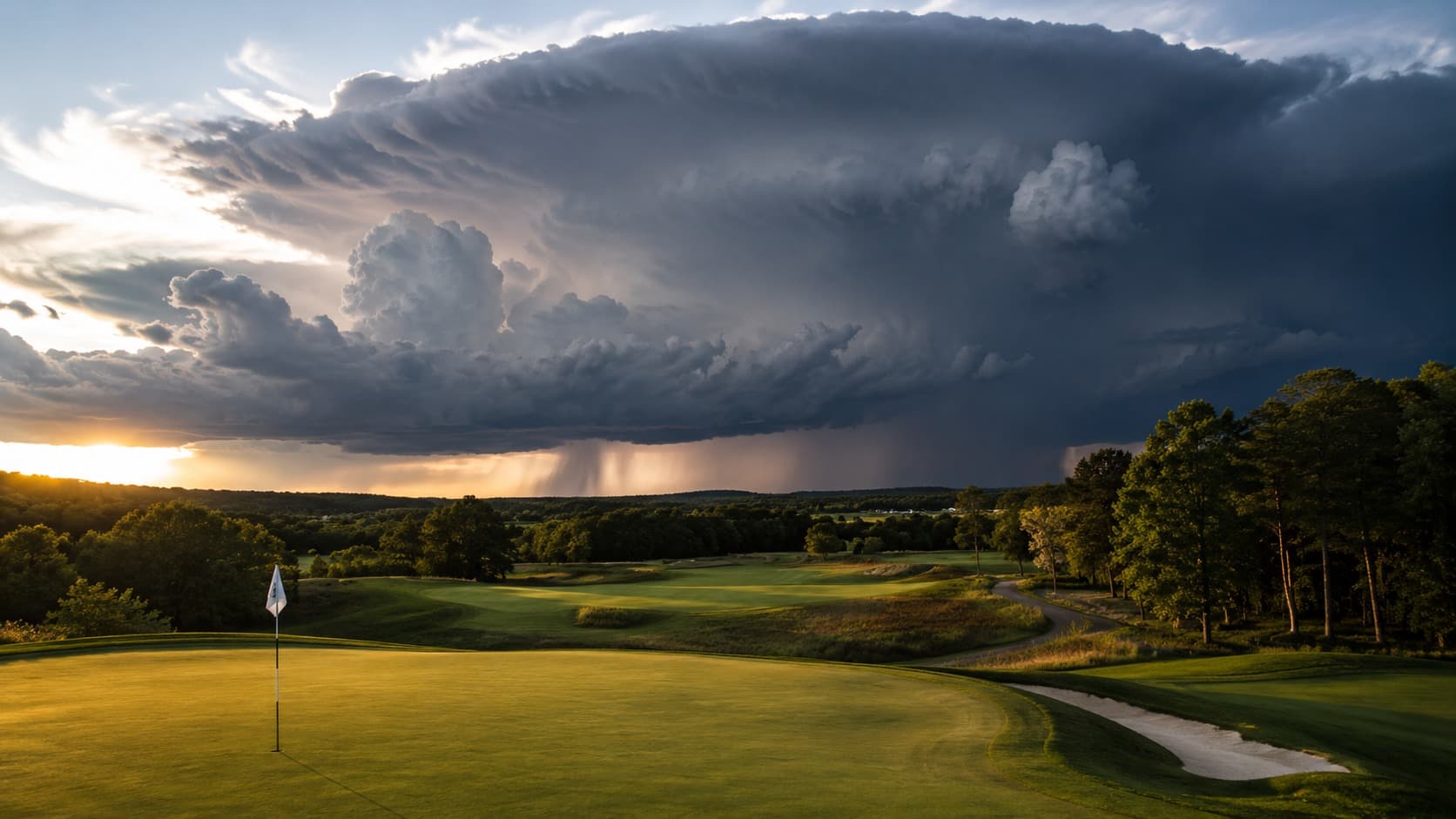
The Three O’Clock Storm: Reading Summer’s Convective Cycle to Protect Your Round
A 40% chance of afternoon thunderstorms does not mean a 40% chance of getting rained on. In the summer convective season it means the morning is nearly clear and the afternoon carries a fast-building, high-energy storm risk driven by a daily heating cycle. Here is the meteorology behind the pattern, the G-Score data on how the storm cycle punishes afternoon tee times across the Southeast, Midwest, and desert Southwest, the lightning-safety decision tree that actually matters, and the workflow that gets you off the course before the first bolt.
Read Story
How to Read a G-Score: The 0–100 Golf Playability Number, Decoded
A G-Score on this site is a single 0–100 number that tells you whether today is worth tee-up. Here is exactly what each band means, what drives the calculation, and how to use it to plan a round you will actually score on.
Read StoryMinSu Kim
Founder & Golf Data Analyst
MinSu is a data analyst and golfer with 10+ years on the course. He built Golf Weather Score to answer one question: is today a good day to play? He combines weather data, course intelligence, and the proprietary G-Score algorithm to help golfers make smarter decisions.
Every Friday Morning
When Ackerman-Allen Golf Course plays best next weekend.
Friday 6am ET: peak G-Score windows for Ackerman-Allen Golf Course, wind direction by hour, and one gear call. Three minutes to read, save you the round.
One email a week. Unsubscribe in one click.
The Caddie's Oracle
Draw your luck before the tee off