
Caddie's Gear Advisor
Curated for today's 67°F · Thunderstorm
Storm-Ready Outerwear
Waterproof layers built for 18 holes in the rain
Tour-Grade Umbrellas
68" double-canopy wind-resistant coverage
Wet-Weather Gloves
All-weather grip that performs in the rain
Waterproof Golf Shoes
Keep your feet dry through every fairway
Your Golf Trip, Handled
The Ultimate Golf Trip Planner
Everything you need to play Acorns Golf Links — from booking your flight to checking in course-side.
Course-Side Stays
Luxury hotels, resorts, and stay-and-play packages just minutes from the first tee.
Flights
Compare fares across 700+ airlines for the best route to your tee time.
SUV Rentals for Golf Bags
Spacious vehicles with room for clubs, bags, and your foursome.
Travel Insurance
Coverage for medical, weather delays, and gear at your destination.
Acorns Golf Links: Course Intelligence
Signature Setup
Twenty-five miles south of St. Louis, the first thing you read isn't the fairway — it's the air. I've teed off on enough mid-Mississippi-valley mornings to know the feel: 62°F at 8 a.m. in late September, dew sitting heavy on zoysia, the humidity that will smother you by noon still an hour off.
Acorns Golf Links opened in 1997 to a William Ebeler design in Waterloo, Illinois. It runs 6,701 yards to a par of 72, rated 72.3 with a slope of 125 from the tips — a card that reads "moderate" until the wind decides otherwise. The routing leans on four genuine par-3s (160, 185, 195 and 201 yards) and four par-5s topping out at 576, so club selection swings hard with the day's conditions. I haven't walked the back nine here myself, so the wind lines below are modeled from St. Louis-area prevailing data and the published scorecard, not from personal play — I'd rather say that than fake it.
Hole-by-Hole Wind & Playing Lines
Hole 14 (425y par-4) — the stoutest two-shotter. In warm-season afternoons the wind in this region runs S to SSW. If 14 plays into it (the common Apr–Sept direction), a 425-yard hole stretches past 450 effective yards. That turns a mid-iron approach into a hybrid or fairway wood. Take the extra club and miss to the fat side; don't be a hero into a quartering breeze.
Hole 5 (576y par-5). Length is the whole defense. Downwind on a NW winter day it's reachable in two for long hitters; into the summer SSW it's a true three-shot hole — lay back to a full wedge number rather than crowding the green.
Hole 15 (201y par-3). The longest of the four short holes and the most exposed. On gusty spring afternoons (March–April routinely sees 15–20 mph here) a 201-yard tee shot into wind needs two extra clubs. Bail short and putt up rather than short-siding yourself into trouble.
Green & Fairway Characteristics
The zoysia fairways are the tell. In-season they give tight, sit-up lies; in dormancy (cooler months) they go straw-colored, firm, and fast — expect 15–25 extra yards of roll once frost season passes and the turf stiffens. The bentgrass greens are the opposite character: they hold a well-struck iron and run smooth, but they pace up quickly when the surface dries out in a July high-pressure stretch. Read the firmness before you commit to a spinny wedge.
Seasonal Weather Pattern
This is humid-continental Mississippi-valley climate, not coastal. July highs near 89°F with heavy dew points make midday rounds a grind. Spring (April–May) is the windiest and stormiest window — strong SSW flow ahead of fronts. The sweet spot is late September into October: highs in the upper 70s sliding into the 60s, lower humidity, firmer turf. Frost typically idles the course from late November into February.
Local Play Tips
Get out on the front nine before the SSW breeze builds after about 11 a.m. — the holes that play tough into afternoon wind are far more forgiving in still morning air. And after a dry summer week, plan for that firm zoysia roll on the par-5s; a conservative lay-up can leak through the fairway into rough.
Pre-Round Weather Workflow
Pull the 7-day G-Score before you book. A morning slot with an 8–12-point higher G-Score than the afternoon almost always means lower wind and softer humidity — worth more than a few degrees of temperature. Check windExposure for direction: an SSW reading flags holes 5, 14 and 15 as into-wind clubs-up situations, while a NW winter reading flips 5 into a reachable par-5. Source notes: yardage/rating/slope per the published Acorns scorecard; seasonal norms per NOAA St. Louis climate data.
Related Reading
Before you tee off at Acorns Golf Links
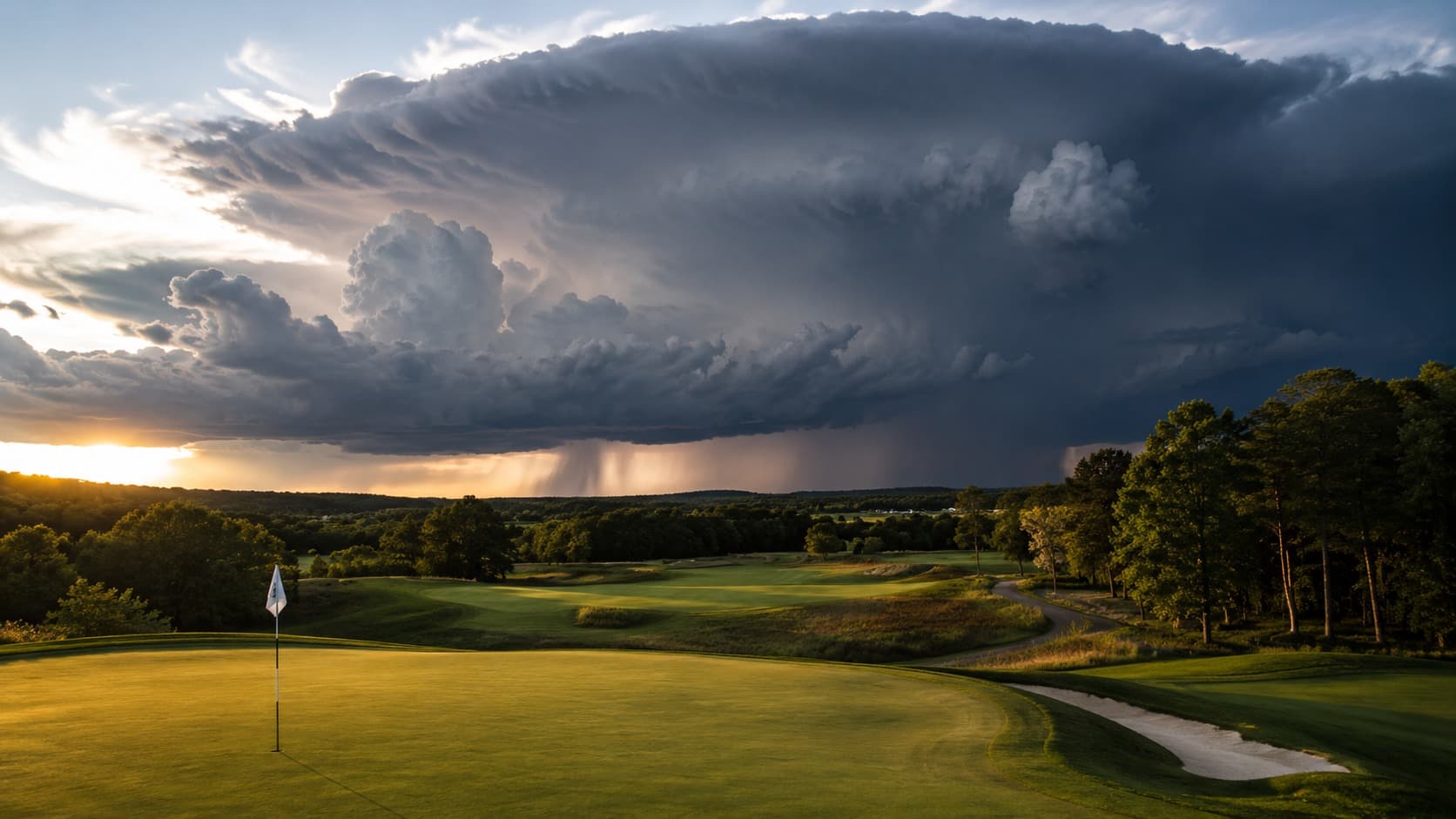
The Three O’Clock Storm: Reading Summer’s Convective Cycle to Protect Your Round
A 40% chance of afternoon thunderstorms does not mean a 40% chance of getting rained on. In the summer convective season it means the morning is nearly clear and the afternoon carries a fast-building, high-energy storm risk driven by a daily heating cycle. Here is the meteorology behind the pattern, the G-Score data on how the storm cycle punishes afternoon tee times across the Southeast, Midwest, and desert Southwest, the lightning-safety decision tree that actually matters, and the workflow that gets you off the course before the first bolt.
Read Story
How to Read a G-Score: The 0–100 Golf Playability Number, Decoded
A G-Score on this site is a single 0–100 number that tells you whether today is worth tee-up. Here is exactly what each band means, what drives the calculation, and how to use it to plan a round you will actually score on.
Read StoryMinSu Kim
Founder & Golf Data Analyst
MinSu is a data analyst and golfer with 10+ years on the course. He built Golf Weather Score to answer one question: is today a good day to play? He combines weather data, course intelligence, and the proprietary G-Score algorithm to help golfers make smarter decisions.
Every Friday Morning
When Acorns Golf Links plays best next weekend.
Friday 6am ET: peak G-Score windows for Acorns Golf Links, wind direction by hour, and one gear call. Three minutes to read, save you the round.
One email a week. Unsubscribe in one click.
The Caddie's Oracle
Draw your luck before the tee off