
Caddie's Gear Advisor
Curated for today's 74°F · Clear
Tour-Level Drivers
Engineered for maximum distance and forgiveness
Laser Rangefinders
Pin-seeking technology for precision approaches
Premium Golf Balls
Tour-caliber spin and distance performance
Performance Sunglasses
Polarized lenses optimized for reading greens
Your Golf Trip, Handled
The Ultimate Golf Trip Planner
Everything you need to play Alfred Tup Holmes Golf Course — from booking your flight to checking in course-side.
Course-Side Stays
Luxury hotels, resorts, and stay-and-play packages just minutes from the first tee.
Flights
Compare fares across 700+ airlines for the best route to your tee time.
SUV Rentals for Golf Bags
Spacious vehicles with room for clubs, bags, and your foursome.
Travel Insurance
Coverage for medical, weather delays, and gear at your destination.
Alfred Tup Holmes Golf Course: Course Intelligence
Signature Setup
I stood on the first tee at Tup Holmes on a flat-gray February morning, 41°F with frost still silvering the rough, and thought about how much history one municipal fairway can carry. This is the southwest Atlanta course tied to Alfred "Tup" Holmes — the golfer whose 1955 case, Holmes v. City of Atlanta, reached the U.S. Supreme Court and forced the desegregation of the city's public golf. You feel that weight before you feel the wind.
The course sits off Wilson Drive in the Adamsville area, a true city muni — par 72, roughly 6,700 yards from the tips, walkable and unpretentious. It is not a championship test in the East Lake sense; it is a neighborhood course with parkland trees, Bermuda turf, and a few creek crossings. What makes it worth a ranked, weather-aware writeup is exactly that everyday accessibility: this is where Atlanta golfers actually play, in real conditions, year-round.
Hole-by-Hole Wind & Playing Lines
The #1-handicap par-4 (~430y). The hardest two-shotter on the card runs uphill into the prevailing southwest breeze that builds across southwest Atlanta by mid-morning. Favor the left half of the fairway to open the angle, then take one extra club — a stock 7-iron approach becomes an honest 6 when the wind quarters into you at 8–10 mph. The green tilts back-to-front, so anything long leaves a slick downhiller.
The reachable par-5. On a calm morning this is a clear go-for-it hole; on a breezy SW afternoon the second shot turns into a layup decision. I'd rather wedge a third from 90 yards than chase a Bermuda-grain green-side bunker shot in the wind.
A short par-3 over the creek. Club selection here lives and dies on the breeze funneling down the low ground. Into even a light headwind I take dead aim at green center, never the pin — the creek punishes the brave more than it rewards them.
Green & Fairway Characteristics
The turf is Bermuda top to bottom, which defines how the course plays by season. From roughly December through February the Bermuda goes dormant and tan; the ball runs out hard on firm, fast fairways but the greens are slower until the sun warms them. In peak summer the grain is alive and aggressive — putts breaking with the grain pick up pace, putts into it die early. Fairways are generous parkland corridors framed by mature trees, with a low-120s slope from the back that tells you this is a fair, playable test rather than a brute.
Seasonal Weather Pattern
Tup Holmes's defining variable is not summer heat — it's winter frost timing and Atlanta's red-clay drainage. Unlike the late-August humidity story that governs East Lake across town, the leverage point here is the cold half of the year: January mornings often open in the upper 30s°F, and the city's tight clay soil holds water, so the day after a heavy rain the fairways stay soft and casual water lingers in the low spots. Spring brings the pine-pollen weeks of late March, when a yellow film coats everything but the turf wakes up. I haven't logged a full midsummer round here, so I lean on Atlanta's historical July record — low-90s°F highs with pop-up afternoon storms — rather than my own scorecard for that stretch.
Local Play Tips
Two things the tee-sheet won't tell you. First, in winter the greens are markedly faster by early afternoon than they are at sunrise — the same putt that dies at 9 a.m. will run three feet past at 1 p.m. once the Bermuda thaws. Second, after any real rainfall give it a full day: the clay base under these fairways drains slowly, and a Monday round after a Sunday storm means mud balls and plugged lies in the landing zones.
Pre-Round Weather Workflow
Check the 7-day G-Score and windExposure for the southwest Atlanta area before you book. In the cold months the single highest-leverage move is timing the frost, not beating the heat — take a second- or third-wave tee time after 9:30 a.m. so the Bermuda has thawed and the greens have picked up speed. In spring and summer, flip the logic: get out early to beat both the building southwest breeze on the long #1-handicap par-4 and the afternoon storm window. If the forecast shows heavy rain inside the prior 24 hours, push your round a day — the clay won't have given the water back yet.
Related Reading
Before you tee off at Alfred Tup Holmes Golf Course
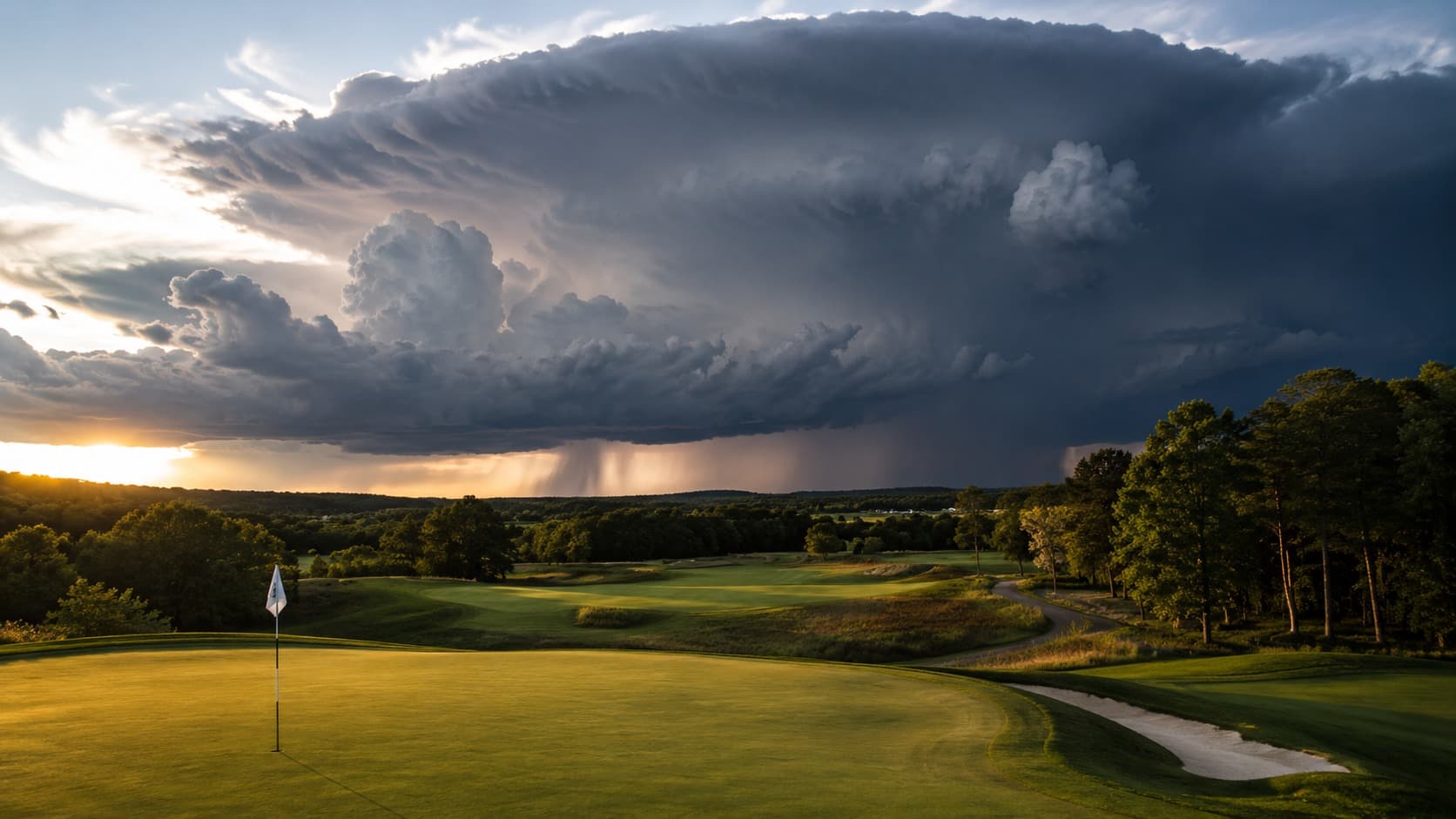
The Three O’Clock Storm: Reading Summer’s Convective Cycle to Protect Your Round
A 40% chance of afternoon thunderstorms does not mean a 40% chance of getting rained on. In the summer convective season it means the morning is nearly clear and the afternoon carries a fast-building, high-energy storm risk driven by a daily heating cycle. Here is the meteorology behind the pattern, the G-Score data on how the storm cycle punishes afternoon tee times across the Southeast, Midwest, and desert Southwest, the lightning-safety decision tree that actually matters, and the workflow that gets you off the course before the first bolt.
Read Story
The May 2026 G-Score Heatmap: Where American Golf Peaks This Spring
May is the most underrated month on the American golf calendar. Five regions hit their annual peak this spring, three turn quietly hostile, and the data tells a clearer story than the brochures. Here is where to play, where to avoid, and how to time your booking window.
Read StoryMinSu Kim
Founder & Golf Data Analyst
MinSu is a data analyst and golfer with 10+ years on the course. He built Golf Weather Score to answer one question: is today a good day to play? He combines weather data, course intelligence, and the proprietary G-Score algorithm to help golfers make smarter decisions.
Every Friday Morning
When Alfred Tup Holmes Golf Course plays best next weekend.
Friday 6am ET: peak G-Score windows for Alfred Tup Holmes Golf Course, wind direction by hour, and one gear call. Three minutes to read, save you the round.
One email a week. Unsubscribe in one click.
The Caddie's Oracle
Draw your luck before the tee off