
Caddie's Gear Advisor
Curated for today's 58°F · Mist
Tour-Level Drivers
Engineered for maximum distance and forgiveness
Laser Rangefinders
Pin-seeking technology for precision approaches
Premium Golf Balls
Tour-caliber spin and distance performance
Performance Sunglasses
Polarized lenses optimized for reading greens
Your Golf Trip, Handled
The Ultimate Golf Trip Planner
Everything you need to play All Weather Golf — from booking your flight to checking in course-side.
Course-Side Stays
Luxury hotels, resorts, and stay-and-play packages just minutes from the first tee.
Flights
Compare fares across 700+ airlines for the best route to your tee time.
SUV Rentals for Golf Bags
Spacious vehicles with room for clubs, bags, and your foursome.
Travel Insurance
Coverage for medical, weather delays, and gear at your destination.
All Weather Golf: Course Intelligence
Signature Setup
All Weather Golf sits at 634 N Pennsylvania Avenue in Wilkes-Barre (ZIP 18705), near 41.25°N in Luzerne County. I want to be straight up front: this is an indoor golf-simulator center, not an outdoor course. There are no fairways, no bunkers, and no greens to read — anything you've seen describing this place as a "parkland layout with undulating greens" is wrong. The actual product is a set of simulator bays running E6/TruGolf software, where you hit real shots into an impact screen and the system tracks the ball from impact to landing. You can practice on a virtual range or play a full round on a real course of your choosing, from any set of tees. Reservations and lessons go through (570) 574-2603.
When Weather Forces You Indoors (the real "playing lines")
This is where a venue like this matters on a weather site. Wilkes-Barre is Northeastern Pennsylvania — USDA zone 6a, roughly 600 feet of elevation, and an honest outdoor golf season of about seven months (April through October). The other five months are the problem: average winter lows near 20°F and roughly 46 inches of annual snowfall shut down outdoor play. I haven't hit balls at this specific venue, so I won't fake a bay-by-bay report — but I've spent enough NEPA-adjacent winters to know the pattern. When the G-Score on your home course drops into single digits from late November through March, an indoor sim is the only place your swing stays grooved. The "playing line" here is a scheduling decision, not a wind read.
Bay & Equipment Characteristics
The hitting surface is a mat and an impact screen, not live turf, so lie and rollout behave differently than grass — flush contact is rewarded and you lose the feedback of a tight or fluffy lie. The E6 engine includes adjustable aim, improved physics for shot accuracy, and full ball-flight tracking. Because the environment is climate-controlled, the variables that golfweatherscore normally tracks — wind, temperature, rain — are removed entirely. That is the point. You come here precisely to take weather out of the equation.
Seasonal Pattern (why "All Weather" is literal)
Outdoor courses around Wilkes-Barre play firm and fast in July and August, then turn cold and soggy through a short, gusty fall. By December the question isn't course conditions — it's whether anything is open at all. This venue's value curve is the inverse of an outdoor course: lowest demand in summer, highest from roughly November to March when snow and sub-freezing mornings end real play. If you're a NEPA golfer, that off-season window is exactly when your handicap quietly drifts up.
Local Play Tips
Call ahead — (570) 574-2603 — because simulator bays are time-blocked, unlike walking onto a range. If your goal is improvement rather than just escaping cabin fever, ask about the high-speed video lessons and situational-shot work; a screen with frame-by-frame video is more useful for swing changes than beating balls outdoors in a 35°F drizzle. Use winter sim sessions to rebuild tempo and pre-load specific real-course rounds you plan to play once April returns.
Pre-Round Weather Workflow
Flip the usual workflow. Instead of checking the 7-day G-Score to decide whether to play outside, use it as your trigger to come here: when the forecast shows sustained sub-40°F days, snow, or G-Scores too low for your home course, that's the signal to book an indoor bay. Treat the windExposure and temperature panels as a calendar — green outdoor windows mean play your real course; red ones mean keep your swing alive at All Weather Golf until conditions turn.
Related Reading
Before you tee off at All Weather Golf

The Mental Game: Sports Psychology Research Behind Golf's Greatest Clutch Performers
Science-backed sports psychology research reveals why golf's greatest clutch performers master pressure through routines, visualization, and focus.
Read Story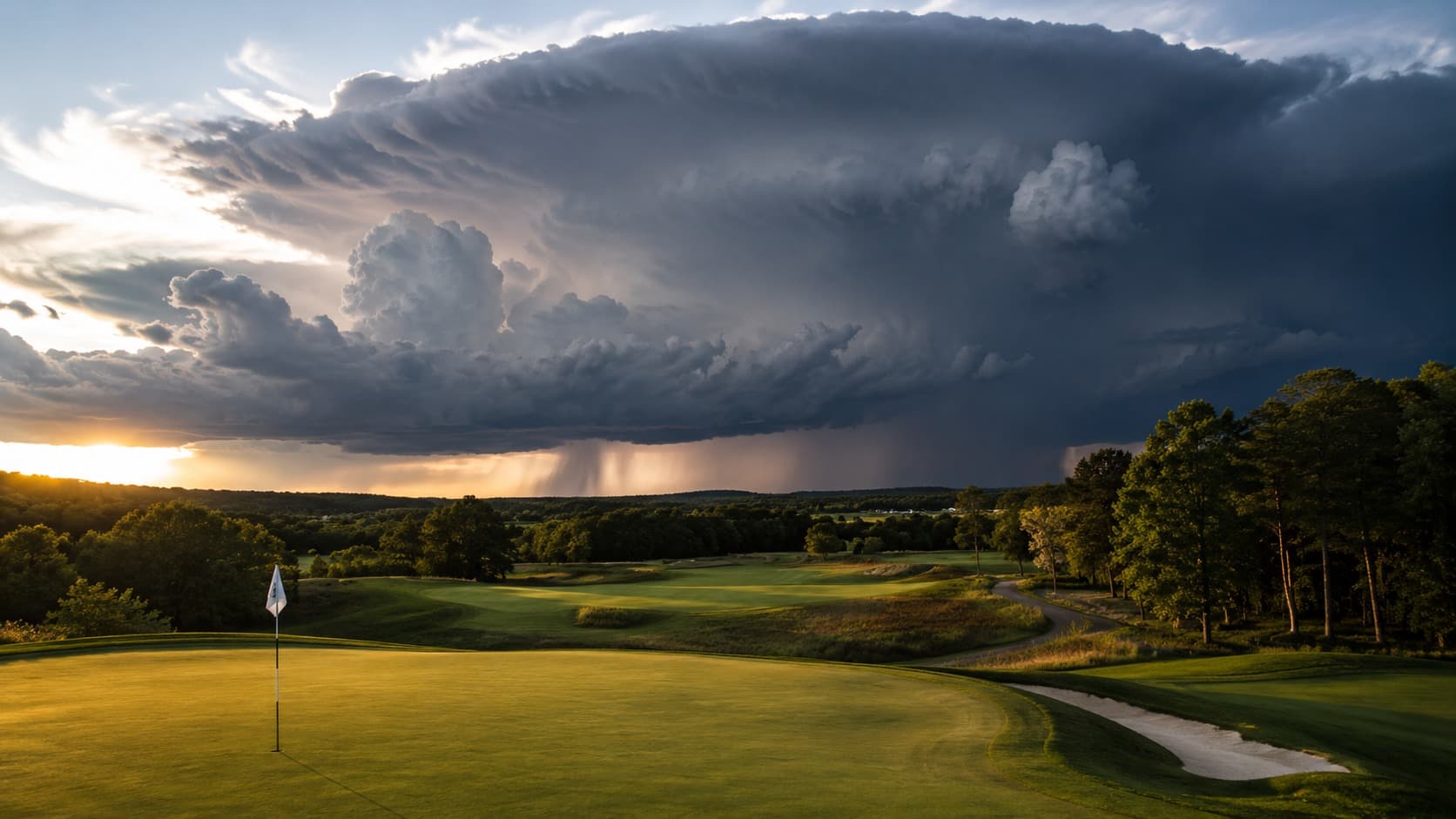
The Three O’Clock Storm: Reading Summer’s Convective Cycle to Protect Your Round
A 40% chance of afternoon thunderstorms does not mean a 40% chance of getting rained on. In the summer convective season it means the morning is nearly clear and the afternoon carries a fast-building, high-energy storm risk driven by a daily heating cycle. Here is the meteorology behind the pattern, the G-Score data on how the storm cycle punishes afternoon tee times across the Southeast, Midwest, and desert Southwest, the lightning-safety decision tree that actually matters, and the workflow that gets you off the course before the first bolt.
Read StoryMinSu Kim
Founder & Golf Data Analyst
MinSu is a data analyst and golfer with 10+ years on the course. He built Golf Weather Score to answer one question: is today a good day to play? He combines weather data, course intelligence, and the proprietary G-Score algorithm to help golfers make smarter decisions.
Every Friday Morning
When All Weather Golf plays best next weekend.
Friday 6am ET: peak G-Score windows for All Weather Golf, wind direction by hour, and one gear call. Three minutes to read, save you the round.
One email a week. Unsubscribe in one click.
The Caddie's Oracle
Draw your luck before the tee off