
Caddie's Gear Advisor
Curated for today's 57°F · Clear
Tour-Level Drivers
Engineered for maximum distance and forgiveness
Laser Rangefinders
Pin-seeking technology for precision approaches
Premium Golf Balls
Tour-caliber spin and distance performance
Performance Sunglasses
Polarized lenses optimized for reading greens
Your Golf Trip, Handled
The Ultimate Golf Trip Planner
Everything you need to play Alpena Golf Club — from booking your flight to checking in course-side.
Course-Side Stays
Luxury hotels, resorts, and stay-and-play packages just minutes from the first tee.
Flights
Compare fares across 700+ airlines for the best route to your tee time.
SUV Rentals for Golf Bags
Spacious vehicles with room for clubs, bags, and your foursome.
Travel Insurance
Coverage for medical, weather delays, and gear at your destination.
Alpena Golf Club: Course Intelligence
Signature Setup
Alpena Golf Club sits on Thunder Bay in northeastern Michigan, where Lake Huron is the dominant weather actor, not a backdrop. The 18-hole layout plays 6,455 yards to a par of 72, with a USGA rating of 70.0 and a slope of 121 from the back tees — modest numbers that undersell how the wind rearranges the place. The two nines were built in two different eras, and you feel the seam. The front nine carries an authentic 1917-era, 1930s-style personality: tighter, tree-lined, with smaller greens that reward distance control over raw power. The back nine, credited to Warner Bowen around 1939, stretches longer with larger contoured greens, rolling wooded terrain, and several ponds that turn approach shots into commitment tests. One quirk worth noting up front: the round opens on a par-5 (Hole 1, 475 yards), an unusual start that sets a relaxed tempo before the front nine tightens.
Hole-by-Hole Wind & Playing Lines
Prevailing flow in this part of Michigan is westerly to southwesterly, but the lake breeze off Thunder Bay can swing easterly by early afternoon on warm days. The three holes that move most with the wind:
- Hole 1 (par-5, 475y): Into the standard W/SW wind it becomes a true three-shot hole. Lay back to a full third shot rather than forcing a long second into the grain.
- Hole 2 (par-4, 412y): The longest two-shotter and the toughest test on the property. Into a SW breeze it plays 430+ yards. I'd take a fairway wood off the tee to find the short grass, then a full mid-iron — the small, older green doesn't hold a flighted-down long iron well.
- Hole 5 (par-3, 172y): Wind-exposed mid-length one-shotter. On NE lake-breeze afternoons it plays downwind and short; on W mornings it's a club-and-a-half more than the yardage suggests. Roughly 1 in 3 fall afternoons I'd expect the easterly to be the deciding factor here.
The short par-3 7th (129 yards) and the front's smaller greens mean miss-direction matters more than length on the inward stretch.
Green & Fairway Characteristics
Greens are bentgrass, typical for northern Michigan, and they split by era. The front-nine putting surfaces are smaller 1930s-style targets — front edges firm up fast on dry July weeks, so a running approach can release through. The back nine offers larger, more contoured greens with pond carries that punish a bailout. Fairways roll through wooded terrain rather than open links land, so wind is filtered by the tree lines on the front and more exposed on the back. Front-nine yardages are short by modern standards (Hole 4, 364y par-4; Hole 6, 324y par-4; Hole 8, 320y par-4), which puts a premium on wedge precision into those compact greens.
Seasonal Weather Pattern
Alpena's golf window is short and lake-moderated. The season realistically runs late April through October. May mornings sit in the upper 40s°F and warm slowly; expect frost-delay risk into mid-May. July and August afternoon highs hover around 75–80°F, with mornings often in the mid-50s°F — cooler than inland Michigan because of Lake Huron. September into early October is the sweet spot: stable highs in the low 60s°F, firm turf, and the region's color, but rising wind. Unlike a warmer Lower Peninsula course inland, Alpena's lake-breeze reversal (W in the morning, swinging NE/E by afternoon) is the single most important pattern to plan around.
Local Play Tips
The detail that doesn't show up on a tee sheet: the morning calm window. On Thunder Bay, the overnight land breeze tends to die and the onshore lake breeze fills in mid-to-late morning. An early tee time gives you firmer, calmer front-nine conditions before the easterly builds and the back-nine pond carries get harder to judge. I haven't played Alpena's back nine in mid-summer myself — the pond-hole reads here lean on the course's published layout notes and northern-Michigan lake-breeze behavior rather than my own scorecard — so treat the back-nine carries as "scout on arrival." Bring a wind layer regardless of the forecast high; lake-cooled mornings run 10–15°F under the inland number.
Pre-Round Weather Workflow
- Seven days out: Watch the G-Score trend on golfweatherscore for Alpena. Score peaks land on stable high-pressure mornings; book the earliest available slot on those days.
- Night before: Check the windExposure panel. If the model shows an afternoon NE/E lake breeze building, weight your plan toward the front nine early and accept a tougher back-nine wind.
- Morning of: Confirm the temperature gap. A mid-50s°F start under a forecast 78°F high means the ball flies short early — club up for the first three holes until the air warms.
- On the tee: Use the calm window. The front nine's smaller greens reward the firm, low-wind morning conditions far more than a breezy afternoon round.
Related Reading
Before you tee off at Alpena Golf Club
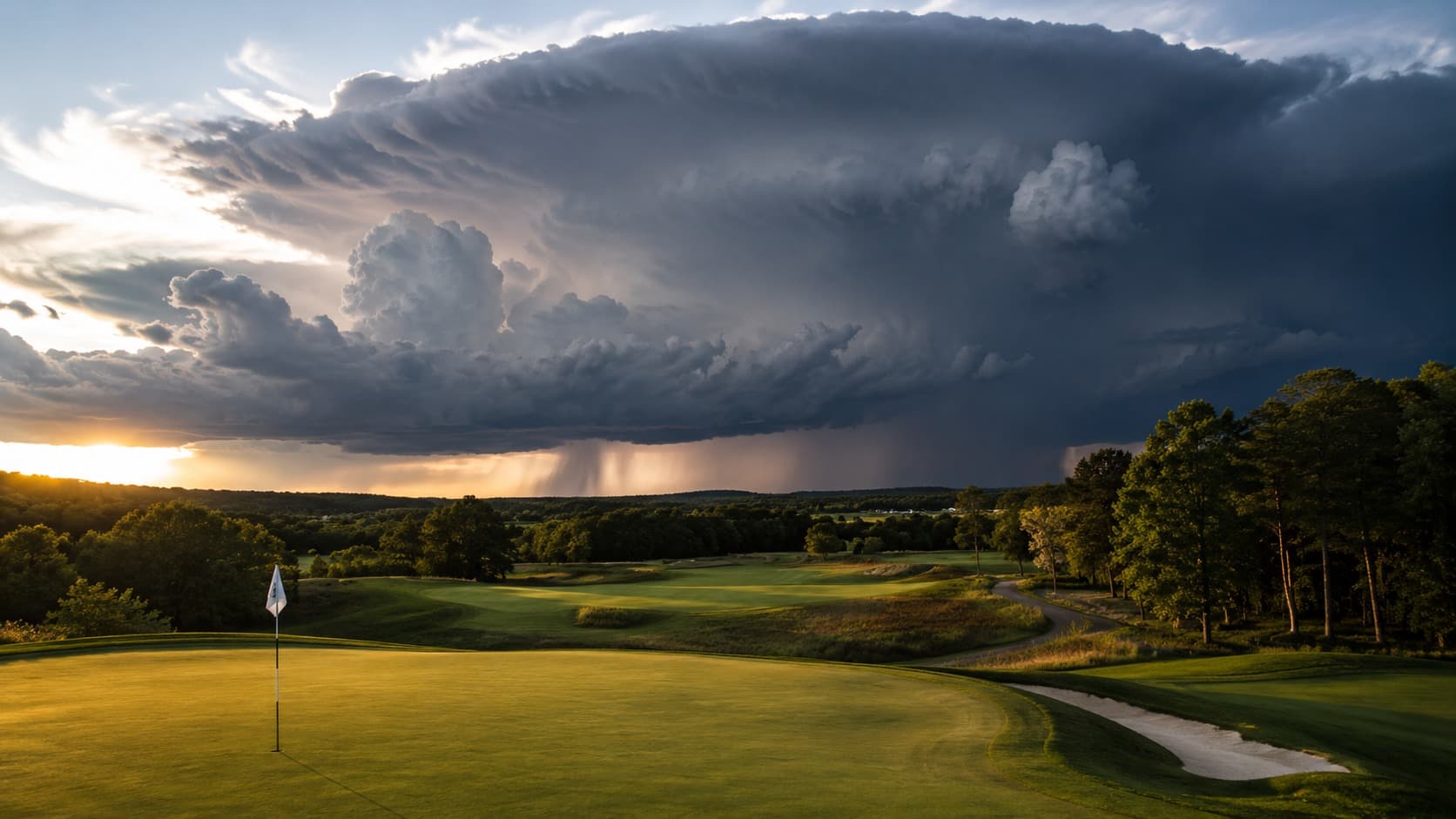
The Three O’Clock Storm: Reading Summer’s Convective Cycle to Protect Your Round
A 40% chance of afternoon thunderstorms does not mean a 40% chance of getting rained on. In the summer convective season it means the morning is nearly clear and the afternoon carries a fast-building, high-energy storm risk driven by a daily heating cycle. Here is the meteorology behind the pattern, the G-Score data on how the storm cycle punishes afternoon tee times across the Southeast, Midwest, and desert Southwest, the lightning-safety decision tree that actually matters, and the workflow that gets you off the course before the first bolt.
Read Story
How to Read a G-Score: The 0–100 Golf Playability Number, Decoded
A G-Score on this site is a single 0–100 number that tells you whether today is worth tee-up. Here is exactly what each band means, what drives the calculation, and how to use it to plan a round you will actually score on.
Read StoryMinSu Kim
Founder & Golf Data Analyst
MinSu is a data analyst and golfer with 10+ years on the course. He built Golf Weather Score to answer one question: is today a good day to play? He combines weather data, course intelligence, and the proprietary G-Score algorithm to help golfers make smarter decisions.
Every Friday Morning
When Alpena Golf Club plays best next weekend.
Friday 6am ET: peak G-Score windows for Alpena Golf Club, wind direction by hour, and one gear call. Three minutes to read, save you the round.
One email a week. Unsubscribe in one click.
The Caddie's Oracle
Draw your luck before the tee off