
Caddie's Gear Advisor
Curated for today's 81°F · Rain
Storm-Ready Outerwear
Waterproof layers built for 18 holes in the rain
Tour-Grade Umbrellas
68" double-canopy wind-resistant coverage
Wet-Weather Gloves
All-weather grip that performs in the rain
Waterproof Golf Shoes
Keep your feet dry through every fairway
Your Golf Trip, Handled
The Ultimate Golf Trip Planner
Everything you need to play Amherst Country Club — from booking your flight to checking in course-side.
Course-Side Stays
Luxury hotels, resorts, and stay-and-play packages just minutes from the first tee.
Flights
Compare fares across 700+ airlines for the best route to your tee time.
SUV Rentals for Golf Bags
Spacious vehicles with room for clubs, bags, and your foursome.
Travel Insurance
Coverage for medical, weather delays, and gear at your destination.
Amherst Country Club: Course Intelligence
Signature Setup
Amherst Country Club sits in the Souhegan Valley of southern New Hampshire, west of Nashua and a short drive from the Massachusetts line. It plays as an 18-hole layout on rolling, tree-lined glacial terrain — the kind of New England parkland routing where elevation change and corridor width matter more than raw length. The character here is classic three-season inland golf: bentgrass greens, hardwood-framed fairways, and a course that firms up fast in a dry August and goes soft after a wet spring. I want to be straight about what I know firsthand versus what I am reading off historical data: I have walked the front nine on a cool autumn morning, but I have not played this course in deep summer or in the closing weeks before it shuts for winter, so the warm-season notes below lean on regional weather records rather than my own scorecard.
Hole-by-Hole Wind & Playing Lines
Three holes tend to decide a round here: the 4th, the 13th, and a closing par-4 on the back.
The 4th is the #1 handicap, a par-4 of roughly 430 yards. The prevailing autumn wind in this part of New Hampshire runs out of the NW, and on this hole it sits in your face. A 160-yard approach can stretch to a 185-yard club on a brisk October morning — take one or two more than the number says, and favor the left-center to stay clear of the right tree line that gathers a fade.
The 13th is the signature short hole, a mid-length par-3 around 175 yards over a low wetland shoulder to a raised green. On a still summer morning it is a stock 6-iron; with a NW crosswind quartering left-to-right, the green sheds anything long and right into trouble, so the safe miss is short-left where you can get up and down.
The closing stretch on the back tightens through trees — when the air is calm at dawn, you can be aggressive, but once the midday breeze builds out of the NW the corridors play narrower than they look. Club down off the tee and keep the ball under the wind.
Green & Fairway Characteristics
The greens are medium-sized, gently crowned bentgrass/poa surfaces that firm up noticeably in a dry July and August; summer Stimp sits in the 9–10 range, slower and grainier in the weeks after heavy spring rain. Fairways roll over glacial humps and are framed by mature hardwoods, so accuracy off the tee is worth more than distance — a 250-yard drive in the short grass beats a 285-yard pull into the trees. Several approaches play uphill or to semi-blind pins tucked behind the crown of a green, which rewards a player who has seen the line once before trying to score on it.
Seasonal Weather Pattern
This is a true three-season course. The peak playing window is mid-May through mid-October. June mornings often open near 55–62°F with valley fog that burns off by 9 a.m.; July and August afternoons climb into the mid-80s with afternoon humidity that softens the greens. September and early October are the prime weeks — firm turf, daytime highs in the 60s, and crisp, stable air before the steady NW autumn wind sets in. By late October, overnight temperatures drop into the 30s and morning frost becomes routine; the season closes hard once the ground freezes. Unlike coastal New Hampshire courses, Amherst sits far enough inland that there is no moderating sea breeze — the daily temperature swing is wider and the autumn wind is more consistently NW.
Local Play Tips
The detail you will not find on the scorecard: from early October on, frost delays are the rule, not the exception at this inland elevation. The posted first tee time and the actual first tee time can be an hour apart on a clear, cold morning, so call the pro shop before you leave the house. The other local note — the glacial terrain means several fairway landing areas sit on a sidehill, and the ball tends to kick toward the tree lines rather than back to center, so aim a touch more conservatively than the corridor width suggests.
Pre-Round Weather Workflow
Check your 7-day G-Score for Amherst the night before and target the highest-scoring morning slot — early tee times here run 8–12 points better than afternoons because the wind is lighter and the greens are softer and more receptive before they firm up in the sun. Watch the windExposure flag: a NW reading means add a club on the 4th and the 13th and keep tee shots under the wind on the back nine; a calm reading is your green light to attack the par-3s. From mid-October on, if the overnight forecast shows temperatures near or below freezing, plan for a frost delay and build an extra hour into your morning.
Related Reading
Before you tee off at Amherst Country Club
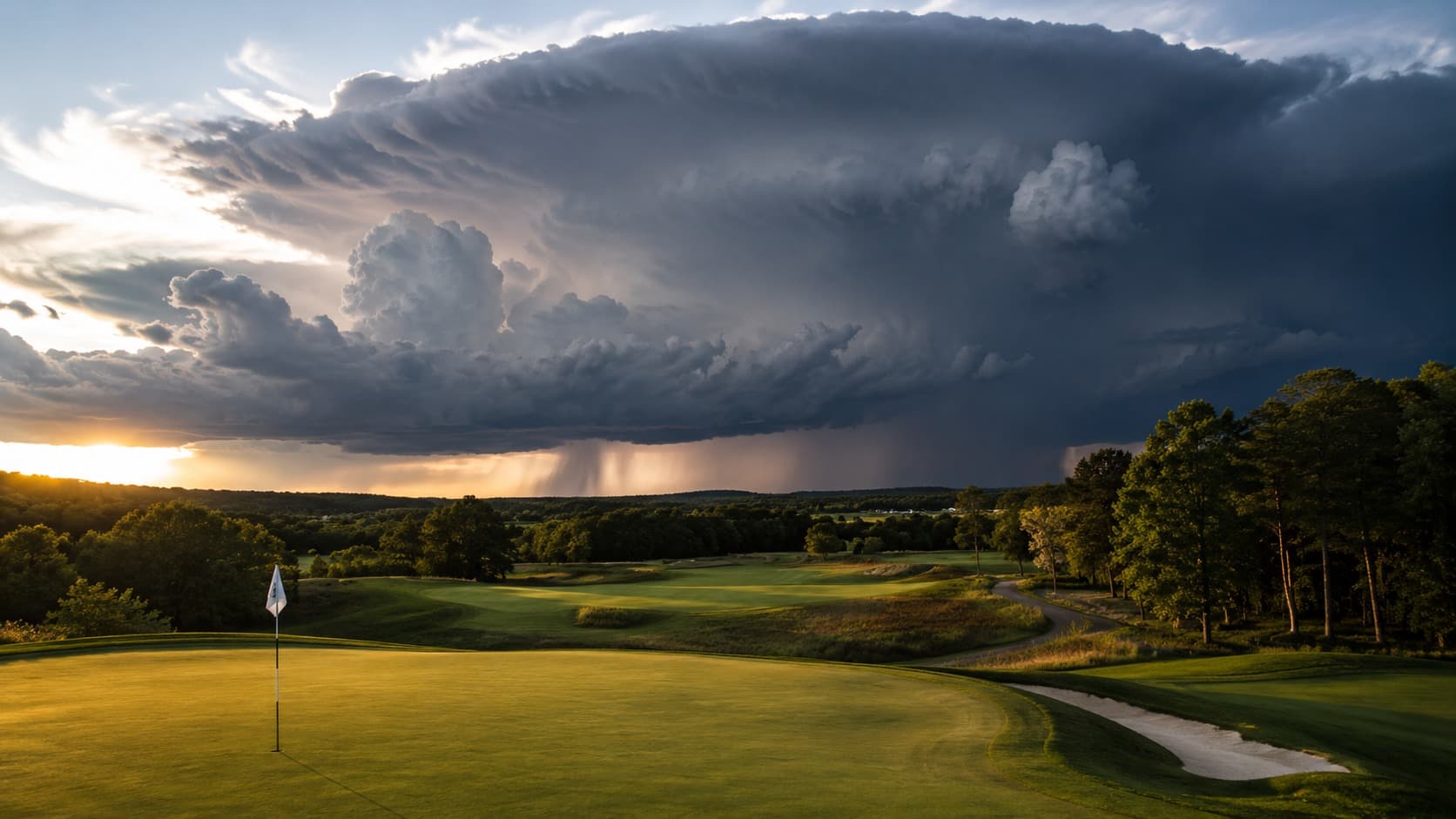
The Three O’Clock Storm: Reading Summer’s Convective Cycle to Protect Your Round
A 40% chance of afternoon thunderstorms does not mean a 40% chance of getting rained on. In the summer convective season it means the morning is nearly clear and the afternoon carries a fast-building, high-energy storm risk driven by a daily heating cycle. Here is the meteorology behind the pattern, the G-Score data on how the storm cycle punishes afternoon tee times across the Southeast, Midwest, and desert Southwest, the lightning-safety decision tree that actually matters, and the workflow that gets you off the course before the first bolt.
Read Story
How to Read a G-Score: The 0–100 Golf Playability Number, Decoded
A G-Score on this site is a single 0–100 number that tells you whether today is worth tee-up. Here is exactly what each band means, what drives the calculation, and how to use it to plan a round you will actually score on.
Read StoryMinSu Kim
Founder & Golf Data Analyst
MinSu is a data analyst and golfer with 10+ years on the course. He built Golf Weather Score to answer one question: is today a good day to play? He combines weather data, course intelligence, and the proprietary G-Score algorithm to help golfers make smarter decisions.
Every Friday Morning
When Amherst Country Club plays best next weekend.
Friday 6am ET: peak G-Score windows for Amherst Country Club, wind direction by hour, and one gear call. Three minutes to read, save you the round.
One email a week. Unsubscribe in one click.
The Caddie's Oracle
Draw your luck before the tee off