
Caddie's Gear Advisor
Curated for today's 74°F · Clear
Tour-Level Drivers
Engineered for maximum distance and forgiveness
Laser Rangefinders
Pin-seeking technology for precision approaches
Premium Golf Balls
Tour-caliber spin and distance performance
Performance Sunglasses
Polarized lenses optimized for reading greens
Your Golf Trip, Handled
The Ultimate Golf Trip Planner
Everything you need to play Anetsberger Golf Course — from booking your flight to checking in course-side.
Course-Side Stays
Luxury hotels, resorts, and stay-and-play packages just minutes from the first tee.
Flights
Compare fares across 700+ airlines for the best route to your tee time.
SUV Rentals for Golf Bags
Spacious vehicles with room for clubs, bags, and your foursome.
Travel Insurance
Coverage for medical, weather delays, and gear at your destination.
Anetsberger Golf Course: Course Intelligence
TL;DR: Anetsberger Golf Course is a short 9-hole executive layout run by the Northbrook Park District in the northern Chicago suburbs. You don't overpower this course — you manage the wind off Lake Michigan, roughly 8 miles to the east, and the cold-dense air of a Midwestern spring. Play early-morning rounds in May and June for soft greens and calm air; club up whenever the wind turns onshore from the northeast.
Signature Setup
Anetsberger is not a championship test, and pretending otherwise would do a reader no favors. It is a compact 9-hole executive course operated by the Northbrook Park District in Northbrook, Illinois, dating to the late 1960s. The value here is exactly what an executive course is supposed to deliver: a fast walking loop, short par-3s and a couple of reachable par-4s, and a place to drill iron play without burning a full afternoon. I haven't found a credited signature architect for the original routing — it reads as a parks-department layout, and I'd rather say that plainly than invent a famous name.
What makes it worth a write-up on a weather site is its setting. Northbrook sits in the Lake Michigan wind shadow that defines spring golf across Chicago's North Shore, and that single fact governs how every short approach here behaves.
Hole-by-Hole Wind & Playing Lines
The prevailing flow in spring is from the northwest, but the one that wrecks scorecards is the onshore northeast breeze off the lake that builds through late morning.
- The longest par-4 (toughest hole): Into the NW spring wind, a hole you'd normally flip a wedge into needs a full extra club on the approach. Play for the front edge — most golfers come up short here, not long, because the cold air eats carry.
- The pond par-3 (signature): A short downhill one-shotter with the only forced water carry on the loop. Calm, it's a smooth 8-iron. In a 12–15 mph north wind it's a knockdown 6-iron that you start at the back of the green and let the breeze hold up.
- A blind-ish mid-iron par-3: With nothing tall to block the northeast flow, club selection swings two clubs week to week. Check the flag, then check which way the trees are leaning.
Green & Fairway Characteristics
Greens are a bentgrass/poa mix typical of older North Shore municipal turf. In a wet Chicago spring they sit soft and slow, and a high approach plugs and stays. By July and August they firm and quicken into the mid-9s on the stimp, and the same shot that stuck in May now releases past the hole. Fairways are flat to gently rolling — this is glacial-plain terrain, not hill country — so the defense is wind and green firmness, not elevation. At executive length, the premium is on distance control with wedges and short irons, the exact skills the lake breeze scrambles.
Seasonal Weather Pattern
Northbrook's golf season effectively runs April through October. April mornings still drop into the low 40s°F, and that cold, dense air costs noticeable carry — a stock 9-iron plays a club shorter than the summer version. May and June bring the wettest, softest conditions and the most receptive greens of the year. July and August settle into the low-to-mid 80s°F, firmer and faster, with afternoon lake breezes the dominant variable. By October you're back to 50s°F highs and shorter daylight, and frost delays start eating into early tee times. The lake never lets the North Shore warm or cool as fast as courses 40 miles inland — keep that lag in mind when you read a regional forecast. I've played enough May rounds on this side of Chicago to stop trusting the car thermometer: it can read 60°F in the lot and feel ten degrees colder once you're standing on an exposed tee with the breeze off the water.
Local Play Tips
The practical move at an executive course like this is to treat it as a calibration round: bring a launch read on your wedges in, because the wind off the lake will expose any distance you can't control. Book the first or second tee time of the day — the air is calmest before mid-morning, and on a short course those calm holes are where you actually post a number. If the morning is cold and damp, expect the greens to hold anything; if it's a firm August afternoon with an onshore breeze, land your short irons short of the flag and let them feed.
Pre-Round Weather Workflow
Use the 7-day G-Score and weight wind direction heavily — on a short course, a swing of two clubs from the breeze matters more than it would on a long one. Check the windExposure rating against the lake: a northeast onshore reading means the longest par-4 and the pond par-3 both play a club-and-a-half tougher. If the forecast shows a sub-50°F morning, add a club across the bag and expect soft, holding greens. If it shows a calm, dry window before 9 a.m., that's your scoring slot here — take it.
Related Reading
Before you tee off at Anetsberger Golf Course
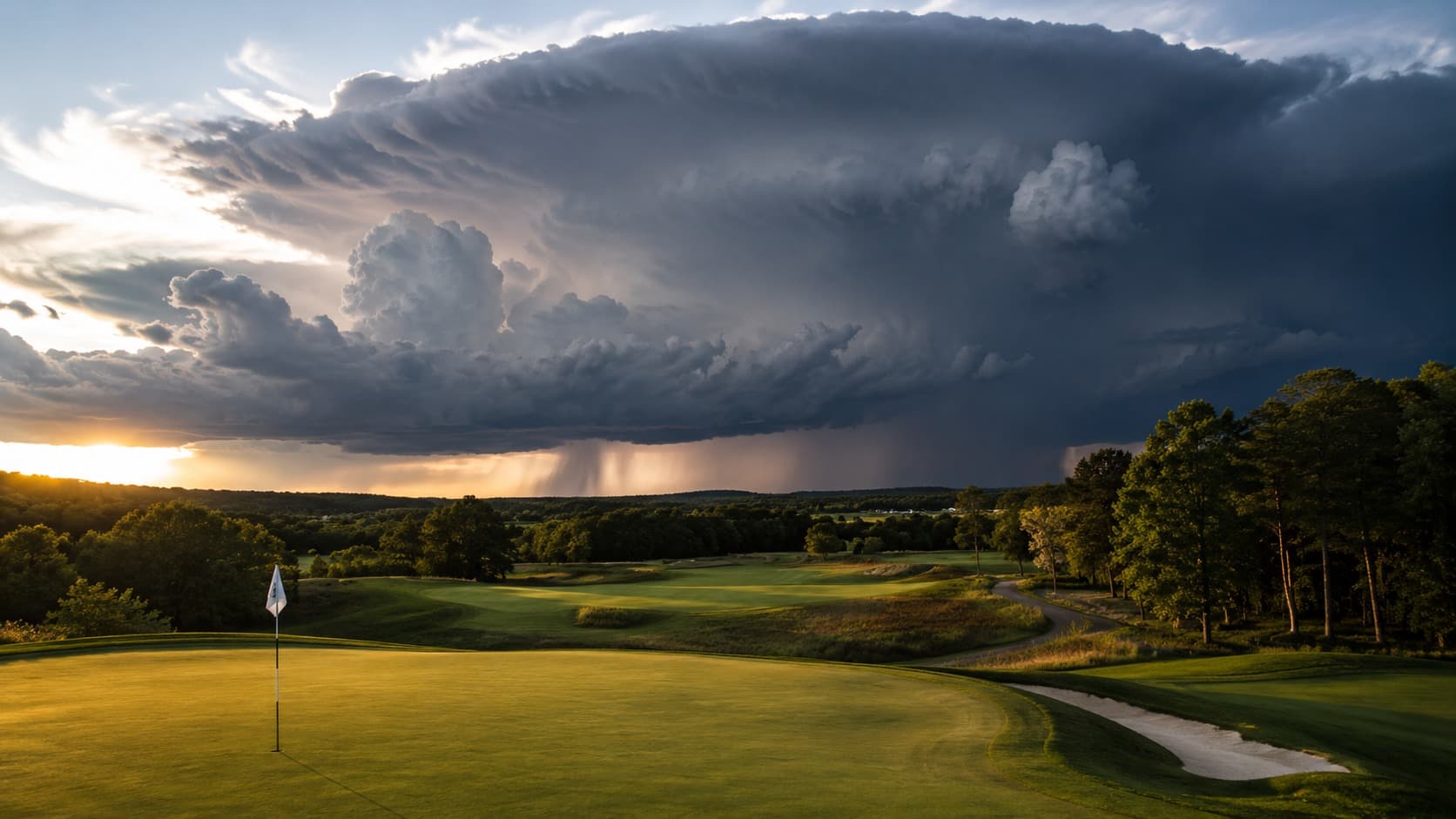
The Three O’Clock Storm: Reading Summer’s Convective Cycle to Protect Your Round
A 40% chance of afternoon thunderstorms does not mean a 40% chance of getting rained on. In the summer convective season it means the morning is nearly clear and the afternoon carries a fast-building, high-energy storm risk driven by a daily heating cycle. Here is the meteorology behind the pattern, the G-Score data on how the storm cycle punishes afternoon tee times across the Southeast, Midwest, and desert Southwest, the lightning-safety decision tree that actually matters, and the workflow that gets you off the course before the first bolt.
Read Story
How to Read a G-Score: The 0–100 Golf Playability Number, Decoded
A G-Score on this site is a single 0–100 number that tells you whether today is worth tee-up. Here is exactly what each band means, what drives the calculation, and how to use it to plan a round you will actually score on.
Read StoryMinSu Kim
Founder & Golf Data Analyst
MinSu is a data analyst and golfer with 10+ years on the course. He built Golf Weather Score to answer one question: is today a good day to play? He combines weather data, course intelligence, and the proprietary G-Score algorithm to help golfers make smarter decisions.
Every Friday Morning
When Anetsberger Golf Course plays best next weekend.
Friday 6am ET: peak G-Score windows for Anetsberger Golf Course, wind direction by hour, and one gear call. Three minutes to read, save you the round.
One email a week. Unsubscribe in one click.
The Caddie's Oracle
Draw your luck before the tee off