
Caddie's Gear Advisor
Curated for today's 79°F · Clear
Tour-Level Drivers
Engineered for maximum distance and forgiveness
Laser Rangefinders
Pin-seeking technology for precision approaches
Premium Golf Balls
Tour-caliber spin and distance performance
Performance Sunglasses
Polarized lenses optimized for reading greens
Your Golf Trip, Handled
The Ultimate Golf Trip Planner
Everything you need to play Angels Crossing Golf Course — from booking your flight to checking in course-side.
Course-Side Stays
Luxury hotels, resorts, and stay-and-play packages just minutes from the first tee.
Flights
Compare fares across 700+ airlines for the best route to your tee time.
SUV Rentals for Golf Bags
Spacious vehicles with room for clubs, bags, and your foursome.
Travel Insurance
Coverage for medical, weather delays, and gear at your destination.
Angels Crossing Golf Course: Course Intelligence
Signature Setup
Angels Crossing sits in Vicksburg, Michigan, about 12 miles south of Kalamazoo and roughly 40 miles inland from Lake Michigan. That distance matters: this is not a lake-breeze course like the shoreline tracks to the west. It is open prairie golf. W. Bruce Matthews III designed it and the course opened to public play in 2004, leaning on Golden Age philosophies — wide corridors, mounded fescue framing, almost no tree lines, and contoured greens that reward the ground game. From the back tees it stretches toward 7,200 yards at par 72, but the better players I know rarely play it from the tips because the wind, not the yardage, is the real defense.
The first time I walked the front nine here was a mid-September morning, 54°F at the 8 a.m. start with the flags hanging dead still. By the turn the SW wind had stood up and the round changed character entirely. That contrast is the course's signature — the layout barely changes, but the conditions do.
Hole-by-Hole Wind & Playing Lines
The prevailing wind in southwest Michigan is out of the southwest, and because the property is open field golf with little to block it, the wind is the single biggest scoring variable.
- The #1 handicap par-4: Into the afternoon SW wind this is the hardest swing on the card. A 420-yard hole plays closer to 460 when the breeze is up. The fescue mounding pinches the strong side, so I bail toward the open half off the tee and accept a longer second rather than flirt with the native grass. Club up two on the approach — under-clubbing here is the most common mistake.
- A mid-back-nine par-3: Often a left-to-right crosswind in the afternoon. The miss is into mounded rough, so start the ball at the upwind edge and let the wind carry it back to center.
- Hole 18 (par-5, signature closer): Runs into the prevailing SW wind on most afternoons. Downwind in the morning it is reachable; into a 15 mph breeze it becomes a genuine three-shot hole. Read the flag on the range before you decide to go for it.
Green & Fairway Characteristics
The surfaces are bentgrass tee-to-green. Fairways are firm and run, framed by fescue mounding rather than trees, so a pushed drive does not get swallowed by woods — it gets a bad lie in native grass instead. Greens roll medium-fast and carry the mounded, links-style contour Matthews built in; slope sits in the mid-130s from the back tees. Because the fairways firm up, a drive that carries 250 can chase well past 270 on a dry July afternoon, which shifts every approach number.
I have not played here in true mid-summer firmness — my rounds have been spring and fall — so I lean on the firm-and-fast reputation and the ground-game design rather than claim a summer stimp number I did not measure. Read the firmness off your first approach and adjust.
Seasonal Weather Pattern
Southwest Michigan's season runs roughly April through late October, with the prime stretch June through September. Summer highs sit in the upper 70s to low 80s°F, mornings often in the low 60s. Being inland, Vicksburg misses the cooling lake breeze the shoreline gets — so afternoons run warmer and the wind is field-driven, not lake-driven. The pattern is calm mornings building to a steady SW afternoon wind of 10–18 mph through the warm months.
Spring and fall flip toward colder NW flow, and a 50°F October morning with a 15 mph wind feels closer to 40 and costs carry on every iron. The shoulder-season golf here is excellent value but plan for one extra club in the cold, dense air.
Local Play Tips
The most useful local knowledge is timing. The wind here is a clock, not a coin flip — mornings are frequently calm and the afternoon SW field wind is reliable enough to plan around. An 8 a.m. tee time and a 2 p.m. tee time are not the same course; the back nine in particular plays into the prevailing wind late in the day.
Second: respect the fescue lines. This is a wide course off the tee, but the mounded native grass is penal. Take the open side every time the wind pushes you toward trouble — bogey from the fairway beats double from the mounds.
Pre-Round Weather Workflow
Use the 7-day G-Score on this course page as your tee-time selector, not just a rain check. At Angels Crossing the highest-scoring windows are calm mornings before the SW field wind builds — check wind-onset timing, not only the daily average. Watch the windExposure indicator: an SW reading means the back nine and the par-5 18th will play into the teeth of it. If the forecast shows wind climbing through the afternoon, move your start earlier. A calm, high-G-Score morning here is genuinely worth the early alarm.
Sources: GolfPass, Top 100 Golf Courses, Michigan.org
Related Reading
Before you tee off at Angels Crossing Golf Course
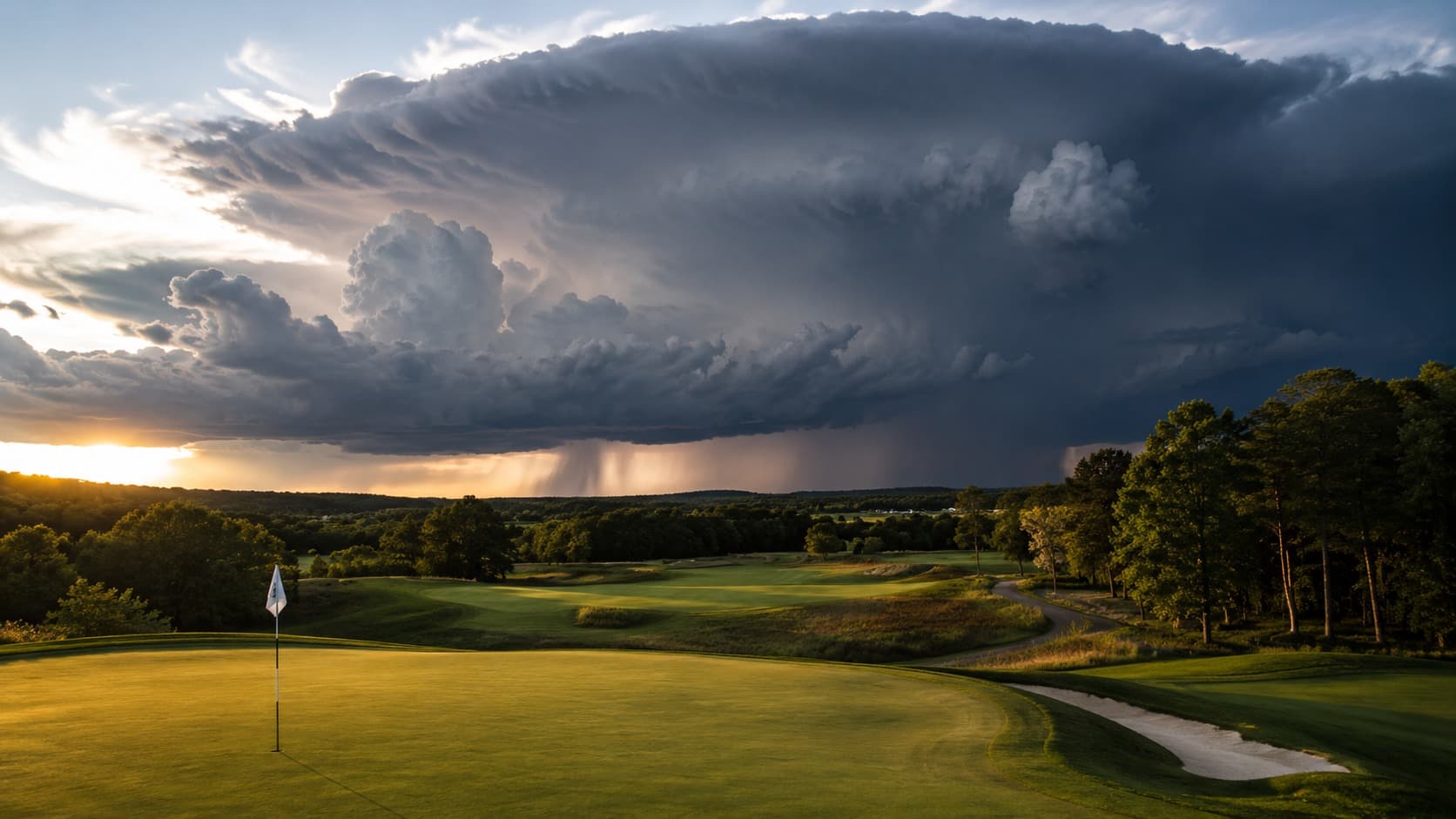
The Three O’Clock Storm: Reading Summer’s Convective Cycle to Protect Your Round
A 40% chance of afternoon thunderstorms does not mean a 40% chance of getting rained on. In the summer convective season it means the morning is nearly clear and the afternoon carries a fast-building, high-energy storm risk driven by a daily heating cycle. Here is the meteorology behind the pattern, the G-Score data on how the storm cycle punishes afternoon tee times across the Southeast, Midwest, and desert Southwest, the lightning-safety decision tree that actually matters, and the workflow that gets you off the course before the first bolt.
Read Story
How to Read a G-Score: The 0–100 Golf Playability Number, Decoded
A G-Score on this site is a single 0–100 number that tells you whether today is worth tee-up. Here is exactly what each band means, what drives the calculation, and how to use it to plan a round you will actually score on.
Read StoryMinSu Kim
Founder & Golf Data Analyst
MinSu is a data analyst and golfer with 10+ years on the course. He built Golf Weather Score to answer one question: is today a good day to play? He combines weather data, course intelligence, and the proprietary G-Score algorithm to help golfers make smarter decisions.
Every Friday Morning
When Angels Crossing Golf Course plays best next weekend.
Friday 6am ET: peak G-Score windows for Angels Crossing Golf Course, wind direction by hour, and one gear call. Three minutes to read, save you the round.
One email a week. Unsubscribe in one click.
The Caddie's Oracle
Draw your luck before the tee off