
Caddie's Gear Advisor
Curated for today's 65°F · Clouds
Tour-Level Drivers
Engineered for maximum distance and forgiveness
Laser Rangefinders
Pin-seeking technology for precision approaches
Premium Golf Balls
Tour-caliber spin and distance performance
Performance Sunglasses
Polarized lenses optimized for reading greens
Your Golf Trip, Handled
The Ultimate Golf Trip Planner
Everything you need to play Ankeny Golf and Country Club — from booking your flight to checking in course-side.
Course-Side Stays
Luxury hotels, resorts, and stay-and-play packages just minutes from the first tee.
Flights
Compare fares across 700+ airlines for the best route to your tee time.
SUV Rentals for Golf Bags
Spacious vehicles with room for clubs, bags, and your foursome.
Travel Insurance
Coverage for medical, weather delays, and gear at your destination.
Ankeny Golf and Country Club: Course Intelligence
Signature Setup
The first thing I noticed at Ankeny Golf and Country Club is how short the card reads and how long the round plays. From the Blue tees it is just 5,996 yards, par 70, rated 69.6 with a slope of 121 — numbers that suggest a gentle parkland walk at 314 SW Irvinedale Dr, north of Des Moines. The scorecard does not tell you about the wind. This is a classic mid-century Iowa club with a tight, tree-lined routing; I could not confirm the original architect from public records, so I won't put a name on it that I can't stand behind. What I can stand behind is the shape of the test: two par-4s of 428 yards bookend the round, and the par-3s have real teeth.
Hole-by-Hole Wind & Playing Lines
Iowa's prevailing summer wind comes out of the south to south-southwest, and the routing here makes you pay for it on the hardest holes.
- Hole 10 (#1 handicap, par-4, 428y): The toughest hole on the course plays into the prevailing S/SSW breeze most summer afternoons. A 428-yard par-4 into a 10–15 mph wind is effectively a 460-yard hole — driver, then a held mid-iron. I tried to fly a 6-iron to the flag here and came up short twice; the smart play is to land it short and let it release.
- Hole 1 (#2 handicap, par-4, 428y): Same yardage, calmer in the morning. Tee off before the wind builds and this is a far more forgiving opener than the 10th.
- Hole 13 (#3 handicap, par-5, 470y): Reachable in two when the wind is at your back out of the north, but the green sits near the creek and rejects anything long.
Green & Fairway Characteristics
The greens at Ankeny are bentgrass and break consistently toward the creek that threads the property — a tilt your eyes will under-read, especially on downhill putts. The fairways are bluegrass and tree-lined, so accuracy off the tee matters more than length on a course this short. The front and back nines mirror each other in feel: the back repeats the 428-yard par-4 and the 470-yard par-5, so by the 13th you already know the lines. Slope is 121 from the Blue and 116 from the White (5,676 yards), so the difficulty comes from precision and wind, not raw distance.
Seasonal Weather Pattern
Central Iowa golf runs roughly April through October. July and August afternoons sit in the mid-80s°F with that persistent south wind and pop-up thunderstorms; mornings in the low-60s°F are the calmest, firmest conditions you'll get. September and early October are the sweet spot — cool, dry, light wind, and fairways that have firmed up. I have not played here in a true Iowa winter and won't pretend to; the course is effectively closed once the ground freezes.
Local Play Tips
Book the earliest tee time you can. The wind on this routing is the entire defense, and it is meaningfully lighter before mid-morning — the two 428-yard par-4s (Holes 1 and 10) go from brutal to manageable. On creek-side greens, trust the tilt toward the water over your read and play about six inches less break than you think; that is the single putt where most visitors three-jack.
Pre-Round Weather Workflow
Use the 7-day G-Score and windExposure forecast before you book. Sort for the morning slot with the lowest sustained south wind — on this layout a calm 8 a.m. round can score 8–12 points better on G-Score than the same round at 3 p.m. Check the windExposure direction: a north tailwind shortens the 470-yard 13th into a real birdie chance, while a strong S/SSW headwind means clubbing up one to two extra on Holes 1 and 10. If thunderstorms show on the afternoon panel, take the early tee time and walk fast.
Related Reading
Before you tee off at Ankeny Golf and Country Club
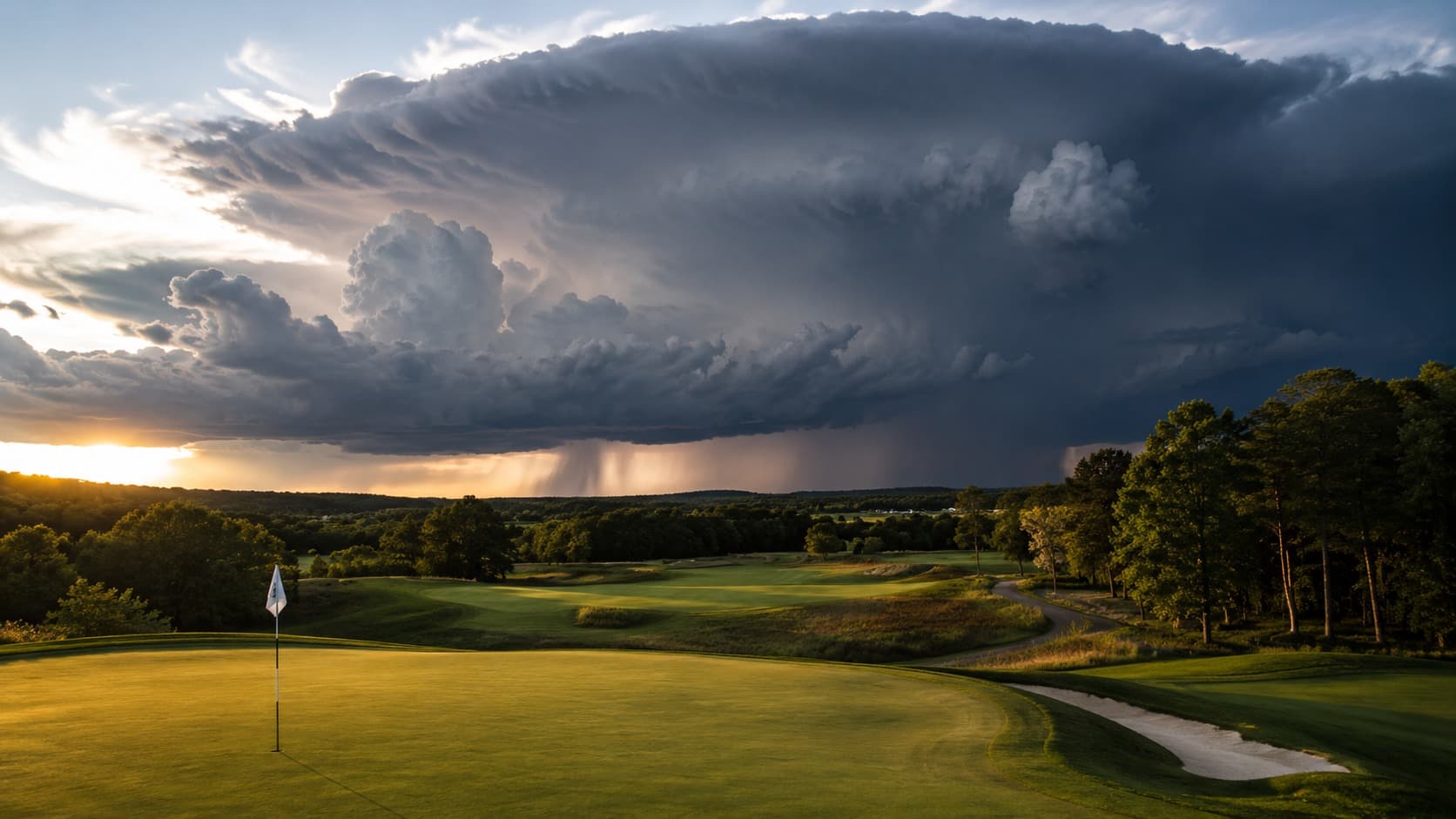
The Three O’Clock Storm: Reading Summer’s Convective Cycle to Protect Your Round
A 40% chance of afternoon thunderstorms does not mean a 40% chance of getting rained on. In the summer convective season it means the morning is nearly clear and the afternoon carries a fast-building, high-energy storm risk driven by a daily heating cycle. Here is the meteorology behind the pattern, the G-Score data on how the storm cycle punishes afternoon tee times across the Southeast, Midwest, and desert Southwest, the lightning-safety decision tree that actually matters, and the workflow that gets you off the course before the first bolt.
Read Story
How to Read a G-Score: The 0–100 Golf Playability Number, Decoded
A G-Score on this site is a single 0–100 number that tells you whether today is worth tee-up. Here is exactly what each band means, what drives the calculation, and how to use it to plan a round you will actually score on.
Read StoryMinSu Kim
Founder & Golf Data Analyst
MinSu is a data analyst and golfer with 10+ years on the course. He built Golf Weather Score to answer one question: is today a good day to play? He combines weather data, course intelligence, and the proprietary G-Score algorithm to help golfers make smarter decisions.
Every Friday Morning
When Ankeny Golf and Country Club plays best next weekend.
Friday 6am ET: peak G-Score windows for Ankeny Golf and Country Club, wind direction by hour, and one gear call. Three minutes to read, save you the round.
One email a week. Unsubscribe in one click.
The Caddie's Oracle
Draw your luck before the tee off