
Caddie's Gear Advisor
Curated for today's 56°F · Clear
Tour-Level Drivers
Engineered for maximum distance and forgiveness
Laser Rangefinders
Pin-seeking technology for precision approaches
Premium Golf Balls
Tour-caliber spin and distance performance
Performance Sunglasses
Polarized lenses optimized for reading greens
Your Golf Trip, Handled
The Ultimate Golf Trip Planner
Everything you need to play Antrim Dells — from booking your flight to checking in course-side.
Course-Side Stays
Luxury hotels, resorts, and stay-and-play packages just minutes from the first tee.
Flights
Compare fares across 700+ airlines for the best route to your tee time.
SUV Rentals for Golf Bags
Spacious vehicles with room for clubs, bags, and your foursome.
Travel Insurance
Coverage for medical, weather delays, and gear at your destination.
Antrim Dells: Course Intelligence
Signature Setup
Antrim Dells sits in Atwood, just north of Ellsworth in Antrim County, a few miles inland from the east shore of Lake Michigan. The name is literal: the course is routed through a series of "dells" — small wooded ravines and dips — that fold between stands of northern hardwoods. It's a homegrown public layout from the mid-1970s, not a marquee architect's resort design, and it plays like one in the best sense: honest, walkable, and shaped by the land rather than bulldozed onto it. I haven't found a verified single-architect credit for it, so I won't put a famous name on it — this is a regional course built for regional golfers, and the routing through the ravines is its identity. The signature stretch is a downhill par-3 that drops into one of the deeper dells, where the green sits below you and the wind reads differently than it does at the tee.
Hole-by-Hole Wind & Playing Lines
The defining weather force here is Lake Michigan, roughly to the west. On a W or NW flow, the prevailing afternoon pattern, holes that run toward the lake play meaningfully longer.
- The #1-handicap par-4: Into a 12–15 mph W/NW lake wind, a 150-yard approach climbs to a 175-yard shot. Club up two, and favor the left/high side — the right tree line catches anything the wind pushes.
- The downhill signature par-3 (~165y): Don't trust the yardage. Standing above the dell, you're sheltered at the tee, but the ball climbs out of the pocket into full wind. I've watched a smooth 7-iron come up a full club short here because the gust only bites once the ball clears the ravine lip.
- The closing par-4: With the lake at your back on an E morning (less common), it's a green-light tee shot; into the standard W afternoon wind, it's a layup-and-grind hole.
Green & Fairway Characteristics
Fairways tumble through the dells with real elevation change — uphill and downhill lies are the norm, not the exception, so flat stances are worth noting when you find one. The greens run bent/poa, medium-paced and receptive in the cooler northern Michigan season rather than glassy. Expect the back nine to feel a touch longer when the wind is up. Total yardage sits in the par-72 range typical of a 1970s Michigan public course — roughly 6,200–6,400 from the regular men's tees — so this is a shotmaker's course, not a bomber's.
Seasonal Weather Pattern
This is short-season golf. The realistic window is early May through mid-October, and the lake dictates everything. May mornings start in the low 40s°F and the greens stay soft. Peak summer (July–August) brings comfortable 75–82°F afternoons but reliable midday lake breezes off Lake Michigan. The standout window is September into early October: stable high pressure, 60s°F, firmer turf, and stunning hardwood color through the dells — but also the first NW gusts that signal the season's close. Lake-effect cloud and the occasional cold rain can roll in fast off the water even on a forecast-clear morning; check the radar to the west, not just the local number.
Local Play Tips
Book the earliest tee time you can. The single biggest scoring variable here isn't the greens — it's whether you finish before the Lake Michigan breeze fills in, usually late morning. A calm 8 a.m. round and a gusty 2 p.m. round on the same day are two different golf courses. Walking is genuinely pleasant given the rolling dell routing, but the elevation change adds up, so a push cart earns its keep over a carry bag on the back nine.
Pre-Round Weather Workflow
Use the 7-day G-Score to find the calm-morning windows, then check the windExposure indicator before you commit to a tee time. For Antrim Dells specifically: a low overnight-to-morning wind reading plus a W/NW afternoon forecast tells you to go early — the score you post before 11 a.m. will likely beat the one you'd post after the breeze builds. In May and October, also watch the morning low temperature; a sub-45°F start means soft, receptive greens and a ball that won't run, so plan for one extra club into every green until the air warms.
Related Reading
Before you tee off at Antrim Dells
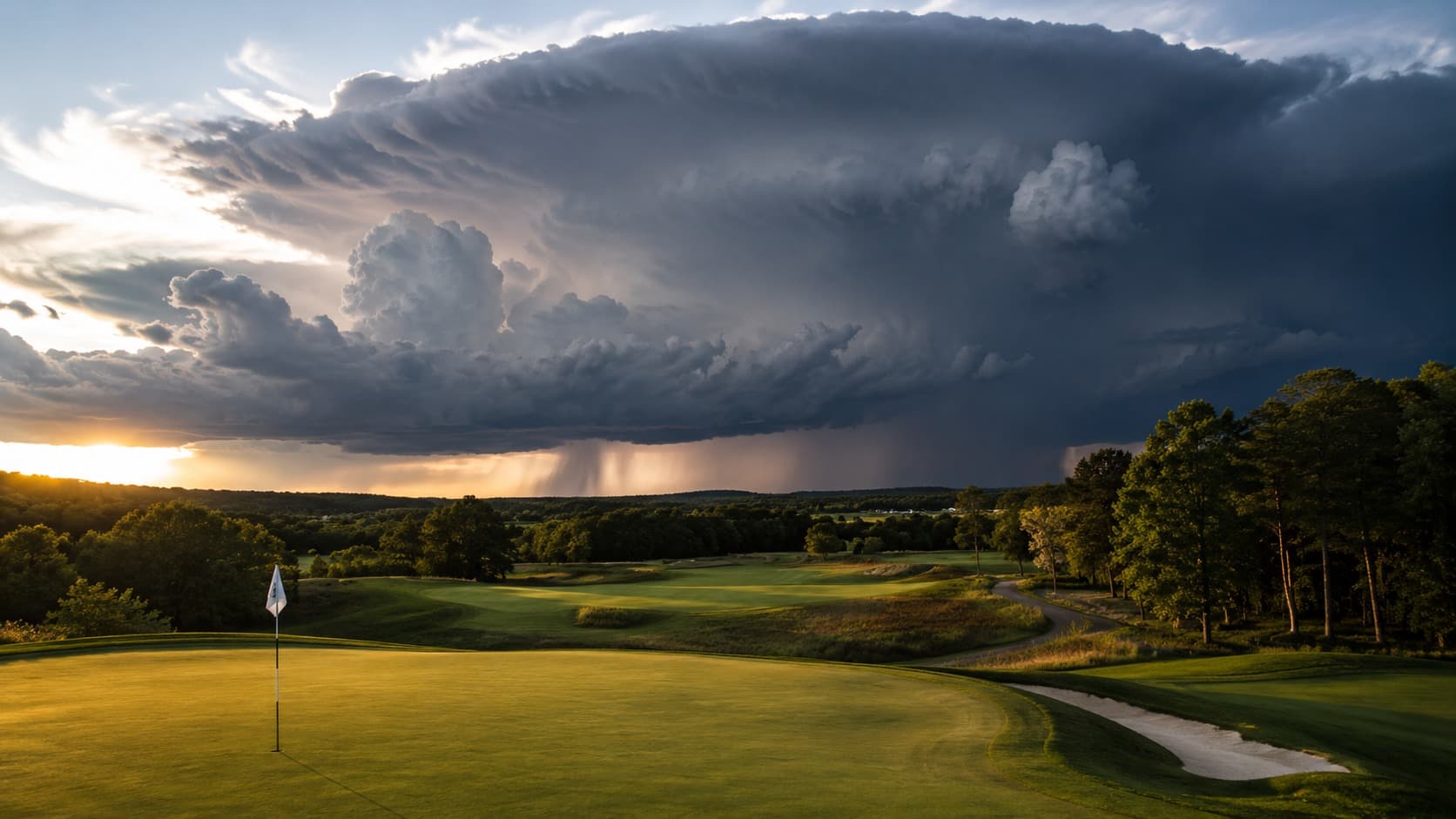
The Three O’Clock Storm: Reading Summer’s Convective Cycle to Protect Your Round
A 40% chance of afternoon thunderstorms does not mean a 40% chance of getting rained on. In the summer convective season it means the morning is nearly clear and the afternoon carries a fast-building, high-energy storm risk driven by a daily heating cycle. Here is the meteorology behind the pattern, the G-Score data on how the storm cycle punishes afternoon tee times across the Southeast, Midwest, and desert Southwest, the lightning-safety decision tree that actually matters, and the workflow that gets you off the course before the first bolt.
Read Story
How to Read a G-Score: The 0–100 Golf Playability Number, Decoded
A G-Score on this site is a single 0–100 number that tells you whether today is worth tee-up. Here is exactly what each band means, what drives the calculation, and how to use it to plan a round you will actually score on.
Read StoryMinSu Kim
Founder & Golf Data Analyst
MinSu is a data analyst and golfer with 10+ years on the course. He built Golf Weather Score to answer one question: is today a good day to play? He combines weather data, course intelligence, and the proprietary G-Score algorithm to help golfers make smarter decisions.
Every Friday Morning
When Antrim Dells plays best next weekend.
Friday 6am ET: peak G-Score windows for Antrim Dells, wind direction by hour, and one gear call. Three minutes to read, save you the round.
One email a week. Unsubscribe in one click.
The Caddie's Oracle
Draw your luck before the tee off