
Caddie's Gear Advisor
Curated for today's 77°F · Thunderstorm
Storm-Ready Outerwear
Waterproof layers built for 18 holes in the rain
Tour-Grade Umbrellas
68" double-canopy wind-resistant coverage
Wet-Weather Gloves
All-weather grip that performs in the rain
Waterproof Golf Shoes
Keep your feet dry through every fairway
Your Golf Trip, Handled
The Ultimate Golf Trip Planner
Everything you need to play Arbor Trace Golf Club — from booking your flight to checking in course-side.
Course-Side Stays
Luxury hotels, resorts, and stay-and-play packages just minutes from the first tee.
Flights
Compare fares across 700+ airlines for the best route to your tee time.
SUV Rentals for Golf Bags
Spacious vehicles with room for clubs, bags, and your foursome.
Travel Insurance
Coverage for medical, weather delays, and gear at your destination.
Arbor Trace Golf Club: Course Intelligence
Signature Setup
The scorecard for Arbor Trace tells you what kind of test it is before you ever tee off: 6,690 yards from the Blue tees, par 72, slope 120 and a course rating of 71.5. That is not a resort layout padded with forward tees — it is a fair, honest Marion, Indiana public course where the difficulty lives in four long par-4s. I want to be straight with readers: the original architect and opening year are not documented in any public record I could verify, so I won't invent a name to fill the line. What I can verify is the card, and the card is where this course's character actually sits. The hardest holes by handicap — #2 (430y), #18 (450y), #3 (435y), and #16 (440y) — are all par-4s over 425 yards, which tells you Arbor Trace defends par with length, not with water roulette.
Hole-by-Hole Wind & Playing Lines
North-central Indiana runs a prevailing southwest wind through summer (June–August) and swings to a colder northwest flow once the fronts start in late October. I haven't walked Arbor Trace personally, so I'm reading orientation off the card and the local strategy notes rather than claiming a round I didn't play — but the math of long par-4s into a 10–15 mph breeze is the same anywhere.
- Hole 2 (430y, par-4, #1 handicap): a dogleg left. Favor the right side off the tee to open the angle, then you still have a long-iron or hybrid into a green that runs back-to-front. Into the SW wind, that 430-yard hole plays nearer 460 — take the extra club and aim for the front-center, not the flag.
- Hole 18 (450y, par-4, #2 handicap): the longest two-shotter on the card and a brutal closer. On a typical July afternoon round, this is where a good card dies. Bunkers guard the fairway; center off the tee, then accept a long approach and a two-putt.
- Hole 16 (440y, par-4, #4 handicap): center-fairway tee shot, deep greenside bunker left — miss right and short, never long.
Green & Fairway Characteristics
These are cool-season greens — bentgrass/bluegrass surfaces typical of the Indiana Midwest — and the recurring note across the course is a back-to-front slope (holes 2, 8, 15 all tilt that way). That matters more than green speed: an approach that lands past the pin leaves a slick downhill putt you can't be aggressive with. Several greens are elevated (holes 3 and 12), so club up half a club on those approaches. The course stretches from 4,785y (Green) up to 6,690y (Blue), so the right tee choice swings your effective difficulty by nearly two strokes of rating.
Seasonal Weather Pattern
Marion sits in USDA-style continental climate: humid, warm summers and genuinely cold winters. July highs average in the mid-80s°F with afternoon humidity that softens grip and adds drag on ball flight; April and October bring the steadiest wind and 45–60°F mornings. The honest playing season is roughly mid-April through late October — and within that, the back-to-front greens behave very differently wet (spring, dewy mornings) versus baked (July afternoons).
Local Play Tips
Book the earliest tee time you can. In the 7–9 a.m. window the greens are still holding overnight dew, they stimp slower, and the back-to-front tilt is forgiving — you can fire at flags. By 2 p.m. on a dry July day those same greens firm up and the slope turns a routine approach into a defensive lag putt. This is the single biggest scoring variable here, and it costs nothing but waking up early.
Pre-Round Weather Workflow
Pull the 7-day G-Score for Arbor Trace before you book. Look for two things: morning wind direction (a SW or NW reading over 10 mph means the long par-4s — 2, 16, 18 — will eat a stroke each, so add tee-box yardage to your club math) and the afternoon firmness trend. If the forecast shows a hot, dry afternoon, the windExposure and G-Score gap between an 8 a.m. and a 2 p.m. tee time is real — often 8–12 points. Tee off early, play the front-center of every green, and let the back-to-front slope feed the ball to the hole instead of fighting it.
Related Reading
Before you tee off at Arbor Trace Golf Club
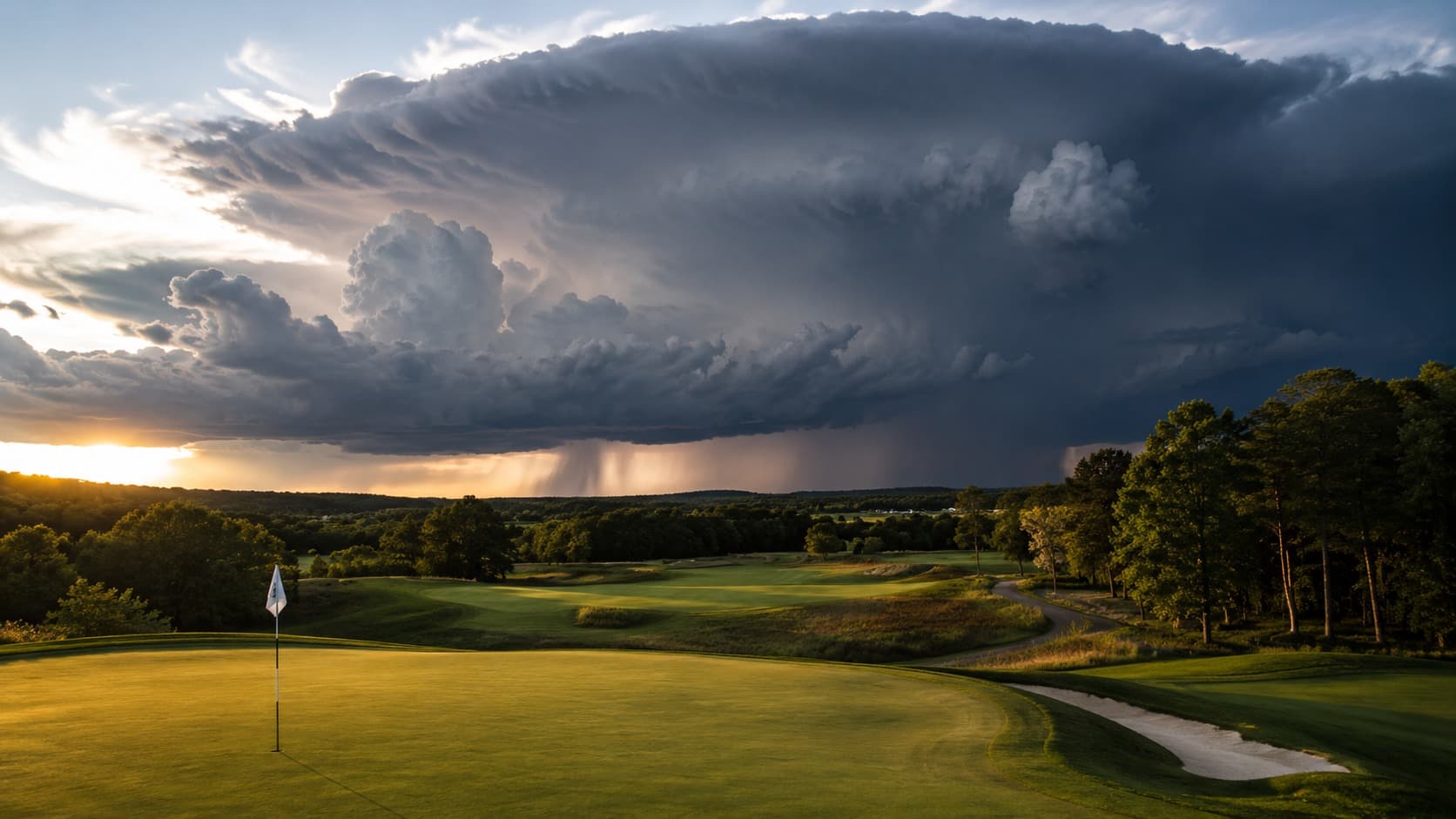
The Three O’Clock Storm: Reading Summer’s Convective Cycle to Protect Your Round
A 40% chance of afternoon thunderstorms does not mean a 40% chance of getting rained on. In the summer convective season it means the morning is nearly clear and the afternoon carries a fast-building, high-energy storm risk driven by a daily heating cycle. Here is the meteorology behind the pattern, the G-Score data on how the storm cycle punishes afternoon tee times across the Southeast, Midwest, and desert Southwest, the lightning-safety decision tree that actually matters, and the workflow that gets you off the course before the first bolt.
Read Story
How to Read a G-Score: The 0–100 Golf Playability Number, Decoded
A G-Score on this site is a single 0–100 number that tells you whether today is worth tee-up. Here is exactly what each band means, what drives the calculation, and how to use it to plan a round you will actually score on.
Read StoryMinSu Kim
Founder & Golf Data Analyst
MinSu is a data analyst and golfer with 10+ years on the course. He built Golf Weather Score to answer one question: is today a good day to play? He combines weather data, course intelligence, and the proprietary G-Score algorithm to help golfers make smarter decisions.
Every Friday Morning
When Arbor Trace Golf Club plays best next weekend.
Friday 6am ET: peak G-Score windows for Arbor Trace Golf Club, wind direction by hour, and one gear call. Three minutes to read, save you the round.
One email a week. Unsubscribe in one click.
The Caddie's Oracle
Draw your luck before the tee off