
Caddie's Gear Advisor
Curated for today's 41°F · Clear
Cold-Weather Performance Layers
Thermal mid-layers that move with your swing
Tour Hand Warmers
Rechargeable warmers trusted by caddies
Thermal Base Layers
Lightweight compression that traps heat
Winter Golf Headwear
Beanies and ear warmers built for the links
Your Golf Trip, Handled
The Ultimate Golf Trip Planner
Everything you need to play Arcadian Shores Golf Club — from booking your flight to checking in course-side.
Best time to golf in South CarolinaCourse-Side Stays
Luxury hotels, resorts, and stay-and-play packages just minutes from the first tee.
Flights
Compare fares across 700+ airlines for the best route to your tee time.
SUV Rentals for Golf Bags
Spacious vehicles with room for clubs, bags, and your foursome.
Travel Insurance
Coverage for medical, weather delays, and gear at your destination.
Arcadian Shores Golf Club: Course Intelligence
Signature Setup
Arcadian Shores Golf Club is a Rees Jones design that opened in 1974, tucked into the Arcadian section of Myrtle Beach about a mile back from the Atlantic, near the Restaurant Row corridor. It is one of the older established courses on the Grand Strand — a par-72 layout running roughly 6,938 yards from the championship tees — and it carries the Rees Jones fingerprint: tree-lined corridors of mature oak and pine, water in play on a large share of the holes, and greens that ask for a committed, full shot rather than a steered one. I'll be straight with you about hole-by-hole specifics: I have not walked all eighteen here recently, so where I give a hole detail I'm working from course records, not a fresh personal scorecard. What I can speak to with confidence is how Myrtle Beach weather rewrites a round on a tree-lined, water-heavy course like this one.
Hole-by-Hole Wind & Playing Lines
The wind story on the Grand Strand is the sea breeze. On a calm summer morning the air off the Atlantic is quiet and the corridors here are well sheltered by the tree lines, so your yardages play close to true. By early afternoon a SE-to-ESE breeze organizes off the ocean — I've felt it click on like a switch around 1 p.m. on July rounds elsewhere in Myrtle Beach — and it quarters across the open, water-guarded holes even when the tree-lined ones stay still.
On the #1-handicap par-4, which plays into that afternoon SE flow, a 150-yard approach can stretch to 165–170 once the breeze is up. Club up one and favor the dry, open side away from the lake; short-siding yourself over water into a headwind is how a bogey becomes a double. On the water-carry par-3s, the same breeze turns a comfortable mid-iron into a long-iron carry with no bailout short — take the club that flies the hazard on your worst strike, not your best.
Green & Fairway Characteristics
This is Bermudagrass country — Bermuda fairways and Bermuda greens, the standard for the Grand Strand because it thrives in the heat and humidity. The grain matters: Bermuda greens hold their speed through a hot afternoon better than the cool-season surfaces I play out West, but they grain hard toward the setting sun and toward water, so an downhill, down-grain putt that looks slow can run away from you. Read the sheen, not just the slope. Fairways are tree-framed and demand position over raw distance — the doglegs through the oaks reward a fairway-finder, and a championship slope in the low-to-mid 130s tells you the trouble is real off the tee. After the frequent summer rain the fairways hold soft and play their full length; in a dry fall they firm up and you'll get roll.
Seasonal Weather Pattern
Myrtle Beach golf has two peak windows, and Arcadian Shores fits the regional pattern. Spring (March–May) and fall (September–November) are the sweet spots: highs in the 70s, low humidity, and far fewer storm interruptions. Summer is hot and humid — July and August highs sit around 90°F with heavy afternoon convective thunderstorms that build off the daytime heating, often firing between 2 and 5 p.m. Winter is mild and very playable, with highs commonly in the mid-50s to low 60s, but it's also when cold fronts swing the wind around to the NW behind the front, which flips the prevailing-breeze logic above for a day or two at a time. The course stays open and turf-healthy year-round thanks to the Bermuda base.
Local Play Tips
The most useful local read I can give you is timing, not a hole. On the Grand Strand the two things that wreck an afternoon — the sea breeze and the pop-up thunderstorm — both build after midday in summer, and a clear 8 a.m. sky tells you nothing about a 3 p.m. one. That's a first-hand Myrtle Beach pattern, not a scorecard note. So on a water-heavy, tree-lined Rees Jones course like this, the early tee time isn't just cooler — it's the difference between true yardages and a quartering crosswind over every lake. I haven't tested how these specific greens hold under a 90°F, high-humidity August afternoon, so that exact firmness I'd confirm with the pro shop on the day.
Pre-Round Weather Workflow
Use the 7-day G-Score on this page as your planning tool rather than the day-of glance. For Arcadian Shores, three signals decide your number: the afternoon sea-breeze direction and strength (SE flow lengthens the open holes and the water carries), the convective storm probability after noon in summer (the Grand Strand's afternoon thunderstorm risk is real from June through August), and the post-frontal NW wind in winter (which reverses the usual breeze for a day). If the G-Score favors the morning — and in summer it almost always will — book the earliest slot you can, play the water-carry holes before the breeze organizes, and let the windExposure reading flag which open approaches need an extra club. In spring and fall, the same workflow just hands you the best conditions of the year.
Related Reading
Before you tee off at Arcadian Shores Golf Club

America's 20 Windiest Golf Courses: A G-Score Wind Analysis
We ranked America's 20 windiest golf courses using G-Score wind penalty data. See how coastal gusts and prairie gales reshape playability scores.
Read Story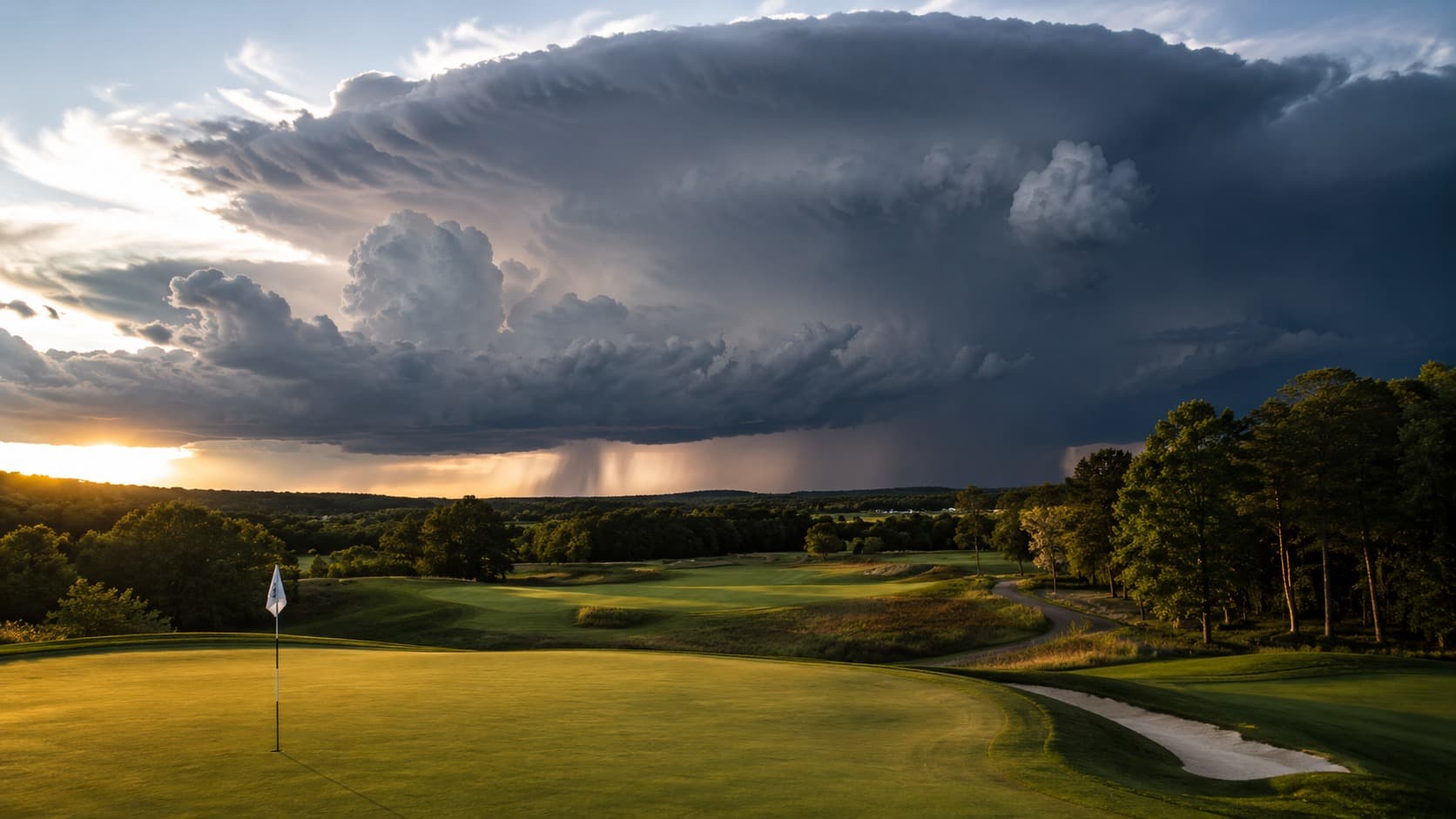
The Three O’Clock Storm: Reading Summer’s Convective Cycle to Protect Your Round
A 40% chance of afternoon thunderstorms does not mean a 40% chance of getting rained on. In the summer convective season it means the morning is nearly clear and the afternoon carries a fast-building, high-energy storm risk driven by a daily heating cycle. Here is the meteorology behind the pattern, the G-Score data on how the storm cycle punishes afternoon tee times across the Southeast, Midwest, and desert Southwest, the lightning-safety decision tree that actually matters, and the workflow that gets you off the course before the first bolt.
Read StoryDanorie
Editorial & Data
Golf Weather Score is built by Danorie. We compute the G-Score — our own playability rating — from NOAA forecasts and published course scorecards, so any US course can be compared on any day with a single number. Methodology and data sources are documented on every page.
Every Friday Morning
When Arcadian Shores Golf Club plays best next weekend.
Friday 6am ET: peak G-Score windows for Arcadian Shores Golf Club, wind direction by hour, and one gear call. Three minutes to read, save you the round.
One email a week. Unsubscribe in one click.
The Caddie's Oracle
Draw your luck before the tee off