
Caddie's Gear Advisor
Curated for today's 89°F · Clear
Ultralight Distance Drivers
Maximum carry in hot, low-drag conditions
UV Protection Apparel
UPF 50+ cooling fabrics for peak-sun rounds
Precision Rangefinders
Slope-adjusted yardage in any condition
Hydration & Cooling
Insulated bottles and cooling towels
Your Golf Trip, Handled
The Ultimate Golf Trip Planner
Everything you need to play Argyle Country Club — from booking your flight to checking in course-side.
Course-Side Stays
Luxury hotels, resorts, and stay-and-play packages just minutes from the first tee.
Flights
Compare fares across 700+ airlines for the best route to your tee time.
SUV Rentals for Golf Bags
Spacious vehicles with room for clubs, bags, and your foursome.
Travel Insurance
Coverage for medical, weather delays, and gear at your destination.
Argyle Country Club: Course Intelligence
Signature Setup
A converted dairy barn for a clubhouse tells you a lot about a course before you hit a shot — this is a piece of old Maryland farmland turned into golf, not a manufactured resort layout. I have walked clubs like this on humid mid-Atlantic mornings, shirt already damp at 8 a.m. around 72°F, and the air sits heavy enough that you feel the ball not carrying the way it would in dry California.
Argyle Country Club is a private 18-hole club in Silver Spring, Maryland, just outside Washington, D.C. Per the club's own history, Argyle began in 1923 as a small club in the District, played for years at Sligo Creek, and moved to its current 150-acre property — a former working dairy farm — in 1945, with members converting the old barn into the clubhouse. I'll be straight about the design record: sources disagree, crediting the early layout variously to a member named Perc Le Duc and to older hands, with a documented 1960 reworking by Ed Ault and Al Jamison and a recent green-and-bunker renovation by architect Joel Weiman. I won't pretend to a single clean authorship the record doesn't support.
Hole-by-Hole Wind & Playing Lines
Argyle's defense is parkland subtlety plus the summer SW breeze that runs up the D.C. corridor, not raw length.
The long uphill par-4. The property's hardest two-shotter climbs back toward the high ground. An uphill green already costs roughly a half-club; into the prevailing SW summer breeze it costs a full club. Play a 410 on the card as a real 430, take the extra stick on the approach, and settle for front-center.
The creek-guarded short par-4. Where water crosses near a green, the temptation is to chase the front edge. On a still morning that is fair; once the breeze quarters into you by midday, the safe miss is short and right, away from the hazard.
The exposed turn holes. On the open stretch the SW wind is unobstructed. A crosswind here is the real card-wrecker — favor the upwind edge and accept the center of the green rather than flirting with a tucked pin.
Green & Fairway Characteristics
The recent Weiman renovation rebuilt the green complexes and switched the playing surfaces to Ironcutter Bermuda, which holds firmer through the brutal Mid-Atlantic summer than the old cool-season turf did. Expect medium-fast greens, several with renovated contour that rejects a ball above the hole, and rolling parkland fairways across the 150-acre site. The course plays in the 6,400–6,600-yard range — a positional test that rewards flighting the ball under the wind and judging a sloping lie over a player who simply overpowers it. Keep approaches below the hole and let the contour feed toward the pin.
Seasonal Weather Pattern
Silver Spring sits in a humid subtropical climate, and Argyle's defining seasonal feature is summer humidity, not coastal wind. June–August runs 85–92°F with thick, moisture-heavy air that kills carry distance and softens turf after the frequent afternoon thunderstorms; the Bermuda surfaces, however, firm up fast once the sun is out. The prime window is mid-September into October: 60–75°F, firmer greens, and the steadiest air. Spring (April–May) is cool and gusty, 55–70°F. Per NOAA records for the D.C. metro, the recurring summer pattern is a calm, dew-heavy morning giving way to a SW breeze of roughly 6–12 mph and pop-up storms by mid-afternoon. Frost and dormancy typically slow play from December into February.
Local Play Tips
Honest limitation first: Argyle is a private club and I have not had a tee time there, so these notes come from the course's documented routing and renovation history and from playing the same humid D.C.-corridor microclimate at other Maryland courses, not from a personal scorecard at Argyle. The transferable edge: on a parkland Bermuda course in a Mid-Atlantic summer, your two enemies are humidity-killed carry and the afternoon storm cycle. Play early, while the greens are still soft and receptive and before the SW breeze builds, and trust that the renovated Bermuda will run firmer — and your approaches shorter — as the day heats up. Club up for the heavy morning air, then re-club as the surfaces bake out.
Pre-Round Weather Workflow
Use the 7-day G-Score on this page the way I would for any humid parkland course. Three days out, check whether your tee window lands before or after the afternoon storm risk and the SW breeze build — on Bermuda turf that firms through the day, a morning slot plays softer and more forgiving than the same course at 3 p.m. The morning of, read the windExposure panel: a SW reading means the long uphill par-4 and the open turn holes all stretch out, so club up and favor front-center. If the temperature reads in the high 80s with high humidity, expect shorter carry off the tee — take one more club than the yardage suggests and keep every putt below the hole.
Related Reading
Before you tee off at Argyle Country Club

The May 2026 G-Score Heatmap: Where American Golf Peaks This Spring
May is the most underrated month on the American golf calendar. Five regions hit their annual peak this spring, three turn quietly hostile, and the data tells a clearer story than the brochures. Here is where to play, where to avoid, and how to time your booking window.
Read Story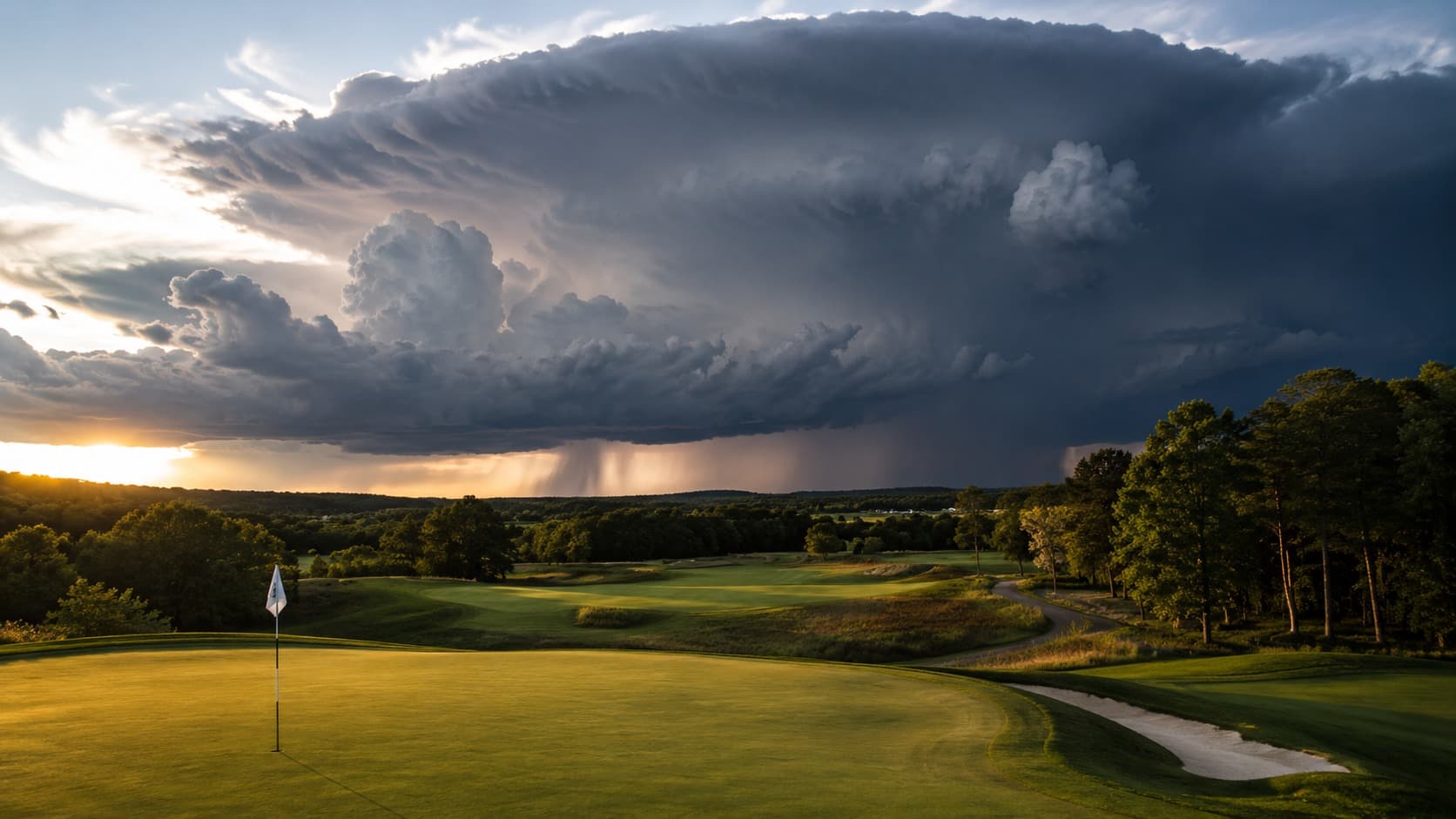
The Three O’Clock Storm: Reading Summer’s Convective Cycle to Protect Your Round
A 40% chance of afternoon thunderstorms does not mean a 40% chance of getting rained on. In the summer convective season it means the morning is nearly clear and the afternoon carries a fast-building, high-energy storm risk driven by a daily heating cycle. Here is the meteorology behind the pattern, the G-Score data on how the storm cycle punishes afternoon tee times across the Southeast, Midwest, and desert Southwest, the lightning-safety decision tree that actually matters, and the workflow that gets you off the course before the first bolt.
Read StoryMinSu Kim
Founder & Golf Data Analyst
MinSu is a data analyst and golfer with 10+ years on the course. He built Golf Weather Score to answer one question: is today a good day to play? He combines weather data, course intelligence, and the proprietary G-Score algorithm to help golfers make smarter decisions.
Every Friday Morning
When Argyle Country Club plays best next weekend.
Friday 6am ET: peak G-Score windows for Argyle Country Club, wind direction by hour, and one gear call. Three minutes to read, save you the round.
One email a week. Unsubscribe in one click.
The Caddie's Oracle
Draw your luck before the tee off