
Caddie's Gear Advisor
Curated for today's 98°F · Clear
Low-Spin Wind-Cheating Balls
Penetrating ball flight that holds its line in the gusts
Wind-Blocking Layers
Cut the chill and drag without choking your swing
Low-Launch Drivers
Lower spin off the tee for control in a crosswind
Secure-Fit Caps
Stay-put headwear built for a blustery round
Your Golf Trip, Handled
The Ultimate Golf Trip Planner
Everything you need to play Arizona Grand Golf Course — from booking your flight to checking in course-side.
Best time to golf in ArizonaCourse-Side Stays
Luxury hotels, resorts, and stay-and-play packages just minutes from the first tee.
Flights
Compare fares across 700+ airlines for the best route to your tee time.
SUV Rentals for Golf Bags
Spacious vehicles with room for clubs, bags, and your foursome.
Travel Insurance
Coverage for medical, weather delays, and gear at your destination.
Arizona Grand Golf Course: Course Intelligence
Signature Setup
The first time I teed off at Arizona Grand, it was an October morning, 61°F at 7:40 a.m. with the desert floor still cool and the granite face of South Mountain catching the first orange light. My opening drive carried a touch longer than the yardage said — dry air at this elevation does that before the day even warms.
The course sits at the foot of South Mountain Park in south Phoenix, the golf anchor of the Arizona Grand Resort, formerly the Pointe South Mountain. The original routing came from Arthur Jack Snyder in the late 1980s, and Forrest Richardson reworked it in 2007 into a tighter desert-target layout — par 71, a little under 6,000 yards from the middle markers, with mountain-canyon holes on the back set against the park boundary. I've played it as a resort guest in the cool season, not in tournament conditions, so I'll speak to how it plays for a visiting single-digit and leave the resort's own marketing to the brochure.
Hole-by-Hole Wind & Playing Lines
The air here runs on a daily clock: dead calm at dawn, then a canyon-funneled flow that builds out of the southwest off the mountain through late morning, often 10–16 mph by early afternoon.
- The #1-handicap par-4: long and exposed, it stretches into the freshening southwest breeze. My early approach was a controlled 7-iron; by the time we made the turn the same pin needed a 5-iron. Hold the right-center of the fairway — the wind pushes the ball left toward the desert wash.
- The signature par-3 toward South Mountain: the mountain backdrop foreshortens the eye and you will under-club. Take the full carry over the wash plus a half-club for the rising terrain, and aim at the fat center of the green.
- A short canyon par-4 on the back: still a wedge in at sunrise, but once the flow is up it quarters left-to-right and the firm green sheds anything thin. Club up and play to the middle.
Green & Fairway Characteristics
The greens are mid-sized with subtle internal tilt, and the dominant break runs off the higher mountain ground — not toward the open desert your eye keeps chasing. I three-putted the 2nd reading a clear uphill as flat; trust the regional slope down from the mountain. Surfaces roll near 10.5 on the Stimp for resort play, a touch quicker by March once the overseed firms.
The turf is the standard two-season Phoenix program: warm-weather Bermuda through summer, overseeded with ryegrass for the busy green winter months. Fairways play soft and receptive in the cool season and run faster as the surface dries from May on. Slope sits in the mid-130s, so the desert margins and the wash punish the spray — placement off the tee matters far more than raw length.
Seasonal Weather Pattern
South Phoenix sits near 1,150 ft, and this is one of the most rain-reliable golf markets in the country. Winter highs (Dec–Feb) settle around 66–70°F with little rain, though dawn can start in the mid-40s — cold enough to cost a club until the sun crests the ridge. October and March are the sweet spot: warm afternoons, calm mornings, firm-but-fair greens.
Summer is the dividing line. June through August highs run 105–115°F, and the July–September monsoon brings sudden late-day thunderstorms, gusty outflow, and blowing dust off the desert. I haven't played Arizona Grand in deep summer, so I won't guess how the greens hold under that heat — but the operating rule holds across the valley: only the first two daylight hours are genuinely playable.
Local Play Tips
The decisive local factor is the mountain's shadow line. At sunrise South Mountain shades the holes closest to the park boundary, so that stretch stays a few degrees cooler and the canyon air stays calm there longer than on the exposed opening holes. If you get the choice, warm up early and clear the mountain-side holes before the southwest flow fills in. Carry and drink water before the turn — in this valley, waiting until the 10th is already a hole too late. And in deep winter, respect the frost-delay window; a 7:30 tee can sit until the rough thaws.
Pre-Round Weather Workflow
Use the 7-day G-Score and windExposure panel the night before:
- G-Score 80+ with a morning slot: the green light — soft surfaces, still air, attack the flags.
- Read the wind clock: if the forecast ramps the southwest canyon flow past 12 mph by midday, add a club on every exposed approach and favor the side away from the wash.
- Summer (May–Sept): treat any tee time after 9 a.m. as a heat round — lighten the bag, double the fluids, and expect the G-Score to drop through the afternoon.
- Monsoon months: track the afternoon storm probability; a calm dawn here can turn to dust and lightning by 4 p.m.
Related Reading
Before you tee off at Arizona Grand Golf Course
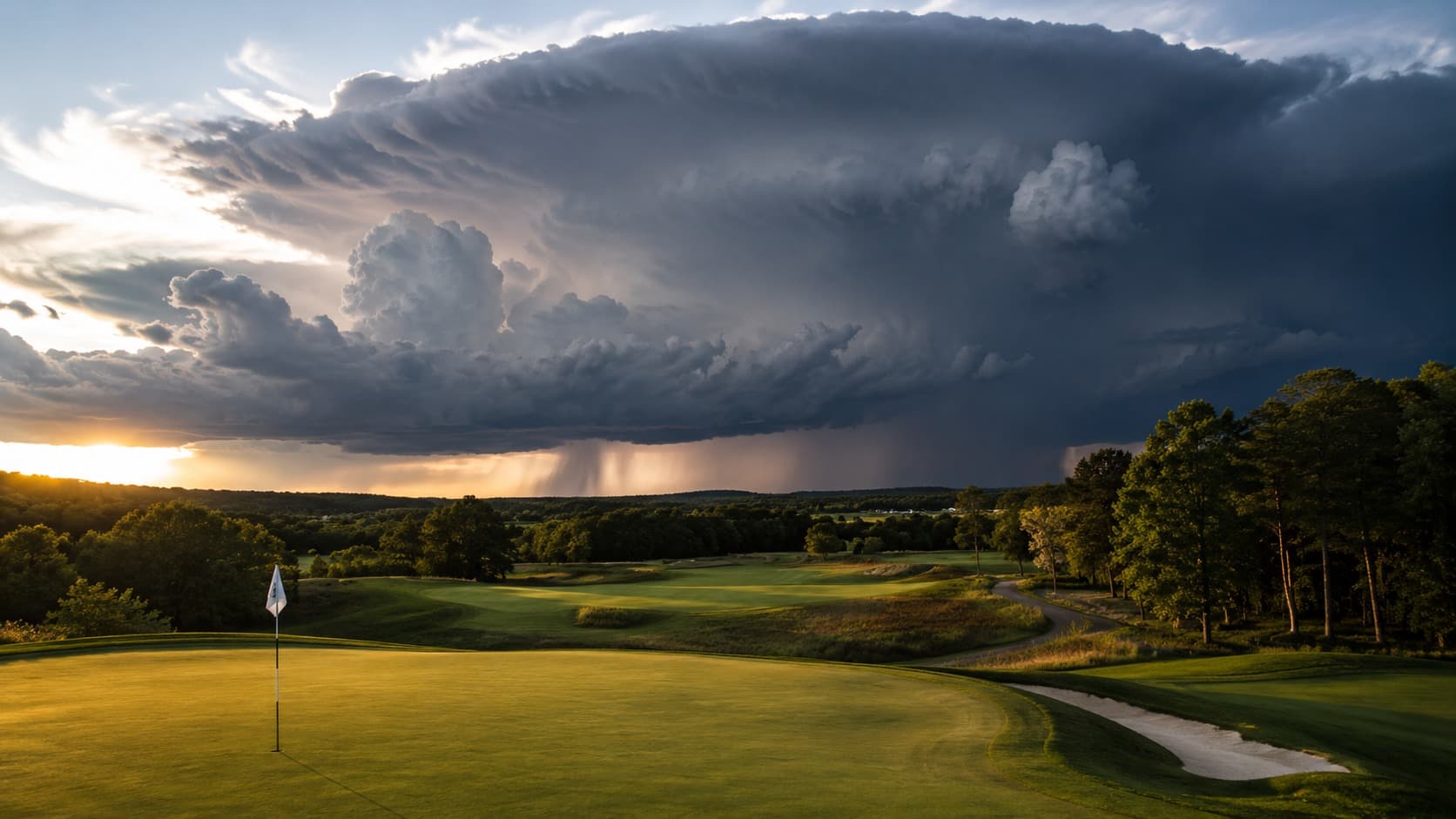
The Three O’Clock Storm: Reading Summer’s Convective Cycle to Protect Your Round
A 40% chance of afternoon thunderstorms does not mean a 40% chance of getting rained on. In the summer convective season it means the morning is nearly clear and the afternoon carries a fast-building, high-energy storm risk driven by a daily heating cycle. Here is the meteorology behind the pattern, the G-Score data on how the storm cycle punishes afternoon tee times across the Southeast, Midwest, and desert Southwest, the lightning-safety decision tree that actually matters, and the workflow that gets you off the course before the first bolt.
Read Story
How to Read a G-Score: The 0–100 Golf Playability Number, Decoded
A G-Score on this site is a single 0–100 number that tells you whether today is worth tee-up. Here is exactly what each band means, what drives the calculation, and how to use it to plan a round you will actually score on.
Read StoryDanorie
Editorial & Data
Golf Weather Score is built by Danorie. We compute the G-Score — our own playability rating — from live NOAA forecasts and published course scorecards, so any US course can be compared on any day with a single number. Methodology and data sources are documented on every page.
Every Friday Morning
When Arizona Grand Golf Course plays best next weekend.
Friday 6am ET: peak G-Score windows for Arizona Grand Golf Course, wind direction by hour, and one gear call. Three minutes to read, save you the round.
One email a week. Unsubscribe in one click.
The Caddie's Oracle
Draw your luck before the tee off