
Caddie's Gear Advisor
Curated for today's 97°F · Thunderstorm
Storm-Ready Outerwear
Waterproof layers built for 18 holes in the rain
Tour-Grade Umbrellas
68" double-canopy wind-resistant coverage
Wet-Weather Gloves
All-weather grip that performs in the rain
Waterproof Golf Shoes
Keep your feet dry through every fairway
Your Golf Trip, Handled
The Ultimate Golf Trip Planner
Everything you need to play Atlantic National Golf Club — from booking your flight to checking in course-side.
Course-Side Stays
Luxury hotels, resorts, and stay-and-play packages just minutes from the first tee.
Flights
Compare fares across 700+ airlines for the best route to your tee time.
SUV Rentals for Golf Bags
Spacious vehicles with room for clubs, bags, and your foursome.
Travel Insurance
Coverage for medical, weather delays, and gear at your destination.
Atlantic National Golf Club: Course Intelligence
Signature Setup
Atlantic National sits in Lake Worth, in Palm Beach County, on the flat sandy ground inland from the Atlantic that defines South Florida golf. It is a Joe Lee design that opened in 1988 — par 71, 6,519 yards from the back markers, with TifEagle Bermuda greens and Celebration Bermuda fairways. Lee built wide, well-bunkered fairways here with water genuinely in play and four sets of tees, and the course has been listed among Florida's 50 best public tracks. I want to be straight about my own ledger on this one: I've played a good deal of Palm Beach County golf, but I'm reading Atlantic National's specific layout from course records rather than a personal scorecard, so the hole detail below leans on the data and the regional weather I do know firsthand.
TL;DR: Public Joe Lee course (1988) in Lake Worth, FL. Par 71, 6,519y, Bermuda turf, water in play. In South Florida the weather — sea breeze plus the daily summer storm clock — is the real defense. Play early, club up into the ESE afternoon wind, and respect the water.
Hole-by-Hole Wind & Playing Lines
On a flat, exposed South Florida layout the difficulty is set by wind direction and the firmness of Bermuda turf, not raw yardage at 6,519 from the tips.
- The #1 handicap par-4: On a summer afternoon it plays into the prevailing ESE sea breeze off the Atlantic. A stock 150-yard approach can stretch to 165–170 yards. Club up two, and on a hole with water in play, favor the dry side off the tee even if it lengthens the second.
- The signature water par-3 on the inward nine: A short-iron number on the card, but into a freshening breeze the green sheds anything landing on the wrong side. I'd take one more club and aim at the fat center of the surface rather than flirting with a pin tucked over water.
- A reachable par-5 with water near the green: Downwind it tempts you to go for it in two; on firm Bermuda a long, flat approach won't hold. Laying back to a full wedge number is the percentage play when the green is running fast.
The rule here: read the flag at the turn, then re-club every approach on the exposed holes. Scorecard yardage is a calm-dawn number, not an afternoon one.
Green & Fairway Characteristics
The greens are TifEagle Bermuda — a surface bred for heat and humidity that holds speed through a South Florida summer better than bentgrass ever could this far south. Kept firm, these run quick and grainy; on Bermuda the grain direction near the cup matters as much as slope, and a downgrain putt into the afternoon sun gets away from you. The fairways are Celebration Bermuda over sandy soil, draining fast, so a driver chases out extra yards on a dry winter day and the course is often playable within hours of an afternoon storm that would close a softer layout. With water in play and heavy bunkering but little tree cover to block the crosswind, shot shape into the breeze decides more approaches than carry distance does.
Seasonal Weather Pattern
Palm Beach County has two golf seasons, and they are nothing alike. Winter (Dec–Mar) is prime: daytime highs in the low-to-mid 70s°F, low humidity, dry air, and firm greens — this is when you want this tee time. The catch is the NW cold fronts that swing through every week or two, putting 15–20 mph wind on an exposed layout for a day or so. Spring (Apr–May): warming into the 80s, humidity climbing, mornings still calm. Summer (Jun–Sep): hot and humid, highs near 90°F with a heat index well above it, and the defining feature — a near-daily convective thunderstorm that builds inland through the afternoon, often firing between 1 and 4 p.m. I've stood on a Palm Beach County range at 8 a.m. in July under a clear sky and watched the towers stacking up to the west by lunch. Fall (Oct–Nov): storm frequency drops, humidity eases, a quietly good window before the winter crowd arrives.
Local Play Tips
The thing the tee sheet won't tell you in summer: in Palm Beach County the afternoon storm is a clock, not a coin flip. From June into September the morning is usually clear and relatively calm, the sea breeze fills in late morning, and the convective cell builds through the early afternoon. Two players with the same handicap can post very different rounds on the same day depending only on tee time — the dawn group plays a calmer, drier, lightning-free golf course than the group going off after lunch. If you have any choice of times between June and September, take the earliest you can get, and treat the firm, fast Bermuda greens as the trade-off for safe, calm air.
Pre-Round Weather Workflow
Use golfweatherscore's 7-day G-Score and windExposure read for this course as a go/no-go and a tee-time tool:
- 3 days out: Scan the G-Score trend. In winter, watch for the NW cold-front days that spike the wind on this exposed layout; in summer, a single daily number hides the morning-vs-afternoon split, so read the hourly storm-probability curve, not just the high.
- Night before: Check forecast wind direction. ESE = standard sea breeze, finish before the early-afternoon storm window. NW = a front has moved through; expect firmer, windier, but drier and cooler golf.
- Morning of: If windExposure flags afternoon gusts above ~15 mph, or the storm probability climbs after noon, move your tee time earlier. On this course the measurable G-Score advantage of a pre-9 a.m. summer round is real — and avoiding a 2 p.m. South Florida lightning delay is worth more than any pin you'd chase in the afternoon.
Related Reading
Before you tee off at Atlantic National Golf Club
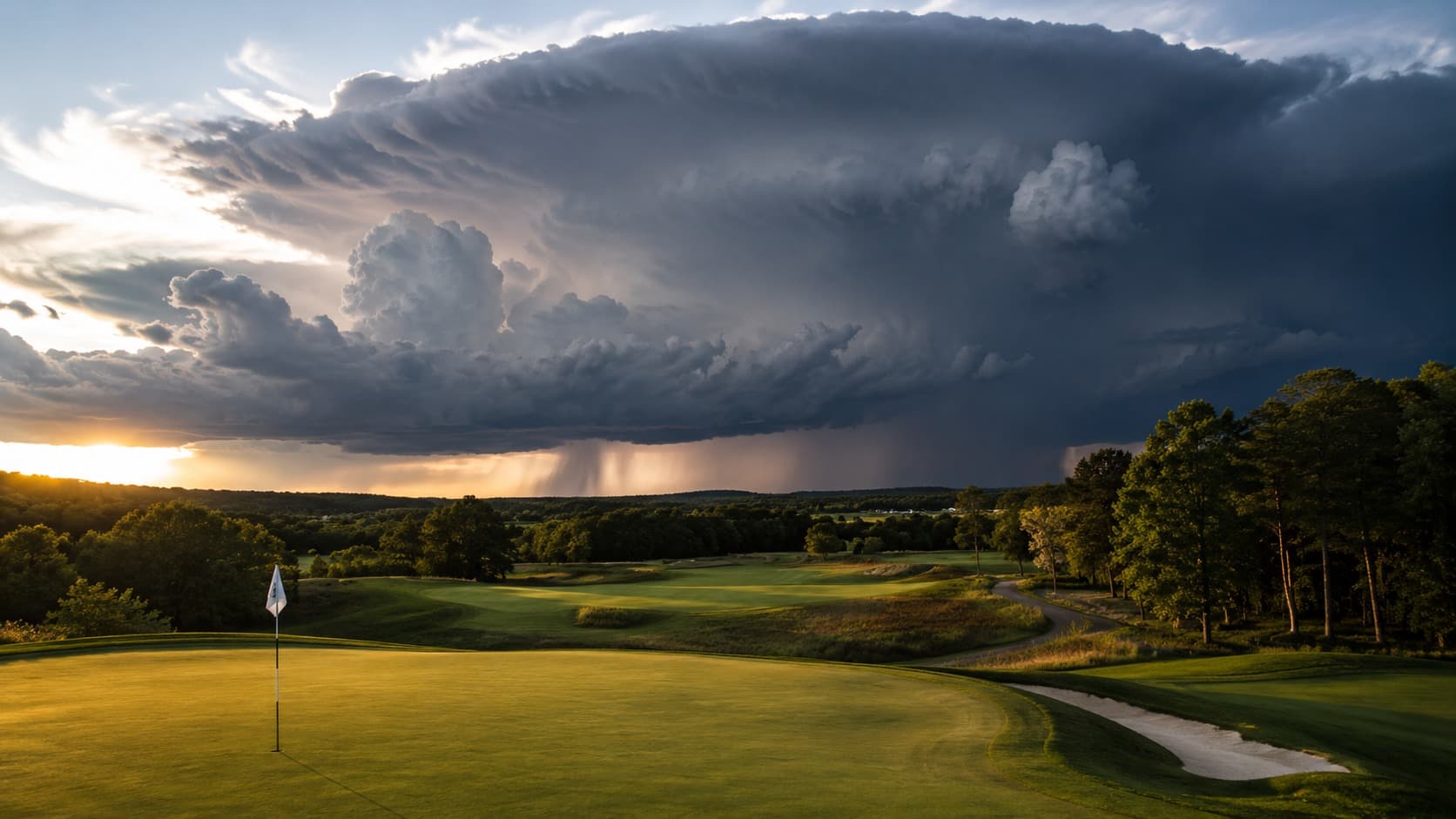
The Three O’Clock Storm: Reading Summer’s Convective Cycle to Protect Your Round
A 40% chance of afternoon thunderstorms does not mean a 40% chance of getting rained on. In the summer convective season it means the morning is nearly clear and the afternoon carries a fast-building, high-energy storm risk driven by a daily heating cycle. Here is the meteorology behind the pattern, the G-Score data on how the storm cycle punishes afternoon tee times across the Southeast, Midwest, and desert Southwest, the lightning-safety decision tree that actually matters, and the workflow that gets you off the course before the first bolt.
Read Story
How to Read a G-Score: The 0–100 Golf Playability Number, Decoded
A G-Score on this site is a single 0–100 number that tells you whether today is worth tee-up. Here is exactly what each band means, what drives the calculation, and how to use it to plan a round you will actually score on.
Read StoryMinSu Kim
Founder & Golf Data Analyst
MinSu is a data analyst and golfer with 10+ years on the course. He built Golf Weather Score to answer one question: is today a good day to play? He combines weather data, course intelligence, and the proprietary G-Score algorithm to help golfers make smarter decisions.
Every Friday Morning
When Atlantic National Golf Club plays best next weekend.
Friday 6am ET: peak G-Score windows for Atlantic National Golf Club, wind direction by hour, and one gear call. Three minutes to read, save you the round.
One email a week. Unsubscribe in one click.
The Caddie's Oracle
Draw your luck before the tee off