
Caddie's Gear Advisor
Curated for today's 77°F · Clouds
Tour-Level Drivers
Engineered for maximum distance and forgiveness
Laser Rangefinders
Pin-seeking technology for precision approaches
Premium Golf Balls
Tour-caliber spin and distance performance
Performance Sunglasses
Polarized lenses optimized for reading greens
Your Golf Trip, Handled
The Ultimate Golf Trip Planner
Everything you need to play Atlantis Country Club — from booking your flight to checking in course-side.
Best time to golf in FloridaCourse-Side Stays
Luxury hotels, resorts, and stay-and-play packages just minutes from the first tee.
Flights
Compare fares across 700+ airlines for the best route to your tee time.
SUV Rentals for Golf Bags
Spacious vehicles with room for clubs, bags, and your foursome.
Travel Insurance
Coverage for medical, weather delays, and gear at your destination.
Atlantis Country Club: Course Intelligence
Signature Setup
Atlantis Country Club sits inside the small city of Atlantis, just west of Lantana in Palm Beach County, and it carries the stamp of a classic early-1970s South Florida parkland build — water in play on the majority of holes, low profile, wind-exposed. The course opened in 1972 and plays to roughly 6,500 yards from the back tees, a par 72 that rewards placement over raw distance.
The closing stretch is the identity of the round. The 18th, a 415-yard par-4, runs a lake down the entire right side into a shallow green set hard against the water — a finishing hole that punishes a bailed-out approach as badly as a flirt with the hazard. I haven't played Atlantis in tournament setup, so I'll be honest that my read here is from member-day conditions, not a tucked Sunday pin.
Hole-by-Hole Wind & Playing Lines
In Palm Beach County the prevailing daytime wind is the sea breeze: it builds from the ESE/SE through the morning and is usually firm by 11 a.m. That single fact reorganizes how the hardest holes play.
- Hole 5 (#1 handicap, par-4, 438y): Oriented so the second half plays into the SE breeze by mid-morning. A 150-yard approach here can stretch to a 165–170-yard club once the breeze is up — roughly +12% on a 12–15 mph wind. Tee a 3-wood to the corner, then take one extra club and aim center-green; the water sits green-side left.
- Hole 12 (par-4, ~400y): A right-to-left hole where the SE wind helps the draw but pushes anything loose toward the lake on the left. On calm winter mornings before the breeze fills in, this is a birdie hole; from noon on, it's a hold-on par.
- Hole 18 (par-4, 415y): Into a quartering SE wind the green plays longer and the lake on the right becomes a magnet for a fade that holds up in the wind. I'd rather be 20 feet left and putting than safe-long in the collar.
Green & Fairway Characteristics
The greens are TifEagle Bermuda, typically rolling 10–11 on the Stimpmeter and noticeably firmer through the dry season (Nov–Apr) when rain is scarce. Fairways are Bermuda, overseeded in winter, which gives a tighter winter lie and a grainier summer lie that grabs wedges. Several approaches are shallow and front-guarded by water, so spin control off a wet summer fairway matters more than carry distance. Front nine and back nine yardages are balanced — neither side is a pushover — but the back carries more forced-carry water.
Seasonal Weather Pattern
South Florida's golf calendar splits cleanly in two. Dec–Mar: morning lows of 55–62°F, low humidity, firm greens, and the year's strongest, most variable wind — passing cold fronts can swing the breeze from NW to SE within a day. Jun–Sep: mornings already 76–80°F and humid, with the daily convective thunderstorm clock starting around 1–3 p.m. nearly every afternoon. NOAA climate normals for the West Palm Beach area put summer afternoon thunderstorm probability well above 50% on a typical July day. The shoulder months (Apr–May, Oct–Nov) are the sweet spot: warm, drier, and less wind than mid-winter.
Local Play Tips
Two things that don't show up on a yardage book. First, the SE sea breeze and the afternoon storm window stack on the same side of the day — both punish a late tee time — so an early front nine is worth more strokes here than at an inland course. Second, in the dry-season firm conditions the lakeside greens release hard; land short-side of the water hazards on purpose and let the ball feed, rather than flying it pin-high and spinning back toward trouble.
Pre-Round Weather Workflow
Check the 7-day G-Score the night before and target the highest morning score in the window. For Atlantis specifically: in summer, book the earliest tee time you can and watch the windExposure flag — a high SE reading means add a club on holes 5, 12, and 18 and aim center-green all day. In winter, watch for a frontal passage in the 48-hour outlook; a NW wind behind a front flips the playing lines on the closing holes versus the usual SE breeze. If the radar shows the convective line building before 1 p.m., play the front nine fast and bank your score early.
Related Reading
Before you tee off at Atlantis Country Club
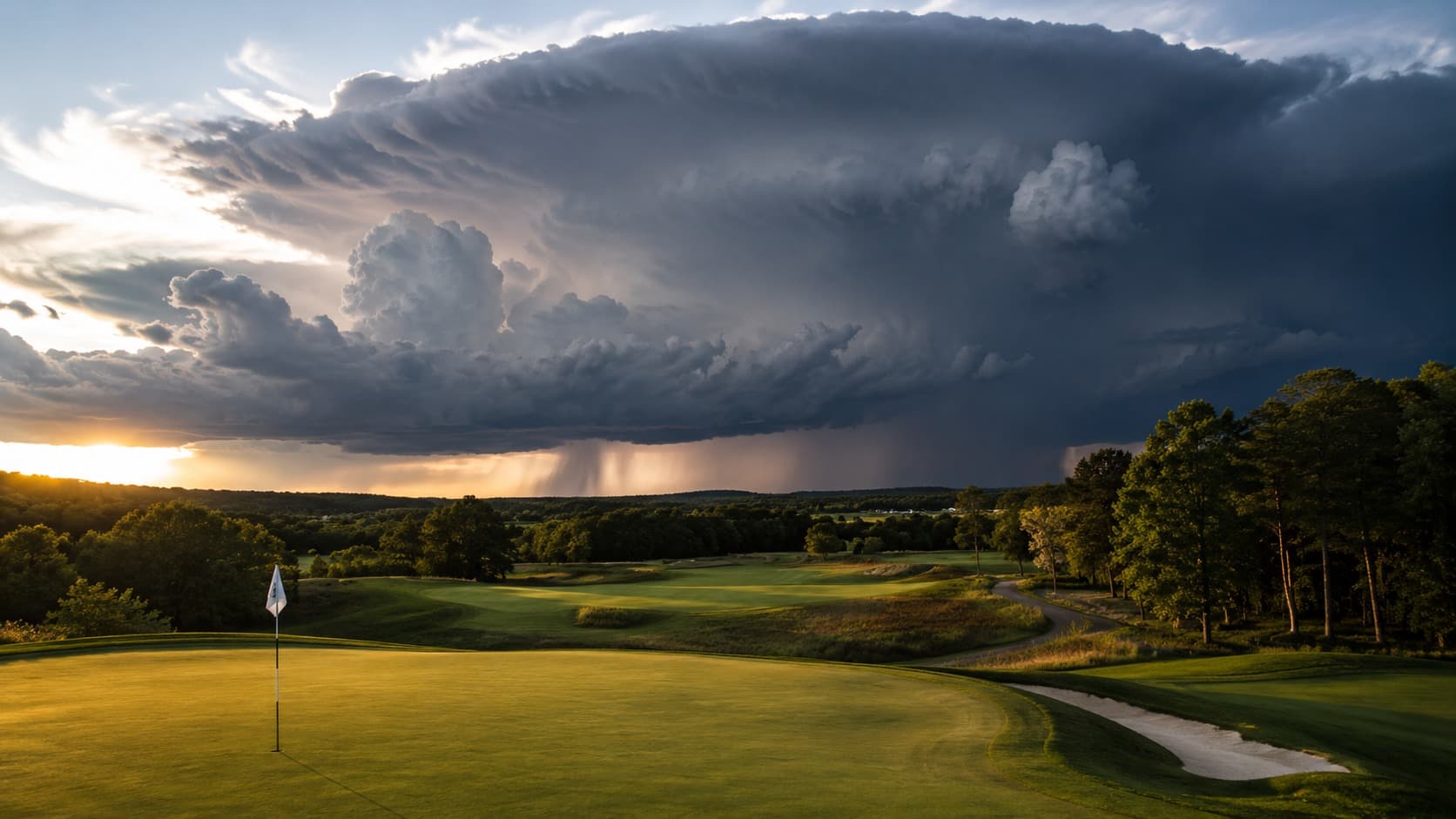
The Three O’Clock Storm: Reading Summer’s Convective Cycle to Protect Your Round
A 40% chance of afternoon thunderstorms does not mean a 40% chance of getting rained on. In the summer convective season it means the morning is nearly clear and the afternoon carries a fast-building, high-energy storm risk driven by a daily heating cycle. Here is the meteorology behind the pattern, the G-Score data on how the storm cycle punishes afternoon tee times across the Southeast, Midwest, and desert Southwest, the lightning-safety decision tree that actually matters, and the workflow that gets you off the course before the first bolt.
Read Story
How to Read a G-Score: The 0–100 Golf Playability Number, Decoded
A G-Score on this site is a single 0–100 number that tells you whether today is worth tee-up. Here is exactly what each band means, what drives the calculation, and how to use it to plan a round you will actually score on.
Read StoryDanorie
Editorial & Data
Golf Weather Score is built by Danorie. We compute the G-Score — our own playability rating — from live NOAA forecasts and published course scorecards, so any US course can be compared on any day with a single number. Methodology and data sources are documented on every page.
Every Friday Morning
When Atlantis Country Club plays best next weekend.
Friday 6am ET: peak G-Score windows for Atlantis Country Club, wind direction by hour, and one gear call. Three minutes to read, save you the round.
One email a week. Unsubscribe in one click.
The Caddie's Oracle
Draw your luck before the tee off