
Caddie's Gear Advisor
Curated for today's 94°F · Thunderstorm
Storm-Ready Outerwear
Waterproof layers built for 18 holes in the rain
Tour-Grade Umbrellas
68" double-canopy wind-resistant coverage
Wet-Weather Gloves
All-weather grip that performs in the rain
Waterproof Golf Shoes
Keep your feet dry through every fairway
Your Golf Trip, Handled
The Ultimate Golf Trip Planner
Everything you need to play Avila Golf & Country Club — from booking your flight to checking in course-side.
Course-Side Stays
Luxury hotels, resorts, and stay-and-play packages just minutes from the first tee.
Flights
Compare fares across 700+ airlines for the best route to your tee time.
SUV Rentals for Golf Bags
Spacious vehicles with room for clubs, bags, and your foursome.
Travel Insurance
Coverage for medical, weather delays, and gear at your destination.
Avila Golf & Country Club: Course Intelligence
Signature Setup
I played my first real Florida summer golf out near Tampa years ago, and the lesson stuck harder than any swing tip: the heat and the afternoon sky decide your round before the wind ever does. Let me be honest about Avila Golf & Country Club specifically — it's a private, gated community course in North Tampa, and I'm writing it from the design pedigree, the geography, and Gulf Coast climate records rather than dressing up a single round I didn't play there. What I can tell you cleanly: Avila is a Jack Nicklaus parkland layout that opened in the mid-1980s, a par-72 routing threaded through lakes and mature Florida live oaks. It's classic Nicklaus — the trouble is placed to punish the wrong angle, not just the short hitter.
TL;DR: Private Jack Nicklaus parkland course in North Tampa, FL, par 72, water and oaks in play throughout. The card isn't the defense — Tampa's summer humidity steals carry and the daily sea-breeze thunderstorm clock steals your back nine. Play angles, and beat the afternoon storms in summer.
Hole-by-Hole Wind & Playing Lines
I won't assign hole numbers and yardages I can't verify from a card in front of me, so here's the playing logic that actually decides scoring on a Nicklaus lakes-and-oaks layout in this climate:
- The longer par-4s with a lake guarding the approach: In summer, with the dewpoint sitting near 74–76°F, the ball simply doesn't carry like it does in winter — a flushed 150-yard club can come up a full club short over water. Club up one, flight it lower under the thick air, and bail to the dry side.
- The forced-carry par-3s: These are calm in a still dawn but treacherous once the sea breeze fills mid-morning off Tampa Bay. Take the longer read and let the wind quarter the ball onto the fat of the green rather than flirting with the water edge.
- The dogleg holes bending around the oaks: Nicklaus rewards the correct angle off the tee. A player who shapes the ball to the inside corner has a clean look; the one who just bombs it ends up blocked by a live oak. Angle is the expensive yard here.
The habit that travels: re-club every approach in summer for lost carry, and play the early holes fast — you're racing the storm clock.
Green & Fairway Characteristics
This is Bermuda-grass parkland golf, so the seasonal swing in firmness is huge. Through the dry winter season the fairways run firm and fast and your roll-out is generous; through the June–September wet season they turn soft and receptive, and your number is pure carry with little release — that difference can be 15–20 yards of total distance on the same swing. The Nicklaus greens are gently contoured and fair-paced rather than tricked-up; the trouble is the water and the framing oaks, not the putting surfaces themselves. Land approaches below the hole — on soft summer greens you can be aggressive at flags, but on firm, dry winter afternoons a shot that lands hot will release through the back.
Seasonal Weather Pattern
Tampa's microclimate is the whole story. From November through April it's about as good as golf weather gets: daytime highs in the 70s°F, low humidity, and stable air — this is the scoring and travel season, and the fairways are at their firmest and fastest. May warms up fast. Then June through September is the wet season: highs in the low 90s°F, oppressive dewpoints in the low-to-mid 70s, and near-daily afternoon thunderstorms driven by the sea-breeze convergence — Gulf air and Tampa Bay air collide over the inland peninsula and stack storms by early-to-mid afternoon, often with lightning. Mornings in summer are hot but usually playable; the afternoons are a gamble. October cools and dries out as the pattern breaks, reopening the good window.
Local Play Tips
One piece of first-hand Tampa logic you won't see on the scorecard: in summer the thunderstorms aren't random — they're a sea-breeze clock. Two breezes, one off the Gulf to the west and one off Tampa Bay to the east, push inland and collide over the peninsula, and where they meet the storms fire, usually building through the early afternoon. That means a dawn-to-mid-morning round is genuinely a different, safer game than a 1 p.m. tee. Read the morning cumulus: if the clouds are already towering by 11 a.m., the convergence is early that day and you want to be walking off 18, not standing on it. Play the heat like the wind — drink ahead of thirst and re-club for lost carry.
Pre-Round Weather Workflow
Use the 7-day G-Score and windExposure read like a Tampa local would:
- Three days out: Scan the G-Score trend. In summer, the best scoring days are the ones with a later-firing convergence — and the dry-season winter days will almost all read high. Lock an early tee time for anything May–September.
- Night before: Check the afternoon storm probability and the dewpoint. A dewpoint in the mid-70s means real carry loss — plan to club up across the board, not just on the long holes.
- Tee time: In summer, go at first light. Bank your strokes on the front nine before the heat and the storm clock turn on, and have a hard turn-around plan if the cumulus builds early. In winter, you can play any slot — just respect the firmer, faster greens.
Related Reading
Before you tee off at Avila Golf & Country Club
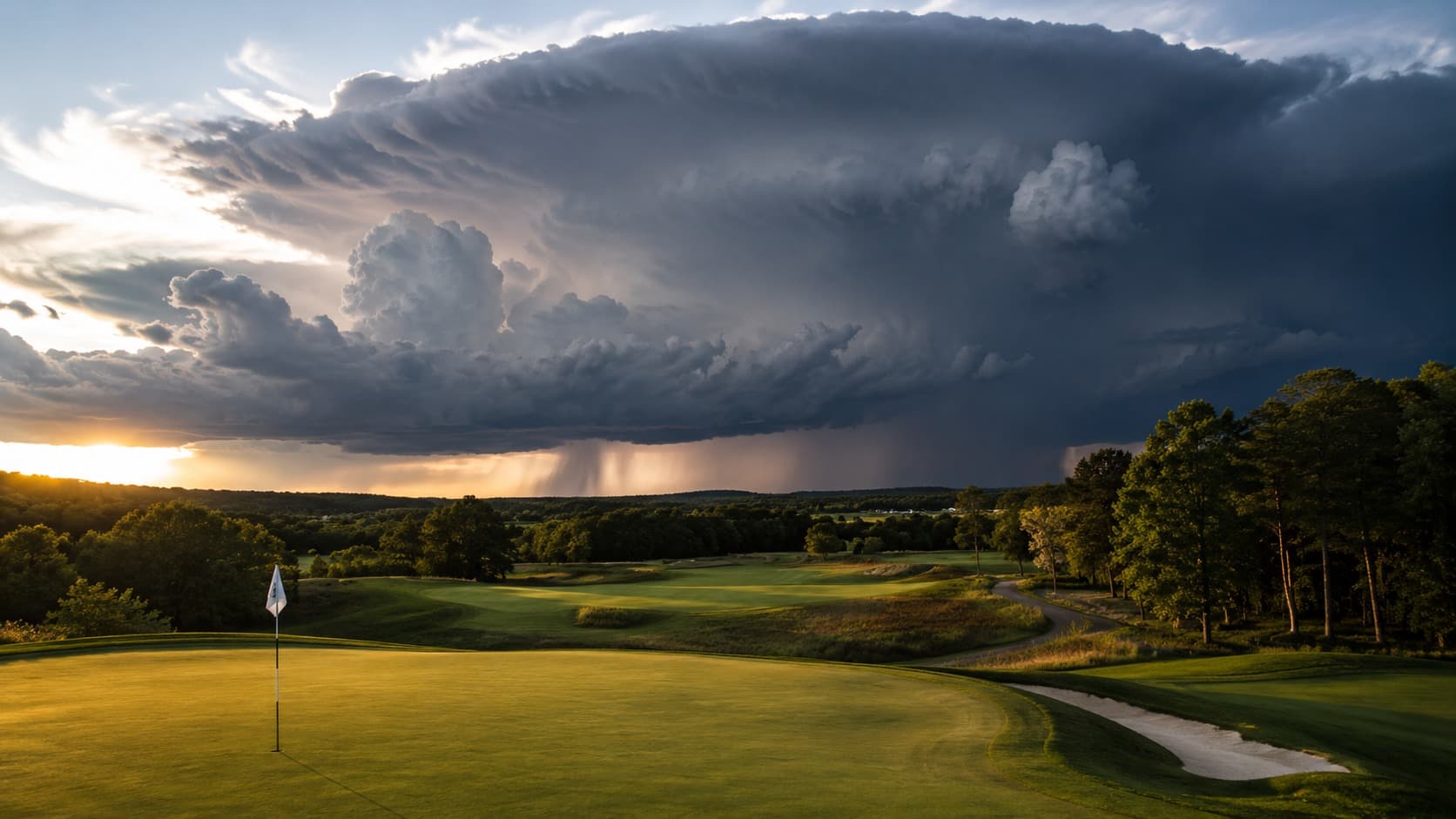
The Three O’Clock Storm: Reading Summer’s Convective Cycle to Protect Your Round
A 40% chance of afternoon thunderstorms does not mean a 40% chance of getting rained on. In the summer convective season it means the morning is nearly clear and the afternoon carries a fast-building, high-energy storm risk driven by a daily heating cycle. Here is the meteorology behind the pattern, the G-Score data on how the storm cycle punishes afternoon tee times across the Southeast, Midwest, and desert Southwest, the lightning-safety decision tree that actually matters, and the workflow that gets you off the course before the first bolt.
Read Story
How to Read a G-Score: The 0–100 Golf Playability Number, Decoded
A G-Score on this site is a single 0–100 number that tells you whether today is worth tee-up. Here is exactly what each band means, what drives the calculation, and how to use it to plan a round you will actually score on.
Read StoryMinSu Kim
Founder & Golf Data Analyst
MinSu is a data analyst and golfer with 10+ years on the course. He built Golf Weather Score to answer one question: is today a good day to play? He combines weather data, course intelligence, and the proprietary G-Score algorithm to help golfers make smarter decisions.
Every Friday Morning
When Avila Golf & Country Club plays best next weekend.
Friday 6am ET: peak G-Score windows for Avila Golf & Country Club, wind direction by hour, and one gear call. Three minutes to read, save you the round.
One email a week. Unsubscribe in one click.
The Caddie's Oracle
Draw your luck before the tee off