
Caddie's Gear Advisor
Curated for today's 95°F · Thunderstorm
Storm-Ready Outerwear
Waterproof layers built for 18 holes in the rain
Tour-Grade Umbrellas
68" double-canopy wind-resistant coverage
Wet-Weather Gloves
All-weather grip that performs in the rain
Waterproof Golf Shoes
Keep your feet dry through every fairway
Your Golf Trip, Handled
The Ultimate Golf Trip Planner
Everything you need to play Bacall Golf Course (The Villages) — from booking your flight to checking in course-side.
Course-Side Stays
Luxury hotels, resorts, and stay-and-play packages just minutes from the first tee.
Flights
Compare fares across 700+ airlines for the best route to your tee time.
SUV Rentals for Golf Bags
Spacious vehicles with room for clubs, bags, and your foursome.
Travel Insurance
Coverage for medical, weather delays, and gear at your destination.
Bacall Golf Course (The Villages): Course Intelligence
TL;DR: Bacall is one of The Villages' executive nine-hole loops in central Florida (Sumter County, ~60 ft elevation). It's short, walkable, and built for fast morning rounds — but central Florida heat, humidity, and the afternoon thunderstorm clock matter more here than yardage. Play it early.
Signature Setup
Bacall sits inside The Villages, the sprawling retirement community north of Orlando near the Ocala line. It's an executive course — nine holes, a mix of par-3s and short par-4s, not a championship 18 — and it was built by The Villages' own development and design team during the community's mid-2000s southern expansion rather than by a single name-brand architect. I want to be honest: this isn't a course with a USGA-rated tournament pedigree, and I won't pretend otherwise. Its value is utility — a quick, low-stress loop you can finish before the heat turns.
The closing par-4 over water is the hole that defines a round here. Everything before it is gettable; that one asks for a real decision.
Hole-by-Hole Wind & Playing Lines
Central Florida wind is mild but directional, and on an executive layout a 10 mph breeze swings club selection by a full club.
- The long par-4 (the toughest two-shotter): On a southerly afternoon breeze (10–12 mph, common June–September) it plays dead into the wind. A 320-yard hole stretches to feel like 355. I'd hit a hybrid off the tee for position, wedge on, and take par — chasing the green off the tee here puts you in the water or palmetto right.
- The water-carry par-3: Into a NW winter wind (Nov–Feb cold fronts), add a full club. What's a smooth 8-iron on a calm dawn becomes a hard 6.
- The short par-4 dogleg: Downwind on a north breeze it tempts you to cut the corner — resist; the landing zone is narrow and the runout is firm Bermuda.
Green & Fairway Characteristics
Fairways are Bermudagrass, firm and fast-running in the dry season (Oct–May), softer and grabbier through the summer rains. Greens are Bermuda/TifEagle, overseeded with ryegrass in winter for color and roll. Expect medium speed — roughly 9 on the Stimpmeter, not lightning — with subtle central-Florida grain that follows the afternoon sun: putts break toward the setting sun more than the slope suggests. The nine is compact and walkable; from forward to back markers you're looking at a modest spread, well under a championship card.
Seasonal Weather Pattern
This is where central Florida separates from the rest of the golf map. Summers (June–September) run highs of 90–93°F with dew points near 75°F — the heat index pushes past 100 by noon, and the afternoon thunderstorm clock is real: storms fire most days between 1 and 4 p.m., often with lightning. Winter (December–February) is the prize: highs in the low 70s, mornings in the upper 40s to mid-50s, dry, and reliably sunny — the snowbird season for a reason. Spring is dry and breezy; the wet season ramps from late May.
I haven't played Bacall in a July afternoon — nobody sane has — so that summer read is from central-Florida historical weather (NOAA Sumter/Ocala stations) plus my own Villages-area winter mornings, not a personal summer round on this nine.
Local Play Tips
The executive courses in The Villages are walk-on and fast-moving, so tee-sheet pressure is lower than the championship 18s — but the real lever is the clock, not the booking. On a winter dawn I've found the first 90 minutes after sunrise give you still air, dew-slowed greens (putts come up short — hit them firm), and the best light. By 10 a.m. in summer the humidity alone costs you focus and distance feel.
Pre-Round Weather Workflow
Use the 7-day G-Score and windExposure the night before:
- Summer (Jun–Sep): book the earliest slot. If the G-Score for any afternoon dips below the morning by 8+ points, it's the storm window — don't fight it. Finish 9 before 1 p.m.
- Winter (Dec–Feb): check the morning low. Under 50°F means a real extra club on the water-carry holes and dew-slow greens for the first hour.
- Wind: a S/SE reading above 10 mph means the long par-4 plays a full club-plus longer — plan the layup before you tee off, not on the tee.
- Always: in central Florida, the morning G-Score almost always beats the afternoon. Play early, walk it, and let the heat have the back half of the day.
Related Reading
Before you tee off at Bacall Golf Course (The Villages)
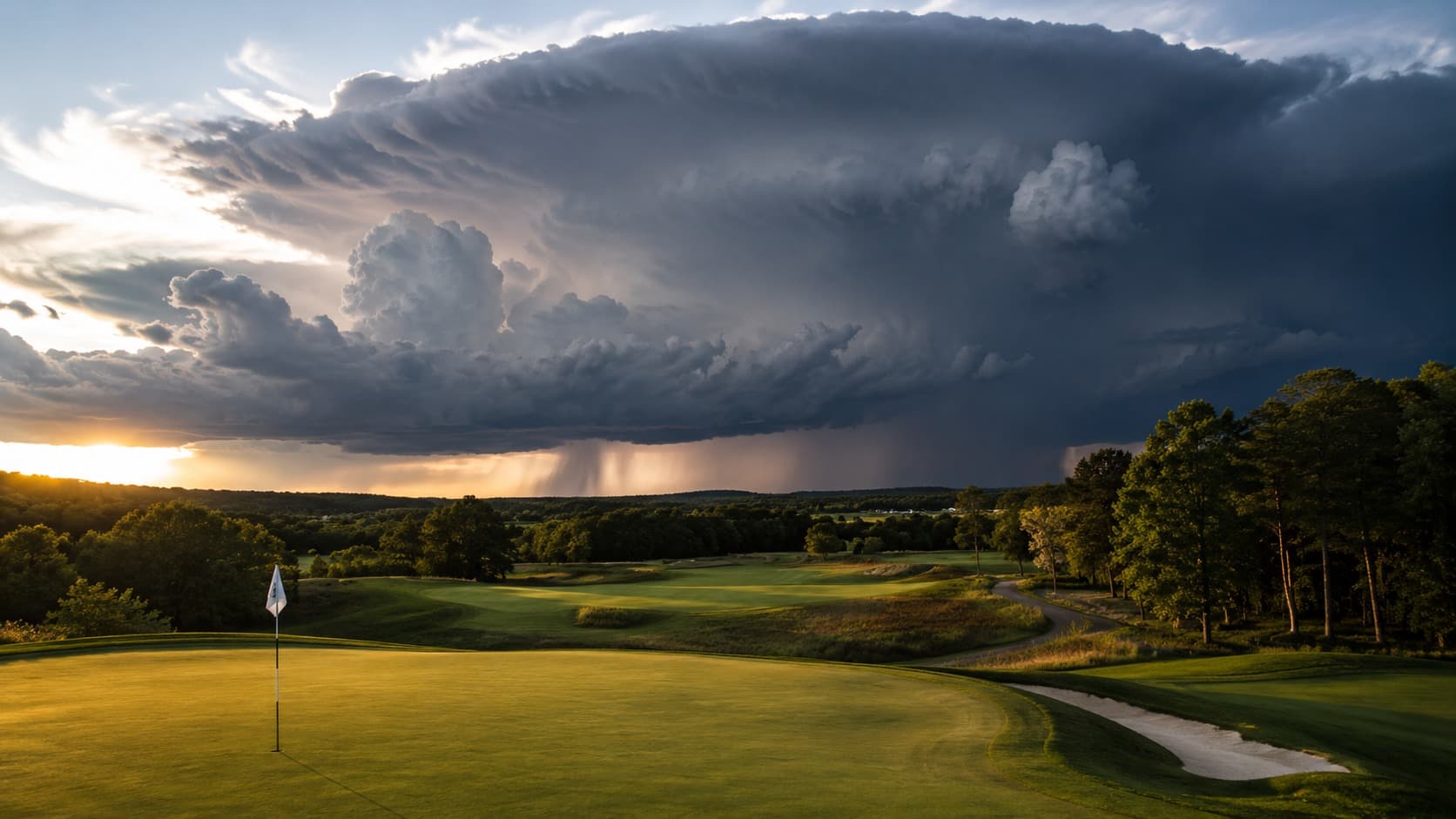
The Three O’Clock Storm: Reading Summer’s Convective Cycle to Protect Your Round
A 40% chance of afternoon thunderstorms does not mean a 40% chance of getting rained on. In the summer convective season it means the morning is nearly clear and the afternoon carries a fast-building, high-energy storm risk driven by a daily heating cycle. Here is the meteorology behind the pattern, the G-Score data on how the storm cycle punishes afternoon tee times across the Southeast, Midwest, and desert Southwest, the lightning-safety decision tree that actually matters, and the workflow that gets you off the course before the first bolt.
Read Story
How to Read a G-Score: The 0–100 Golf Playability Number, Decoded
A G-Score on this site is a single 0–100 number that tells you whether today is worth tee-up. Here is exactly what each band means, what drives the calculation, and how to use it to plan a round you will actually score on.
Read StoryMinSu Kim
Founder & Golf Data Analyst
MinSu is a data analyst and golfer with 10+ years on the course. He built Golf Weather Score to answer one question: is today a good day to play? He combines weather data, course intelligence, and the proprietary G-Score algorithm to help golfers make smarter decisions.
Every Friday Morning
When Bacall Golf Course (The Villages) plays best next weekend.
Friday 6am ET: peak G-Score windows for Bacall Golf Course (The Villages), wind direction by hour, and one gear call. Three minutes to read, save you the round.
One email a week. Unsubscribe in one click.
The Caddie's Oracle
Draw your luck before the tee off