
Caddie's Gear Advisor
Curated for today's 71°F · Clear
Tour-Level Drivers
Engineered for maximum distance and forgiveness
Laser Rangefinders
Pin-seeking technology for precision approaches
Premium Golf Balls
Tour-caliber spin and distance performance
Performance Sunglasses
Polarized lenses optimized for reading greens
Your Golf Trip, Handled
The Ultimate Golf Trip Planner
Everything you need to play Badin Inn Golf Club — from booking your flight to checking in course-side.
Course-Side Stays
Luxury hotels, resorts, and stay-and-play packages just minutes from the first tee.
Flights
Compare fares across 700+ airlines for the best route to your tee time.
SUV Rentals for Golf Bags
Spacious vehicles with room for clubs, bags, and your foursome.
Travel Insurance
Coverage for medical, weather delays, and gear at your destination.
Badin Inn Golf Club: Course Intelligence
Signature Setup
Let me be straight with you before the wind reads: I've studied Badin Inn from its history, the Donald Ross attribution, and central-Carolina climate records — I haven't teed it up myself, so what follows is profile-and-pattern reasoning, not a round I'm dressing up as memory. The course sits in Badin, North Carolina, a small Stanly County town that the French aluminum company L'Aluminium Français laid out around 1913 and Alcoa later ran as a company town on the shore of Badin Lake, the Narrows reservoir on the Yadkin River. The golf has real pedigree: Donald Ross is credited with the original nine, built around 1917, which puts this among the older designs in the Piedmont. The back nine came later, and because I can't verify who finished it, I won't invent a name. What matters for play is the setting — rolling Piedmont clay at roughly 560 feet, hard up against a large lake that drives the wind.
TL;DR: Historic Donald Ross-rooted nine (c. 1917) in Badin, NC, an Alcoa company town on Badin Lake. Modest length, but fully exposed to lake-driven and frontal wind. No sea breeze — the wind rides weather systems and the daily lake thermal. Play position over power and track the front timing.
Hole-by-Hole Wind & Playing Lines
The club doesn't publish a per-hole handicap card I could verify, so I won't fabricate hole numbers and yardages. Here's how the wind dictates play on a layout in this setting:
- The lakeside holes on a S/SW summer flow: When the warm-season southerly is up at 10–15 mph, it funnels straight off Badin Lake with nothing to break it. A flushed 150-yard club behaves like 165–170. Club up one and flight the ball low rather than ballooning it into the gust.
- The longer two-shot holes after a NW front: Once a cold front clears, the dry northwest wind at your back firms the Bermuda fairways and shrinks the card — land well short of the green and let the ball release rather than flying a hot pitch onto a surface that won't hold it.
- Any crosswind hole near the water: On lake-exposed ground a player who can hold a shaped ball into a crosswind scores better than one who just hits it far. Length is the cheap yard here; ball flight is the expensive one.
The habit that travels: read the wind off the flags on the first exposed hole, decide whether it's a "front" wind or a "lake-thermal" wind, and re-club accordingly all the way in.
Green & Fairway Characteristics
The fairways are Bermuda over rolling Piedmont clay subsoil, the kind of ground that bakes out and runs in a dry spell and softens fast under a summer storm. The greens trace back to the older bentgrass-era Ross design philosophy — fair and contoured rather than tricked-up, rewarding an approach below the hole. At roughly 560 feet of elevation with mature trees on the inland holes and open exposure toward the lake, your stock yardages are only reliable in the rare windless window. Firmness is the swing factor: a July high-pressure stretch leaves the greens fast and unreceptive, while the frequent afternoon thunder cells of a Carolina summer can soften everything within an hour.
Seasonal Weather Pattern
Badin sits in a humid subtropical Piedmont climate, moderated locally by the lake. Spring (Mar–May): the most variable stretch — shifting SW-to-NW winds behind passing fronts and wide day-to-day temperature swings; often firm, fast, and breezy. Summer (Jun–Aug): hot and humid, highs in the upper-80s to low-90s°F, a prevailing S/SW breeze off the lake, and a real risk of afternoon thunderstorms that can stop play. Fall (Sep–Oct): the prime window — crisp mornings, drier NW air behind fronts, firm greens, and the calmest scoring weather of the year. Winter: mild by northern standards but raw on the lake; cold-front winds and the occasional freeze. For that stretch I lean on NOAA central-Carolina historicals rather than anything firsthand.
Local Play Tips
Here's the one thing a coastal instinct gets wrong at Badin Inn: you don't beat the wind by teeing off early to outrun a sea breeze — there isn't one. On a lakeside Piedmont course the wind is driven partly by passing weather systems and partly by the daily land-lake thermal, which builds through the afternoon as the water and the surrounding clay heat at different rates. A bluebird high-pressure morning can be dead calm; a spring frontal passage can pin 20 mph gusts on you all day, and a hot summer afternoon can stir a steady onshore-style flow off the lake that wasn't there at sunrise. Plan around the synoptic forecast — the next front and the post-front wind shift — and you'll read this course far better than a golfer who just grabs the first tee time out of habit.
Pre-Round Weather Workflow
Treat golfweatherscore's 7-day G-Score and windExposure as your go/no-go and your timing tool — but read it for a lake-and-Piedmont course, not a coastal one:
- Three days out: scan the G-Score trend for the passage of fronts. The difference between a 9 and a 4 here is usually a weather system arriving, not the time of day.
- The night before: lock in wind direction and speed. A S/SW flow means warm, humid, storm-prone golf with the lake breeze in play; a NW flow behind a front means firm, fast, dry conditions where the downwind holes shrink.
- Round morning: if windExposure flags sustained gusts over ~18 mph — common in spring and ahead of summer storms — accept that the longer holes will play a club or two longer into the breeze off the lake, and let position-golf, not heroics, protect your number.
Related Reading
Before you tee off at Badin Inn Golf Club
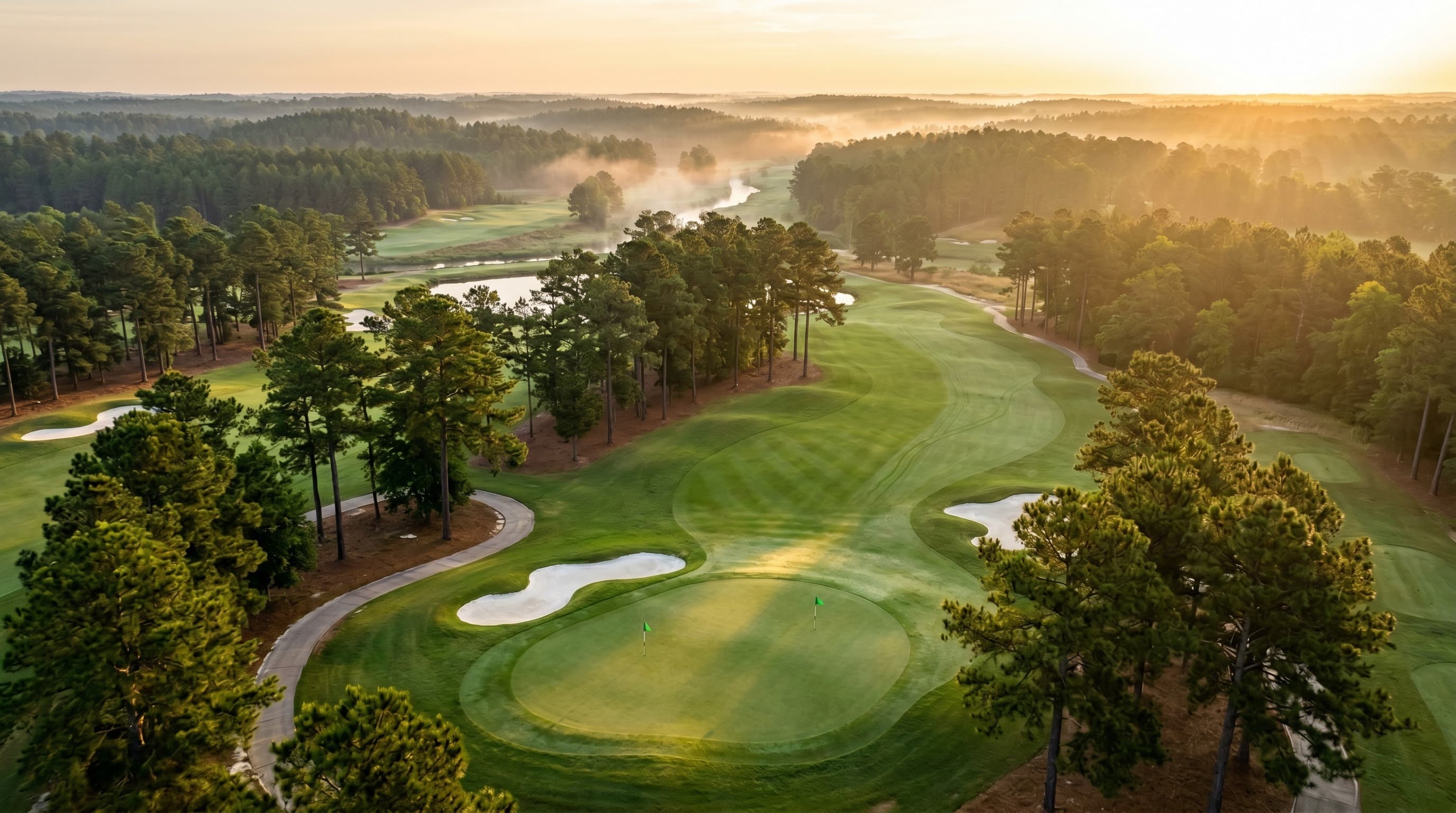
The May 2026 G-Score Heatmap: Where American Golf Peaks This Spring
May is the most underrated month on the American golf calendar. Five regions hit their annual peak this spring, three turn quietly hostile, and the data tells a clearer story than the brochures. Here is where to play, where to avoid, and how to time your booking window.
Read Story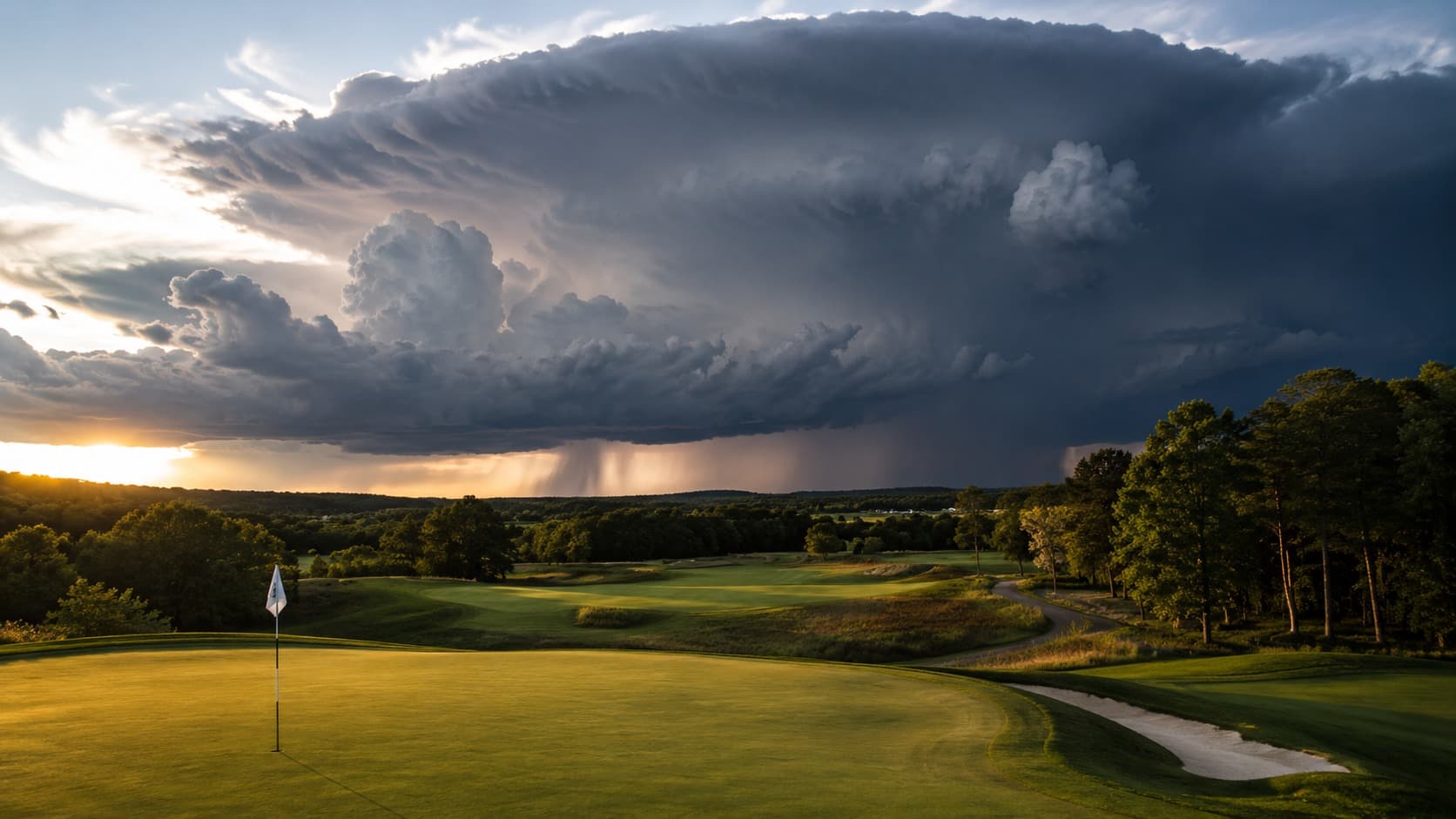
The Three O’Clock Storm: Reading Summer’s Convective Cycle to Protect Your Round
A 40% chance of afternoon thunderstorms does not mean a 40% chance of getting rained on. In the summer convective season it means the morning is nearly clear and the afternoon carries a fast-building, high-energy storm risk driven by a daily heating cycle. Here is the meteorology behind the pattern, the G-Score data on how the storm cycle punishes afternoon tee times across the Southeast, Midwest, and desert Southwest, the lightning-safety decision tree that actually matters, and the workflow that gets you off the course before the first bolt.
Read StoryMinSu Kim
Founder & Golf Data Analyst
MinSu is a data analyst and golfer with 10+ years on the course. He built Golf Weather Score to answer one question: is today a good day to play? He combines weather data, course intelligence, and the proprietary G-Score algorithm to help golfers make smarter decisions.
Every Friday Morning
When Badin Inn Golf Club plays best next weekend.
Friday 6am ET: peak G-Score windows for Badin Inn Golf Club, wind direction by hour, and one gear call. Three minutes to read, save you the round.
One email a week. Unsubscribe in one click.
The Caddie's Oracle
Draw your luck before the tee off