
Caddie's Gear Advisor
Curated for today's 101°F · Clear
Ultralight Distance Drivers
Maximum carry in hot, low-drag conditions
UV Protection Apparel
UPF 50+ cooling fabrics for peak-sun rounds
Precision Rangefinders
Slope-adjusted yardage in any condition
Hydration & Cooling
Insulated bottles and cooling towels
Your Golf Trip, Handled
The Ultimate Golf Trip Planner
Everything you need to play Badlands Golf Club — from booking your flight to checking in course-side.
Course-Side Stays
Luxury hotels, resorts, and stay-and-play packages just minutes from the first tee.
Flights
Compare fares across 700+ airlines for the best route to your tee time.
SUV Rentals for Golf Bags
Spacious vehicles with room for clubs, bags, and your foursome.
Travel Insurance
Coverage for medical, weather delays, and gear at your destination.
Badlands Golf Club: Course Intelligence
Signature Setup
Let me be honest before I start: I have not walked Badlands myself, and the club's status matters here — the Las Vegas course opened in 1996 to a Johnny Miller routing (with Chi Chi Rodriguez attached to the project) and operated for about two decades before closing around 2016–2017 in a long redevelopment dispute over the Peccole Ranch / Queensridge land in west Las Vegas. So everything below is profile-and-pattern reasoning built from the scorecard, the design history, and Las Vegas Valley climate records — not a round I'm dressing up as memory. What made Badlands distinctive was the land: Miller dropped 27 holes (three nines named Diablo, Outlaw, and Desperado) directly into natural desert arroyos, so the washes themselves were the hazards. A standard 18-hole pairing ran about 6,926 yards to a par of 72.
TL;DR: Johnny Miller desert-wash course in west Las Vegas, opened 1996, 27 holes (Diablo/Outlaw/Desperado), ~6,926y, par 72. The arroyos — not length — defend it. High-desert air (~2,500 ft) adds distance; the afternoon SW canyon wind is the real scoring variable. The course has been closed since the mid-2010s amid a development fight.
Hole-by-Hole Wind & Playing Lines
Because per-hole handicap cards for the three nines aren't something I can verify cleanly, I'll describe how the wind and the washes dictate play rather than invent hole numbers:
- Long par-4s into the afternoon SW wind: The valley's prevailing summer flow builds from the southwest after midday at 12–20 mph. Into that, a flushed 150-yard club plays nearer 175. The trap is that most greens here sit just beyond a wash — so club up and carry to the center of the green; a short approach knocked down by the wind drops straight into the arroyo.
- Forced-carry tee shots on the Diablo nine: Several drives must clear raw desert. A headwind shrinks your carry exactly when you need it most — on a breezy day, take the safer line to the wide side of the fairway rather than challenging the longest carry.
- Downwind, downhill holes: With a NW or tailwind at ~2,500 ft elevation, the ball runs out forever on firm Bermuda. Land well short and let it release; flying a hot wedge at a firm green sends it over the back into desert.
The habit that travels: at this elevation and in this wind, distance is the cheap yard. The expensive skill is flighting the ball low enough to keep it out of the wash.
Green & Fairway Characteristics
The fairways were Bermuda, overseeded with ryegrass for winter color, and they firmed up fast under the desert sun — a key reason the downwind holes ran so long. Greens were bentgrass, which in a Mojave summer demands heavy maintenance and tends to play a touch slower and grainier when stressed by heat. With the tips around 6,926 yards and a slope reported in the low-130s, the card is moderate on paper; the difficulty was always the routing — narrow target fairways framed by arroyos, where a miss isn't rough, it's unplayable desert. Position off the tee mattered far more than raw power.
Seasonal Weather Pattern
Las Vegas is a Mojave high-desert climate, and the swing is extreme. Summer (Jun–Aug): brutal, with highs routinely 100–110°F and a real monsoon risk in July–August — afternoon thunder cells and dust-driving outflow winds. Golf is a sunrise activity only. Spring (Mar–May) and Fall (Oct–Nov): the prime windows — daytime highs in the 70s–80s°F, low humidity, and the most playable, firmest conditions of the year. Winter (Dec–Feb): mild days in the 55–60°F range but genuinely cold desert mornings near freezing; the ball won't carry as far in dense, cold morning air, which partly offsets the elevation bonus. Unlike a coastal course, there's no maritime moderation — the daily temperature swing here can exceed 30°F.
Local Play Tips
The one thing a sea-level golfer gets wrong at a course like Badlands: you can't trust your home yardages. At roughly 2,500 feet of elevation, thinner air adds about 6–8% to carry distance — your 150-yard club is closer to a 160 here on a still day. Combine that with firm desert fairways and you can fly greens you'd normally hold. Then layer the afternoon SW canyon wind on top, which funnels and accelerates as it moves through the arroyos, and your real number swings hard depending on the hour. Tee off early: a calm 8 a.m. round on firm-but-cool turf is worth a stroke or two over the same holes once the wind and heat arrive after noon.
Pre-Round Weather Workflow
Treat golfweatherscore's 7-day G-Score and windExposure as your go/no-go and timing tool — and read them for a high-desert course, not a coastal one:
- Three days out: scan the G-Score for summer monsoon risk. In July–August a clean morning can turn into a lightning-and-dust afternoon fast; the trend tells you whether to commit to a dawn tee.
- The night before: lock in wind direction and speed. A building SW flow means the back nine plays longer into the breeze every hole; a calm or NW pattern means firm, fast, run-out conditions where you land short and let it release.
- Round morning: if windExposure flags sustained gusts over ~20 mph — common on summer afternoons — combine that with the elevation bonus and recompute every club. And remember the practical reality: confirm the course's current operating status before you travel, because this property has been closed and tied up in redevelopment since the mid-2010s.
Related Reading
Before you tee off at Badlands Golf Club
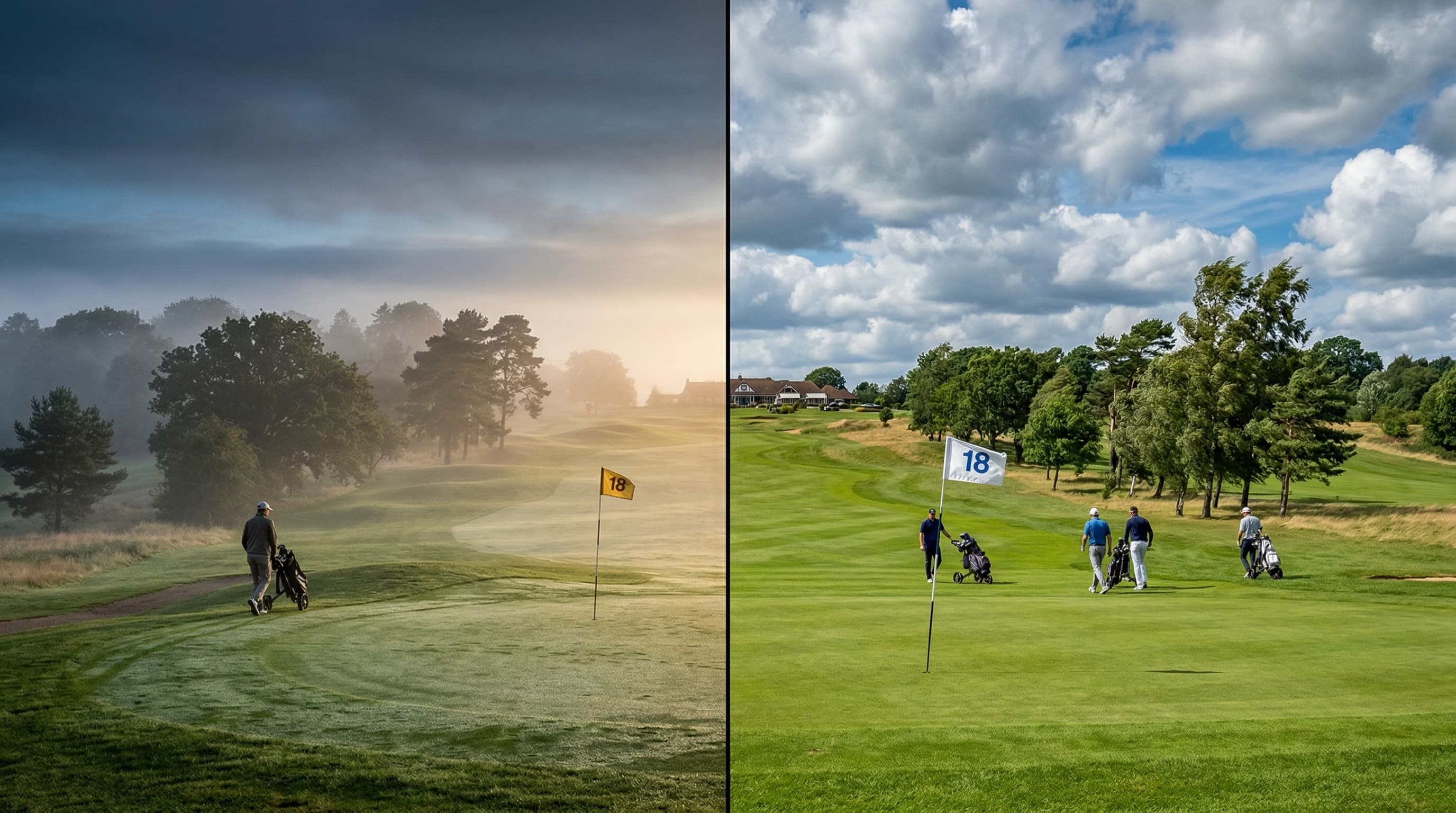
Morning vs Afternoon Tee Times: What Weather Data Reveals About When to Play
Hourly weather data reveals morning tee times score 8-12 G-Score points higher than afternoon slots. Here is what the numbers say about optimal timing.
Read Story
Best Golf Weather by State: Ranking America by Average G-Score
We ranked all 50 US states by average G-Score golf playability. California tops the list, but the results beyond the top five may surprise you.
Read StoryMinSu Kim
Founder & Golf Data Analyst
MinSu is a data analyst and golfer with 10+ years on the course. He built Golf Weather Score to answer one question: is today a good day to play? He combines weather data, course intelligence, and the proprietary G-Score algorithm to help golfers make smarter decisions.
Every Friday Morning
When Badlands Golf Club plays best next weekend.
Friday 6am ET: peak G-Score windows for Badlands Golf Club, wind direction by hour, and one gear call. Three minutes to read, save you the round.
One email a week. Unsubscribe in one click.
The Caddie's Oracle
Draw your luck before the tee off