
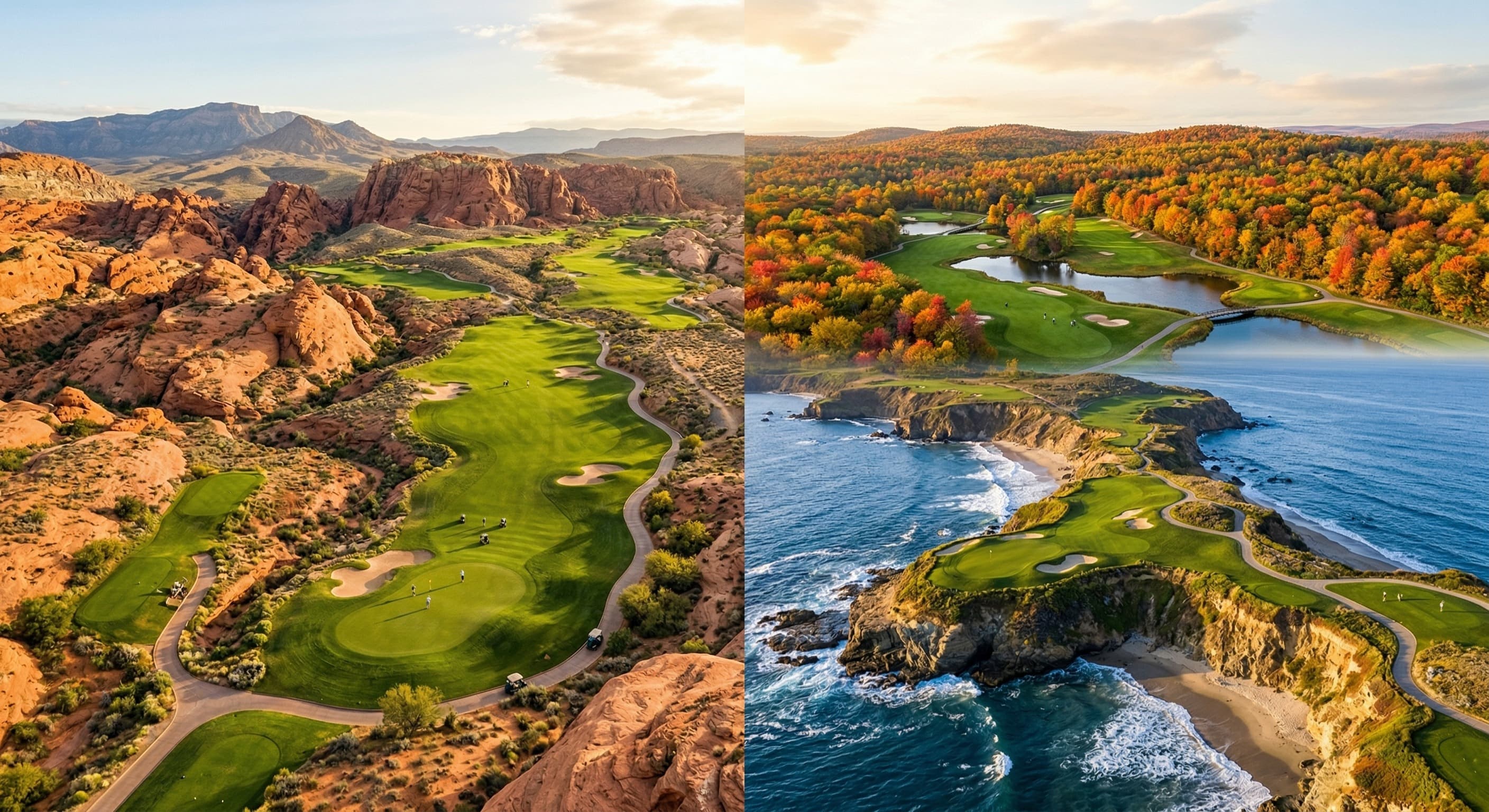
Not all states are created equal when it comes to year-round golf. Every golfer knows the frustration of checking the forecast and seeing rain, freezing temperatures, or relentless wind on a day that was supposed to be spent on the course. But what if you could step back from any single weekend and look at the bigger picture? What if you could measure, score, and rank every US state by how friendly its weather actually is for playing golf across an entire calendar year?
That is exactly what we did. Using G-Score weather analysis, the same proprietary scoring system that powers real-time course-level recommendations on GolfWeatherScore.com, we evaluated historical weather patterns for all 50 states. We calculated average G-Scores, counted annual playable days, identified peak seasons, and applied penalty factors for extreme conditions. The result is the most comprehensive golf weather ranking of American states ever assembled.
Some of these rankings will confirm what you already suspect. Others might genuinely surprise you. A state famous for golf tourism does not always have the best weather for playing it. And a few overlooked states deliver remarkably consistent conditions that most golfers never think to explore.
Whether you are planning a relocation, choosing your next golf trip, or simply curious about how your home state stacks up, this guide will give you the data-driven answer. Let us start with how we built these rankings.
How We Ranked Every State: The G-Score Methodology
The G-Score is a composite weather playability metric designed specifically for golf. Unlike generic weather ratings or simple temperature averages, the G-Score accounts for the unique combination of factors that determine whether conditions on a golf course are comfortable, safe, and conducive to good play.
The Five Core G-Score Factors
Every G-Score calculation evaluates five environmental variables, each weighted according to its impact on the golf experience:
Temperature (weighted 30%): The ideal playing range is 60 to 80 degrees Fahrenheit. Scores peak in this window and decline progressively as temperatures move toward extremes. Mild warmth is slightly preferred over mild cool, reflecting the reality that most golfers are more comfortable at 78 than at 58.
Wind Speed (weighted 25%): Wind under 10 mph is considered ideal. Scores remain strong up to 15 mph, which most golfers can manage with minor adjustments. Above 15 mph, scores drop significantly. Sustained winds above 25 mph create severe penalties, as ball flight becomes unpredictable and the experience becomes unpleasant for most players.
Precipitation Probability (weighted 20%): Rain probability directly reduces the G-Score. A zero percent chance of rain earns full marks. Light drizzle risk causes minor deductions. Anything above 40 percent precipitation probability drops the score substantially, reflecting both playability concerns and the likelihood that many golfers would cancel their round.
UV Index (weighted 15%): Moderate UV levels between 3 and 6 are ideal. Very low UV typically correlates with overcast skies and cooler conditions. Very high UV above 8 introduces health concerns and discomfort during a four-plus-hour round, especially in states where summer sun exposure is intense.
Humidity (weighted 10%): Relative humidity between 30 and 60 percent is comfortable. Extremely low humidity below 15 percent can cause discomfort and dehydration. High humidity above 75 percent creates oppressive conditions that affect stamina, grip, and overall enjoyment.
Year-Round Average vs Peak Season Scoring
For these state rankings, we calculated two metrics. The primary ranking uses the year-round average G-Score, which takes monthly averages across 12 months and produces a single composite number. This rewards states with consistent, multi-season playability rather than states that have spectacular conditions for only three months.
We also tracked peak season G-Score, which captures each state's best consecutive three-month window. This metric helps identify states that may rank lower overall but offer truly elite conditions during their optimal months.
Playable Days Per Year
A critical secondary metric is the number of days per year when the G-Score exceeds 60. We define G-Score 60 as the threshold for a genuinely enjoyable round where weather enhances rather than detracts from the experience. States with 300 or more playable days offer a fundamentally different golf lifestyle than states with 150 or fewer.
Penalty Factors
Raw averages can be misleading. A state with mild springs and falls but brutal summers and winters might average out to a decent number, but the lived experience includes long stretches of unplayable weather. To account for this, we applied penalty factors for four conditions:
Extreme Heat Penalty: Days exceeding 95 degrees Fahrenheit receive a harsh score reduction. Playing in triple-digit heat is not just uncomfortable; it can be dangerous. States with extended periods above 95 see their averages pulled down accordingly.
Extreme Cold Penalty: Days below 45 degrees Fahrenheit are penalized. While some hardy golfers will play in the low 40s, the experience is significantly diminished and most courses in these conditions are either closed or unpleasant.
Sustained High Wind Penalty: States where average wind speeds regularly exceed 15 mph across multiple months receive additional deductions. Occasional gusty days are normal everywhere, but chronic wind fundamentally changes the golf experience.
Monsoon Season Penalty: States with defined wet seasons featuring daily storm patterns, such as Florida's summer thunderstorms or the Southwest monsoon, receive penalties during those months that reflect the near-certainty of interrupted or cancelled rounds.
With this methodology established, let us look at the results.
Top 10 Best Golf Weather States in America
These are the ten states where weather most consistently supports excellent golf. Each ranking reflects the year-round average G-Score, playable day count, best and worst months, and the regional nuances that shape the experience.
1. California - Average G-Score: 78
California's dominance in this ranking is not close. No other state combines mild temperatures, minimal precipitation, moderate wind, and comfortable humidity as consistently across 12 months. The Golden State delivers roughly 310 to 330 playable days per year depending on region, a number that no other state in the country can match.
The best months for California golf are March through May and September through November. During these windows, daytime highs sit comfortably in the 65 to 80 degree range, wind is typically manageable, and rain is essentially absent. The peak season G-Score in these months regularly exceeds 85.
However, California is not monolithic. Southern California, particularly the greater Los Angeles, San Diego, and Palm Springs areas, delivers the most consistent year-round scores. Coastal morning fog burns off by mid-morning, afternoon temperatures are ideal, and precipitation is rare outside of brief winter rain events. SoCal courses routinely post G-Scores above 75 for nine or ten months of the year.
Northern California is slightly more variable. The San Francisco Bay Area experiences cooler temperatures, more coastal wind, and occasional fog that can persist longer. The Central Valley around Sacramento can see summer highs in the 100s, triggering heat penalties. Wine Country courses in Napa and Sonoma enjoy beautiful spring and fall weather but cooler winters.
Despite these regional differences, California's statewide average remains dominant. The sheer number of days where you can step onto a course in comfortable conditions is unmatched anywhere in the United States.
2. Arizona - Average G-Score: 74
Arizona earns the second spot thanks to an extraordinary October through April season that rivals any golf destination on Earth. During these seven months, the Sonoran Desert delivers clear skies, daytime temperatures between 65 and 85 degrees, almost zero precipitation, and moderate humidity. Phoenix and Scottsdale G-Scores during peak season regularly hit 85 to 90.
The problem is summer. From June through August, Arizona's extreme heat penalty is severe. Daytime highs in Phoenix routinely exceed 110 degrees Fahrenheit. Even Tucson and Flagstaff, which are cooler, still face challenging heat. Summer G-Scores in the Phoenix metro drop to the 35 to 50 range, dragging down the annual average significantly.
Arizona also benefits from 300 or more playable days per year because even early summer and late summer shoulder months remain manageable for early morning rounds. Tee times at dawn during June can still catch temperatures in the low 80s before the worst heat arrives.
The state's dry air is a double-edged sword. Low humidity makes warm temperatures feel more comfortable, which is a genuine advantage. But it also means UV exposure is intense, and golfers must be disciplined about hydration and sun protection.
For golfers willing to plan around the summer dead zone, Arizona is arguably the best golf weather destination in America during its peak months. The winter and spring conditions in Scottsdale are the reason the state has become a mecca for golf tourism and snowbird relocation.
3. Hawaii - Average G-Score: 73
Hawaii offers something no other state can match: true year-round consistency. There is no bad season for golf in Hawaii. Average temperatures hover between 75 and 85 degrees Fahrenheit throughout the calendar, with remarkably small variation between winter and summer. The G-Score never crashes the way it does in Arizona's summer or Minnesota's winter.
Trade winds between 10 and 15 mph are a constant presence, which keeps the air comfortable but does affect ball flight. Experienced Hawaii golfers learn to play with the trades, and the wind penalty is moderate rather than severe. Courses on the windward sides of the islands see stronger breezes, while leeward courses are more sheltered.
Brief tropical showers are the primary weather interruption. Hawaii receives more total rainfall than California or Arizona, but the pattern is different. Showers tend to be short, localized, and followed by sunshine within minutes. A rain event that might cancel a round on the mainland often passes in Hawaii before a golfer finishes the hole.
The main reason Hawaii does not rank higher is the combination of persistent wind and occasional heavy rain days during winter months. The Big Island's Kona Coast and Maui's south shore offer the most sheltered, consistently high-scoring conditions. Oahu's North Shore and Kauai can be windier and wetter.
For pure twelve-month playability without any dead season, Hawaii is unmatched. It lacks the extreme peaks of Arizona's winter or California's autumn, but it also lacks any significant valley.
4. South Carolina - Average G-Score: 71
South Carolina represents the best of the Southeast for golf weather, and it is not an accident that Myrtle Beach, Hilton Head, and Kiawah Island have become some of the most popular golf destinations in the country. The state offers a long playing season with genuinely pleasant conditions during spring and fall.
The best months are March through May and September through November. During these windows, temperatures sit in the 65 to 80 degree range, humidity is moderate, and severe weather is infrequent. G-Scores during peak months regularly reach 78 to 82. The Lowcountry coast adds a mild maritime influence that smooths temperature extremes.
Summer is where South Carolina loses ground. June through August brings high humidity, afternoon thunderstorms, and temperatures that frequently push into the low to mid 90s. The combination of heat and moisture creates oppressive conditions that drop G-Scores into the 55 to 62 range. Afternoon rounds in July and August are genuinely uncomfortable for most golfers.
Winter is mild compared to northern states but not as warm as Florida or Arizona. December through February sees temperatures in the 45 to 60 degree range along the coast, which is playable but not ideal. Inland areas and the Upstate region are cooler.
South Carolina's strength is its balance. It does not have the extreme summer penalty of Arizona or the winter shutdown of northern states. The shoulder seasons are long and lovely, and the state offers roughly 260 to 280 playable days per year.
5. North Carolina - Average G-Score: 70
North Carolina edges into the top five thanks to its geographic diversity and the exceptional quality of its golf weather in the Sandhills region. Pinehurst and the surrounding area enjoy a microclimate that is slightly warmer, drier, and less humid than the rest of the state, making it one of the best year-round golf locations east of the Mississippi.
The best months are April through June and September through October. The state enjoys a genuine four-season climate, but the transitions are gentle. Spring arrives early, fall lingers, and the extremes of summer and winter are moderated by elevation and latitude.
The mountain courses in western North Carolina offer a different experience. Cooler temperatures and shorter seasons limit playability, but the summer months are spectacular with highs in the 70s and low humidity. These courses provide a refuge from the heat that blankets the rest of the Southeast.
The Outer Banks and coastal areas face more wind than inland regions, which affects scores on those courses. But the coast also benefits from milder winter temperatures and earlier springs.
North Carolina averages roughly 250 to 270 playable days per year, with the Sandhills region pushing closer to 280. Summer humidity is the primary penalty factor, though it is generally less severe than in South Carolina or Georgia.
6. Georgia - Average G-Score: 69
Georgia's golf weather profile is similar to South Carolina's but with slightly higher humidity and warmer summer temperatures. The Augusta area, famous worldwide for The Masters, enjoys excellent spring and fall conditions that showcase why the Southeast is such a popular golf region.
March through May is the signature window. Azaleas bloom, temperatures hover in the 65 to 78 degree range, and the air carries just enough moisture to keep courses green without becoming oppressive. G-Scores during Augusta's spring regularly exceed 80.
The summer penalty is more pronounced than in the Carolinas. Atlanta and central Georgia can see sustained periods above 90 degrees with humidity levels that push heat index values into dangerous territory. Coastal Georgia around Savannah and the Golden Isles is slightly cooler but even more humid.
Fall recovers nicely, with October and November offering conditions nearly as good as spring. Winter is mild but can include occasional cold snaps that drop temperatures below comfortable playing range for a few days at a time.
Georgia offers approximately 240 to 260 playable days per year, with the best conditions concentrated in the northern half of the state during spring and fall. The coastal region has a longer mild season but more humidity throughout.
7. Florida - Average G-Score: 68
Florida's ranking may surprise golfers who associate the Sunshine State with perfect golf weather. And indeed, from November through April, Florida is outstanding. Winter G-Scores in Naples, Palm Beach, and the Space Coast regularly exceed 80. Snowbird season exists for a reason: the combination of 72 to 82 degree temperatures, low humidity, and abundant sunshine creates ideal playing conditions.
But Florida's summer is a different story entirely. From June through September, the state endures a daily pattern of extreme heat, suffocating humidity, and afternoon thunderstorms that are among the most predictable and disruptive weather events in the country. G-Scores during summer months drop to the 45 to 58 range across most of the state.
The monsoon season penalty hits Florida hard. It is not simply that summer is warm. It is that virtually every afternoon brings a realistic threat of lightning, heavy rain, and dangerous conditions that force golfers off the course. Morning rounds can sometimes avoid the worst weather, but the window is narrow and the humidity is punishing even at 7 AM.
Florida averages roughly 240 to 260 playable days per year, which is respectable but significantly fewer than California, Arizona, or Hawaii. The state's strength is the quality of its peak season rather than its year-round consistency.
8. Texas - Average G-Score: 67
Texas is so large and climatically diverse that ranking it as a single state almost feels unfair. The Hill Country around Austin and San Antonio offers the best golf weather in the state, with mild winters, manageable summers, and beautiful spring and fall conditions. Meanwhile, the Gulf Coast is humid, the Panhandle is windy and cold in winter, and West Texas is arid and extreme.
The best months for Texas golf are October through November and March through May. During these windows, the Hill Country delivers G-Scores in the 75 to 82 range with comfortable temperatures, low wind, and minimal rain. Dallas-Fort Worth also enjoys excellent shoulder seasons.
Summer heat is the primary penalty. From June through August, most of Texas sees daytime highs above 95 degrees. Houston and the Gulf Coast add brutal humidity to the equation. Even the Hill Country, which is drier, faces temperatures that make afternoon golf inadvisable.
Wind is another factor. The Texas coast and the Panhandle region experience sustained winds that can make golf challenging, particularly in spring. West Texas courses near Midland-Odessa face both extreme heat and persistent wind.
Texas averages roughly 230 to 260 playable days per year depending heavily on region. The Hill Country pushes the upper end of that range, while Houston and the Panhandle fall toward the lower end.
9. Nevada - Average G-Score: 66
Nevada's ranking is almost entirely driven by the Las Vegas corridor. The greater Las Vegas area, including Henderson, Summerlin, and Mesquite, has become one of America's premier golf destinations, and the weather from October through April is a major reason why.
During peak season, Las Vegas delivers clear skies, temperatures between 55 and 78 degrees, almost zero humidity, and negligible rain. G-Scores during the best months easily reach 82 to 88. The desert air and abundant sunshine create conditions that feel custom-designed for golf.
Summer is the problem. Las Vegas regularly exceeds 110 degrees from June through August, and even May and September can push into the upper 90s and low 100s. The extreme heat penalty is as severe as Arizona's, dropping G-Scores into the 30 to 45 range during the worst months.
Northern Nevada around Reno and Lake Tahoe offers a completely different profile. Mountain courses have shorter seasons but spectacular summer weather with highs in the 80s and low humidity. Winter snow closes most courses from December through March.
Nevada averages roughly 220 to 250 playable days per year, concentrated heavily in the cooler months. The quality of peak season is exceptional, but the summer dead zone and northern Nevada's winter closure pull the overall average down.
10. Oregon - Average G-Score: 65
Oregon rounds out the top ten with a profile that is very different from the Sun Belt states above it. The state's inclusion may surprise some, but Oregon's mild temperatures, moderate summers, and world-class coastal golf create a compelling case.
Bandon Dunes on the southern Oregon coast has put the state on the global golf map. The coast offers year-round mild temperatures that rarely exceed 70 or drop below 40 degrees. However, coastal wind is a significant factor, with sustained breezes of 15 to 25 mph common much of the year. This creates a links-style experience that many golfers love but that does reduce G-Scores.
The Willamette Valley around Portland offers the best overall conditions in the state. Summers from June through September are spectacular, with highs in the 75 to 85 degree range, low humidity, and minimal wind. The valley's summer G-Scores rival California's best months.
The penalty comes from October through March, when Oregon's famous rain arrives. The western part of the state receives significant precipitation during winter, and while temperatures remain mild enough to play, the wet conditions and overcast skies reduce scores substantially.
Central Oregon around Bend offers a drier climate with cold winters and warm summers. The season is shorter but the quality during June through September is excellent.
Oregon averages roughly 200 to 240 playable days per year depending on region, with the Willamette Valley and southern coast offering the most consistent windows.
Middle of the Pack: States Ranked 11 Through 25
The middle tier of our rankings includes states with significant golf traditions, strong regional conditions, and enough variability to keep them out of the top ten. Here is a brief analysis of each.
11. Virginia (avg G-Score: 64)
Virginia offers genuine four-season playability with mild winters in the Tidewater region and beautiful mountain courses in the Blue Ridge. The state avoids extreme heat and extreme cold, creating a long season from March through November. Humidity in summer is the main drawback.
12. New Mexico (avg G-Score: 64)
Dry air, abundant sunshine, and 250 or more playable days make New Mexico an underrated golf state. Albuquerque and Santa Fe enjoy moderate temperatures, though summer heat in the southern desert and winter cold at higher elevations limit the range. Wind can be a factor in spring.
13. Tennessee (avg G-Score: 63)
Nashville and the middle Tennessee corridor enjoy surprisingly good year-round golf weather. Winters are short and mild, summers are warm but not as brutal as the Deep South, and fall golf in Tennessee is among the most scenic in the country. Spring rain is the primary penalty.
14. Louisiana (avg G-Score: 62)
Louisiana benefits from a long warm season and mild winters that keep courses open year-round. But extreme summer humidity, frequent thunderstorms, and hurricane season create significant penalties from June through September. The shoulder months of March to May and October to November are excellent.
15. Mississippi (avg G-Score: 62)
Similar to Louisiana with slightly less coastal exposure. The Gulf Coast region is warm and playable much of the year, but summer humidity is punishing. Fall and spring offer the best conditions with moderate temperatures and lower moisture levels.
16. Alabama (avg G-Score: 61)
The Robert Trent Jones Trail has put Alabama on the golf map, and the weather supports year-round play in the southern half of the state. Birmingham and Montgomery enjoy good spring and fall windows. Summer heat and humidity are the primary penalties, though less severe than coastal Gulf states.
17. Utah (avg G-Score: 61)
Utah's golf season runs from April through October with excellent conditions in the Salt Lake City corridor and outstanding summer weather in St. George. The dry climate and moderate wind create comfortable conditions during peak months. Winter cold and snow close most courses for three to four months.
18. Colorado (avg G-Score: 60)
Colorado offers spectacular summer golf with dry air, comfortable temperatures, and stunning scenery. The Front Range from Denver to Colorado Springs is the sweet spot. However, the season is compressed: November through March is largely unplayable, and altitude affects ball flight. Spring wind can be severe.
19. Maryland (avg G-Score: 59)
Maryland benefits from a temperate mid-Atlantic climate with four distinct seasons. The Eastern Shore and Chesapeake Bay area enjoy slightly milder conditions than the western mountains. Playable from March through November, but summer humidity and winter cold limit the overall average.
20. Arkansas (avg G-Score: 59)
Hot Springs and the Ozark region offer solid golf weather with mild winters and manageable summers. The state avoids the worst Gulf humidity while still maintaining a long playing season. Spring storms and summer heat are the main penalties.
21. Washington (avg G-Score: 58)
Western Washington around Seattle mirrors Oregon with spectacular summers and rainy winters. Eastern Washington around Spokane is drier but colder. The state's summer months from June through September are among the best in America, but the compressed season limits the overall ranking.
22. Delaware (avg G-Score: 58)
A small state with a surprisingly good golf climate. Coastal influence moderates temperatures, and the playable season runs from March through November. Summer humidity and winter cold are typical mid-Atlantic penalties, but neither is extreme.
23. Kentucky (avg G-Score: 57)
Four-season golf with mild springs, warm summers, and beautiful fall conditions. The Bluegrass region enjoys moderate temperatures for most of the year, though winter cold closes courses for two to three months. Spring rain can be persistent.
24. Missouri (avg G-Score: 57)
St. Louis and Kansas City offer decent golf weather from April through October. The Ozark region is slightly milder. Summer heat and humidity can be challenging, and winter cold limits the season. Spring and fall are the sweet spots.
25. Connecticut (avg G-Score: 56)
New England's mildest state for golf, with a season running from April through October. Coastal areas benefit from maritime moderation. The quality of summer and early fall golf is high, but the compressed season and occasional nor'easters limit the annual average.
The Bottom 10: States Where Golf Weather Struggles
Every state in America has golfers who love their home courses. But weather data does not lie. These ten states face the most challenging conditions for year-round golf playability.
41. Wyoming (avg G-Score: 46)
Extreme wind, harsh winters, and a very short comfortable season. Wyoming's elevation creates cold temperatures that linger well into May, and the wind across the plains is relentless. Summer months offer a brief window of pleasant conditions, but even July and August can bring chilly evenings and gusty afternoons.
42. Montana (avg G-Score: 45)
Big Sky Country offers breathtaking summer golf, but the season is painfully short. Snow can fall in September and persist through May. The five or six months of playable weather deliver good conditions, but the winter shutdown is severe and prolonged.
43. Vermont (avg G-Score: 44)
Vermont's golf season runs from May through October at best, with peak conditions limited to June through September. Fall foliage rounds are spectacular, but the long, cold winter and unpredictable spring weather limit the overall score significantly.
44. Wisconsin (avg G-Score: 43)
Despite a passionate golf culture and excellent courses, Wisconsin's weather is punishing. Winters are brutal, spring is cold and wet, and even summer can bring cool, windy days. The playable window from June through September is solid but too short to lift the annual average.
45. Maine (avg G-Score: 42)
Maine's short season from June through September features lovely conditions, but the state endures one of the longest winters in the country. Coastal courses face additional wind penalties, and spring arrives late. The quality of summer golf is high, but it cannot overcome seven months of closure.
46. Minnesota (avg G-Score: 41)
Minnesota golfers are among the most dedicated in the country because they have to be. The state offers roughly 150 playable days per year, concentrated from May through September. Winters are severe, with extended periods below zero. Spring is muddy, and fall closes quickly once October passes.
47. North Dakota (avg G-Score: 39)
Combine Minnesota's winter severity with Great Plains wind and you get one of the toughest golf weather states in America. The season is short, the wind is constant, and temperatures swing dramatically. Summer offers a few months of decent conditions, but even July can bring cold fronts.
48. South Dakota (avg G-Score: 38)
Similar to North Dakota with slightly milder temperatures in the Black Hills region. Wind is the dominant penalty factor, with sustained gusts common across the open prairie for most of the year. The compressed summer season limits playable days to roughly 130 to 150.
49. Michigan (avg G-Score: 37)
Michigan surprises some by ranking this low, but the data is clear. The state's long winters, lake-effect snow, cold springs, and persistent cloud cover create a challenging environment. The Upper Peninsula is essentially unplayable for seven months. Even the Lower Peninsula's season is compressed to May through September, with wind off the Great Lakes adding penalties during shoulder months.
50. Alaska (avg G-Score: 32)
Alaska lands at the bottom for obvious reasons. The playable golf season in Anchorage and Fairbanks runs from late May through August, with extended daylight as a unique bonus but cold temperatures, rain, and early snow as constant threats. The state offers perhaps 90 to 110 genuinely playable days per year, the fewest in the nation.
Best Month to Play Golf by State: A Quick Reference
Timing matters as much as destination. Here are the optimal months for golf in each region of the country, based on peak G-Score analysis.
Pacific Coast (CA, OR, WA): September and October deliver the best combination of warm temperatures, minimal rain, and reduced wind. May and June are also excellent, especially in Oregon and Washington where summer peaks later.
Desert Southwest (AZ, NV, NM, UT): October through November and March through April are the sweet spots. Avoid June through August entirely unless you are willing to play at dawn.
Southeast (SC, NC, GA, FL, AL, MS, LA): April and October are the consensus best months. Spring brings ideal temperatures before humidity builds, and fall offers relief after summer storms subside. Coastal areas extend the window slightly longer in both directions.
Texas and Oklahoma: Late October through early November and late March through April. The shoulder seasons avoid both summer heat and winter cold. Hill Country Texas in October is exceptional.
Mid-Atlantic (VA, MD, DE, NJ, PA): May and September offer the best balance of temperature, humidity, and precipitation. Early June is also excellent before summer humidity peaks.
Midwest (OH, IN, IL, IA, MO, KS, NE): June and September are the prime months. Summer heat is manageable in the northern tier, and September often delivers the most consistent conditions.
Mountain West (CO, MT, WY, ID): July and August. The season is compressed but the peak is genuine, with mild temperatures, dry air, and long daylight hours creating outstanding conditions.
Northern Tier and New England (MN, WI, MI, NY, CT, VT, ME): Late June through August. The window is narrow but the quality can be surprisingly high, with comfortable temperatures and long summer days.
Hawaii: January through March. While Hawaii is excellent year-round, winter months see slightly calmer trade winds and less rain on leeward coasts, making them marginally better for golf.
The Sleeper States: Underrated Golf Weather You Should Know About
Not every great golf weather state gets the recognition it deserves. These three states consistently deliver strong G-Scores without the fame of California or Arizona.
Virginia: The Four-Season Sleeper
Virginia rarely appears on lists of top golf weather states, but the data tells a compelling story. The state offers genuine four-season playability with conditions that avoid extremes. Winters in the Tidewater and Hampton Roads area are mild enough for year-round play, with December and January temperatures in the 45 to 55 degree range. That is cold but playable.
Spring and fall are the stars. April through June and September through November deliver G-Scores that rival the Carolinas, with slightly less humidity and more moderate temperatures. The Blue Ridge mountain courses add summer options when lowland heat builds.
Virginia averages roughly 240 to 260 playable days per year in the coastal and central regions. The state's lack of a severe penalty season, no brutal summer heat, no extended winter shutdown, creates a consistently solid annual average that ranks higher than many more famous golf states.
Tennessee: The Surprising Performer
Tennessee benefits from a central location that moderates weather extremes. Nashville and the middle Tennessee corridor enjoy a longer playing season than most golfers expect. Winters rarely produce extended cold below 40 degrees, and summers, while warm, lack the crushing humidity of the Gulf Coast.
The state's best feature may be its fall golf. October in Tennessee delivers some of the finest playing conditions in the eastern United States: temperatures in the 60 to 75 degree range, low humidity, minimal wind, and stunning foliage on courses surrounded by hardwood forests.
Spring rain is the primary negative, as March and April can be wet. But the overall profile is remarkably balanced. Tennessee averages roughly 230 to 250 playable days per year, making it a legitimate four-season golf state that flies under the radar.
New Mexico: The Dry Climate Gem
New Mexico offers something that few states can match: low humidity, abundant sunshine, and 250 or more playable days per year without the extreme heat that punishes Arizona and Nevada. Albuquerque sits at roughly 5,000 feet elevation, which moderates summer highs into the 85 to 95 degree range rather than the 110-plus that plagues Phoenix.
Santa Fe is even milder, with summer highs in the 80s and pleasant evenings. The dry air means that even warm days feel comfortable, and UV exposure, while high, is manageable with proper preparation.
Winter is the main limitation. December through February brings cold nights and occasional snow at higher elevations. But daytime highs often reach the 45 to 55 degree range, which keeps courses open for midday rounds. Spring wind in March and April can be gusty, borrowing from the Great Plains pattern to the east.
For golfers who want desert conditions without desert extremes, New Mexico is arguably the best option in the country. The combination of dry air, moderate elevation, and genuine four-season playability makes it one of the most underrated golf weather states in America.
What These Rankings Mean for Your Golf Planning
Data is only useful if it changes how you make decisions. Here are the key takeaways from these G-Score state rankings that should influence how you plan your golf year.
Peak season matters more than state reputation. Florida is a legendary golf state, but its summer is genuinely difficult. Arizona is a winter paradise with an unplayable summer. Knowing when to visit is more important than knowing where to visit.
Consistency beats peaks. California ranks first not because it has the single best golf weather day in America, but because it has the fewest bad ones. A state that delivers 310 playable days creates a fundamentally different lifestyle than one that delivers 200.
Regional variation within states is real. Texas, California, Oregon, and North Carolina all contain multiple distinct climate zones. The statewide average tells one story, but your specific course location tells another. Always check conditions at the course level, not just the state level.
Shoulder seasons are often the best seasons. Across nearly every state in the country, the transitional months of April to May and September to October deliver the highest G-Scores. These months combine moderate temperatures with declining precipitation and comfortable humidity. If you have flexibility in scheduling, target the shoulders.
Do not sleep on the sleeper states. Virginia, Tennessee, and New Mexico offer outstanding golf weather without the crowds, prices, or hype of the traditional golf destinations. For a golf trip that combines great conditions with value and discovery, these states deserve serious consideration.
Conclusion: Let the Data Guide Your Game
Golf is an outdoor sport, and weather is not a background detail. It is the stage on which every round is played. The difference between a G-Score of 80 and a G-Score of 50 is the difference between a round you remember fondly and one you endure.
These state rankings provide a framework for thinking about golf weather at the macro level. But the real power of the G-Score system is at the course level, on the day you are actually playing. Historical averages tell you where and when to plan. Real-time G-Scores tell you what to expect when you arrive.
That is why we built GolfWeatherScore.com. Before your next round, before your next trip, before your next relocation decision, check the G-Score. See exactly what conditions await at the specific course you are considering. Compare options. Find the perfect window.
Because the best golf is not just about the course, the equipment, or the swing. It is about being in the right place, at the right time, in the right conditions. And now you have the data to make that happen.